
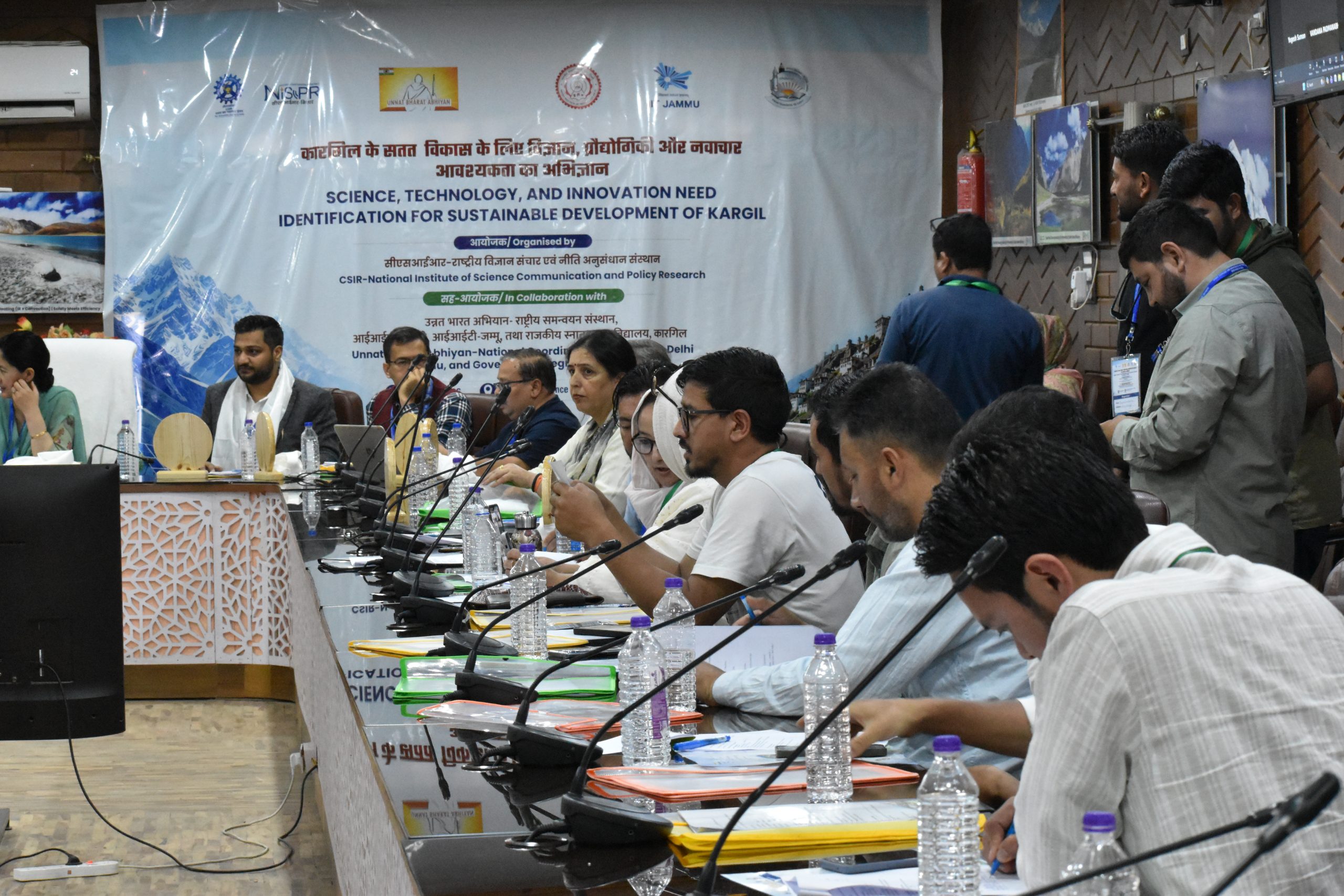
KARGIL, Jul 22: Indian Institute of Technology (IIT) Jammu showcased the progress of its Heeng (Asafoetida) cultivation initiative during a stakeholder consultation program titled “Science, Technology, and Innovation Need Identification for Sustainable Development of Kargil.” The event was jointly organized by CSIR-NIScPR, Unnat Bharat Abhiyan (UBA – IIT Delhi), IIT Jammu, and Government Degree College (GDC) Kargil.
As the Regional Coordinating Institution (RCI) for Jammu Province and the Union Territory of Ladakh under UBA, IIT Jammu initiated the Heeng cultivation project in 2024 through GDC Kargil, an active Participating Institution. The project was launched in a UBA-adopted village in Kargil to promote climate-resilient, high-value agriculture and strengthen sustainable rural livelihoods.
IIT Jammu played a pivotal role in conceptualizing and executing the project. The institute identified and mobilized nine land-owning farmers, facilitated their scientific training, and fully funded their travel, lodging, and logistics. Following the training, Heeng planting material was prepared at CSIR-IHBT, Palampur, after which IIT Jammu coordinated and funded the transport of saplings to Kargil for field plantation.
The program was conducted under the leadership and guidance of Prof. Manoj Singh Gaur, Director of IIT Jammu. Addressing the inaugural session, Prof. Meenakshi Rajeev, Regional Coordinator, Unnat Bharat Abhiyan shared IIT Jammu’s hands-on experience in executing the initiative. Dr. Sameer Kumar Sarma Pachalla, Associate Dean of Outreach also deliver a session on “Funding Opportunities and Local Need Identification,” highlighting strategies to leverage science, technology, and innovation for Kargil’s sustainable growth. Representing IIT Jammu on-site, Mrs. Jeyoti, Project Associate for UBA, traveled to Kargil to engage directly with participating institutions and local stakeholders.
As part of the consultation, delegates from CSIR laboratories, IITs, ICAR institutions, NABARD, and other organizations visited four local Heeng cultivation sites. The field assessment confirmed healthy crop establishment: plants at three sites were in their natural dormancy phase, while visible active growth was recorded at the fourth site due to favorable microclimatic conditions.
Now in its third year, the initiative is progressing on schedule. Heeng plants are expected to reach commercial maturity and yield in approximately five years. The project underscores the vast potential of Heeng as a high-value agricultural venture in Ladakh, demonstrating the importance of sustained scientific and institutional support.