
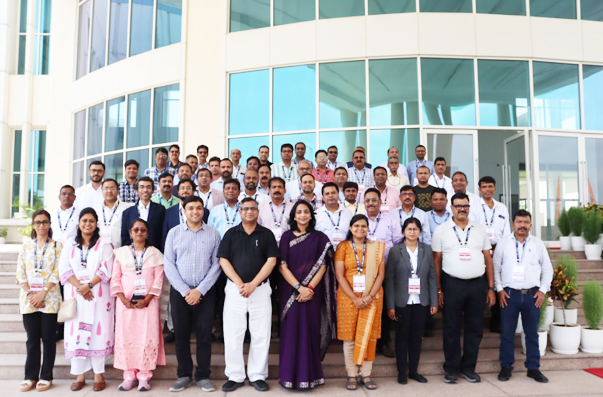
JAMMU, Jul 27: The Indian Institute of Management (IIM) Jammu inaugurated the Leadership Development Programme (LDP) for Young Managers (Batch–VI) for executives of the Steel Authority of India Limited (SAIL) on 27th July 2026 at the Bharat Classroom, Academic Block, IIM Jammu. The five-day Executive Education programme has been meticulously customized to address the evolving leadership and managerial requirements of SAIL while equipping participants with contemporary management perspectives and practical strategies for organizational excellence.
The inaugural ceremony was presided over by Prof. Jabir Ali, Dean, Faculty & Research, IIM Jammu.
The inaugural ceremony was graced by Dr. Atanu Mukherjee, General Manager (Academic), Central HRD & Senior Faculty, Management Training Institute (MTI), SAIL (Online Mode); Prof. Prashant Mishra, Chairperson, Executive Education & Consultancy (EE&C); Programmed directors Dr. Anuja Akhouri and Dr. Naveen Goyal, IIM Jammu. The training program consisted of 50 participants from different plants of SAIL spread across India.
Delivering the inaugural address, Dr. Atanu Mukherjee, General Manager (Academic), Central HRD & Senior Faculty, Management Training Institute (MTI), SAIL, urged participants to move beyond conventional managerial thinking and embrace disruptive and agile innovation to navigate an increasingly competitive business environment.
Stressing the importance of innovative strategies, experiential learning, and collaborative engagement, he encouraged participants to leverage IIM Jammu’s academic ecosystem, interact extensively with faculty and peers, explore emerging technologies including Artificial Intelligence, undertake action learning projects, and draw insights from global best practices to create tangible organizational value.
Addressing the participants, Prof. Jabir Ali, Dean, Faculty & Research, IIM Jammu, emphasized that the programme had been thoughtfully designed to address SAIL’s evolving leadership requirements and prepare participants for greater organizational responsibilities.
He encouraged them to become ambassadors of knowledge within their organizations, highlighting the importance of developing indigenous case studies based on SAIL’s experiences that could contribute to both national and global management literature. He also urged participants to extend classroom discussions beyond formal sessions to maximize the impact and longevity of their learning.
Speaking on the occasion, Prof. Prashant Mishra, Chairperson, Executive Education & Consultancy (EE&C), IIM Jammu, highlighted the pivotal role of Executive Education in bridging academia and industry through practice-oriented learning.
He noted that IIM Jammu’s programmes are carefully customized based on client requirements and industry feedback, while emphasizing lifelong learning, peer learning, and knowledge sharing as essential drivers of professional growth. He also showcased the Institute’s expanding portfolio of executive education, consultancy, and management development programmes.
Welcoming the participants, Dr. Anuja Akhouri, Program Director, IIM Jammu, congratulated the executives on their leadership journey and provided an overview of the customized programme designed to meet SAIL’s organizational requirements.
She encouraged participants to actively engage in discussions, ask insightful questions, and translate classroom learning into practical workplace solutions.
She expressed confidence that the five-day programme would provide an enriching platform for learning, collaboration, and professional development.
The inaugural session also featured participant introductions, fostering a strong foundation for collaborative and peer learning throughout the programme.
The inaugural ceremony concluded with a Vote of Thanks proposed by Dr. Naveen Goyal, Program Director, IIM Jammu, who expressed heartfelt gratitude to the distinguished dignitaries, faculty members, SAIL officials, participants, and the organizing team for their invaluable contributions.
He encouraged participants to continue building upon one another’s experiences, ideas, and professional anecdotes throughout the programme, fostering an environment of collaborative learning and shared growth. This was followed by the National Song and National Anthem.