
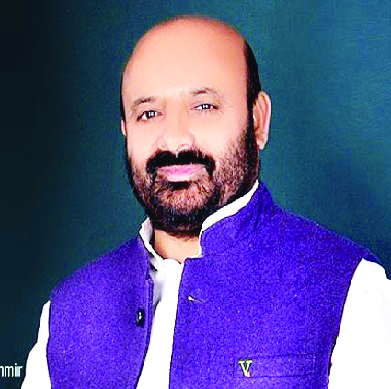
JAMMU, Aug 30: Senior BJP leader and former Jammu and Kashmir Forest Minister Bali Bhagat has launched a scathing attack on the Omar Abdullah government over the alleged failure to effectively protect J&K’s forest land, claiming that nearly 19,496.73 hectares of forest land remains under encroachment.
Bhagat said the issue has gone far beyond an ordinary land dispute and alleged that unchecked encroachment, political patronage and administrative delays could have serious consequences for Jammu and Kashmir’s ecology, demography and future security.
According to Bhagat, the latest government figure of 19,496.73 hectares of encroached forest land reflects the magnitude of the crisis. He alleged that forest areas stretching from Sunjwan, Bathindi, Bahu, Chowadhi and Sidhra to Ramban, Rajouri, Poonch and Shopian have been affected by illegal occupation.
Bhagat alleged that powerful land grabbers, politically connected individuals and people operating with bureaucratic support have managed to occupy public forest land and warned that the government must stop treating such encroachments casually.
He accused the Omar Abdullah government of adopting a slow and complicated approach to eviction, saying that unnecessary procedural hurdles can encourage encroachers and create an impression that once forest land is occupied, eviction can be delayed indefinitely.
Bhagat demanded that the government undertake a 50-year scientific audit of J&K’s forests using satellite imagery, historical forest records, revenue records, GPS mapping and other modern technologies.
He said such an exercise should establish exactly how much forest land existed five decades ago, how boundaries have changed, when encroachments appeared and who benefited from the alleged occupation.
Bhagat further demanded that wherever evidence of organised land grabbing or official collusion is found, FIRs should be registered and the alleged nexus between land mafias, politicians and bureaucrats thoroughly investigated.
Bhagat also pointed to his own tenure as Forest, Social Welfare, Ecology and Environment Minister during the PDP-BJP coalition government in 2015, saying that his department had launched a strong campaign against forest encroachment.
He said that at that time, the Forest Department had identified 14,345 hectares of encroached forest land, including 9,463.39 hectares in Jammu and 4,877.62 hectares in Kashmir.
Bhagat recalled that he had publicly declared that even heavyweight and influential encroachers would not be spared.
He said a committee headed by the Chief Conservator of Forests was constituted to examine encroachments in Sunjwan, Bathindi, Raika and Sidhra, with instructions to demarcate forest land, examine disputed parcels and recommend eviction.
Bhagat further recalled that the government had set a target of retrieving 5,000 hectares of encroached forest land by March 2016.
He said that in Poonch, notices had been issued concerning 1,792.65 hectares, while around nine acres had already been retrieved from 19 persons.
Bhagat also cited reports that 961.25 hectares of forest land were retrieved during his tenure at 2015–16.
Bhagat questioned why, despite anti-encroachment campaigns over the years, the government is still reporting almost 19,500 hectares of forest land under encroachment.
He said the comparison between the figures from 2015 and 2025 should trigger a comprehensive investigation rather than merely another round of notices and eviction drives.
According to Bhagat, the government must identify whether the increase in the recorded figure reflects fresh encroachment, improved surveying, changes in methodology or previously unrecorded occupation.
He alleged that continued illegal occupation of forest and state land and the emergence of unauthorised settlements can gradually alter the demographic and social character of particular areas.
He warned the Omar Abdullah government against allowing illegal settlements to become permanent through administrative inaction.
Bhagat stressed that his objection is not against genuine forest dwellers or persons legally entitled to rights under the Forest Rights Act, 2006.
He said people with legitimate statutory rights must be protected, but alleged that the law must not be misused as a shield for fresh encroachment, commercial construction or organised land grabbing.
In one of his strongest warnings, Bhagat cautioned the government against allowing demographic and land-related tensions to accumulate until they become difficult to control.
He invoked the situation in Nepal as a warning and said governments should learn from developments elsewhere instead of waiting for social and political tensions to reach a point of no return.
Bhagat’s warning, as he put it, is that forest encroachment should not be allowed to become a mechanism for uncontrolled settlement and gradual demographic change.
He urged the government to act before such developments create wider social tensions. Bhagat also referred to the recent controversy surrounding anti-encroachment action in Sidhra.
He said the Forest Department official who acted against alleged encroachment should have been commended for protecting public forest land rather than being subjected to an inquiry or political criticism.
Bhagat alleged that political opposition to eviction drives can demoralise honest officials and embolden encroachers. He questioned why those attempting to reclaim government forest land should face pressure while alleged encroachers continue to occupy public property.
Bhagat said J&K’s forests are not simply pieces of government property but the ecological lungs of the Union Territory.
He warned that continued destruction and occupation of forest land could damage water sources, hills, biodiversity, soil, climate resilience and the livelihoods of communities dependent on the natural environment.
He demanded that the Omar Abdullah government launch a time-bound forest-reclamation mission, publish district-wise encroachment data, conduct satellite-based historical mapping and take criminal action wherever a deliberate land-grabbing network is established.
Bhagat said political connections, wealth or official position must not determine who faces eviction. His demand is that genuine legal rights be protected, while illegal occupants—irrespective of their political or bureaucratic connections—must be removed.
“Public land must remain public,” Bhagat said, warning that J&K cannot afford to lose its forests to encroachment and unauthorised settlements.
He says it is about protecting J&K’s environment, preventing unchecked land grabbing, preserving its demographic balance and ensuring that future generations inherit forests—not encroached colonies.