
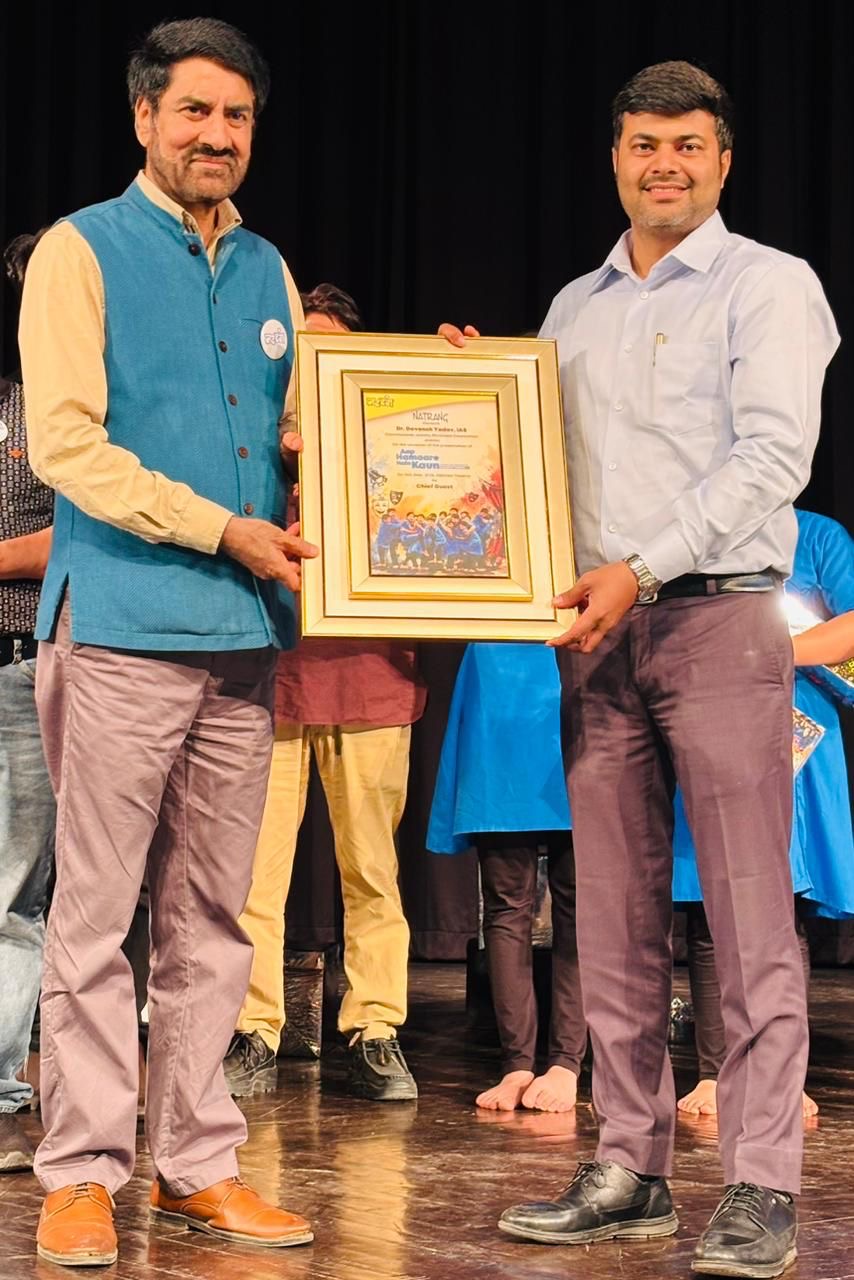
JAMMU, May 17: Commissioner of Jammu Municipal Corporation, Dr. Devansh Yadav, lauded the extraordinary contribution of Natrang in preserving, promoting, and projecting regional art, culture, and artists after witnessing the internationally acclaimed play Aap Hamaare Hain Kaun, written and directed by Padma Shri awardee Balwant Thakur.
Speaking on the occasion, Dr. Devansh Yadav said that Natrang has emerged as one of the most vibrant and impactful cultural institutions of the country, consistently nurturing young talent and keeping the spirit of theatre alive through meaningful and socially relevant productions. He appreciated the organisation for creating a powerful creative platform for youth and for taking the rich cultural heritage of Jammu and Kashmir to national and international audiences with distinction and dignity.
Dr. Yadav observed that institutions like Natrang play a crucial role in shaping a culturally aware and emotionally sensitive society. He said that in an era dominated by digital distractions and shrinking human interaction, theatre continues to serve as a powerful medium of dialogue, reflection, and social transformation. He particularly admired Natrang’s commitment towards using theatre not merely as entertainment, but as a tool for education, awareness, and positive societal change.
Deeply impressed by the performance, Dr. Yadav expressed admiration for the extraordinary calibre of the young performers, their commanding stage presence, and their ability to sustain remarkable levels of energy throughout the uninterrupted hour-long production. He remarked that the play’s message is profoundly contemporary and resonates strongly with the realities and struggles faced by children in the rapidly evolving age of Artificial Intelligence.
Reflecting on the relevance of the production, Dr. Yadav observed that the play serves as an important learning experience for educationists, teachers, school promoters, and parents alike. He noted that it compels society to introspect and reconsider its attitudes and approaches towards children and their emotional well-being.
Aap Hamaare Hain Kaun is a deeply thought-provoking theatrical production that challenges prevailing societal notions surrounding parenting and education. Through a compelling and emotionally engaging narrative, the play confronts parents, educators, and guardians with difficult yet necessary questions about materialism, consumerism, and the relentless pursuit of status and success.
The production powerfully highlights how children are often reduced to carriers of their parents’ unrealized ambitions—forced into predefined career paths such as doctors, engineers, or civil servants—while their individuality, creativity, and innate curiosity are gradually suppressed. It vividly portrays the immense pressure children endure through constant comparisons, emotional stress, and the denial of freedom to shape their own futures, ultimately transforming vibrant young minds into mechanical performers driven solely by examinations and societal expectations.
The play also delivers a sharp critique of the contemporary education system, particularly within the context of rapidly advancing technology and AI-driven learning environments. It underscores how excessive emphasis on performance metrics and outcomes frequently sidelines creativity, critical thinking, emotional intelligence, and empathy. As a consequence, children risk growing up disconnected from purpose, sensitivity, and self-awareness.
Serving simultaneously as a mirror and a wake-up call, Aap Hamaare Hain Kaun addresses the complex emotional and psychological challenges confronting today’s youth—pressures that often emerge not from external forces but from within their own homes and immediate surroundings. Its message strikes a powerful chord, advocating for a more compassionate, balanced, and child-centric approach to upbringing and education.
On the occasion, Dr. Devansh Yadav was also felicitated by Natrang Director Padma Balwant Thakur with a souvenir commemorating the performance of Aap Hamaare Hain Kaun.