
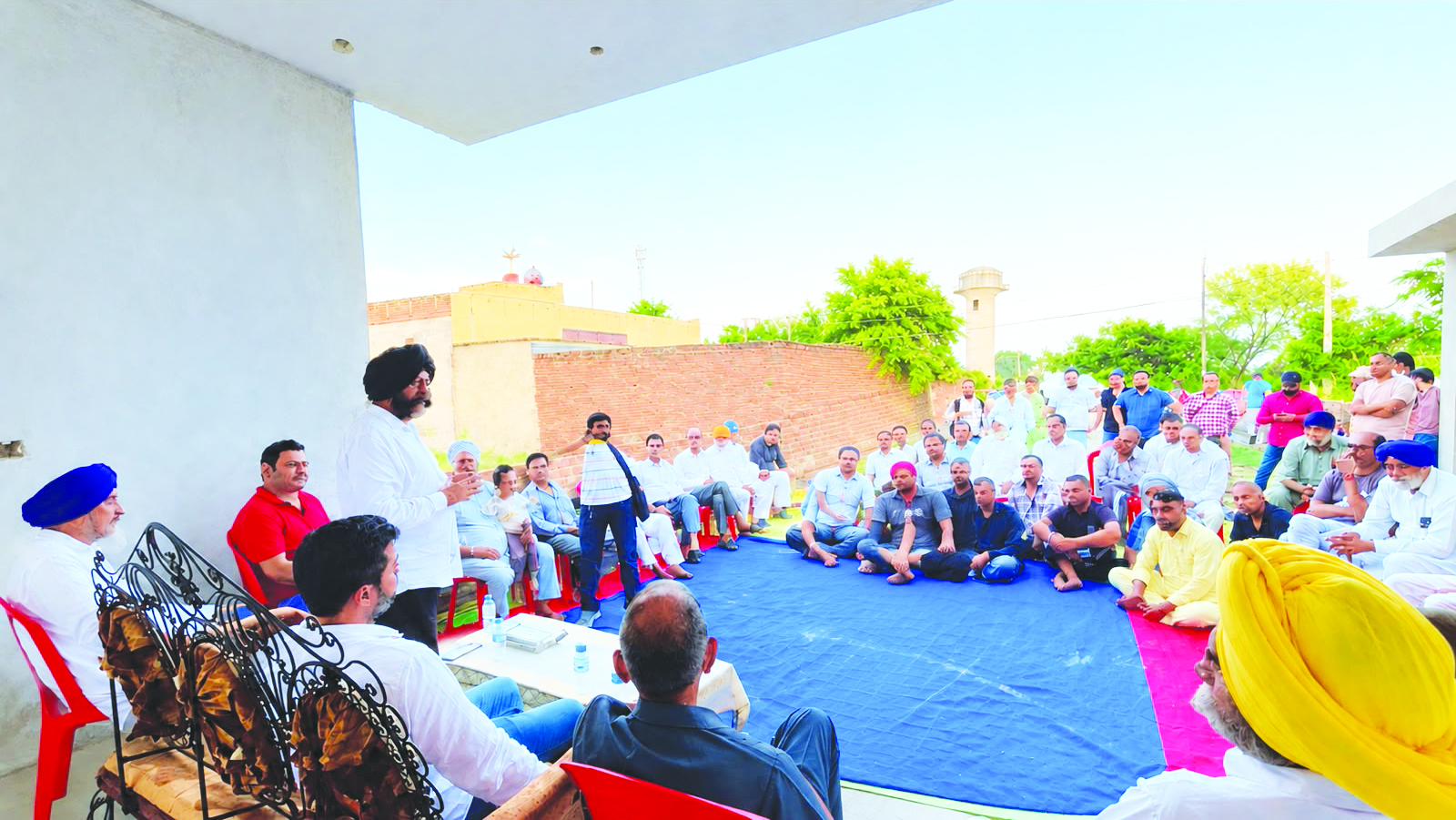
SAMBA, Sep 19: Jammu and Kashmir Apni Party (JKAP) Provincial President S. Manjit Singh today addressed a meeting at Ward-9 of Municipal Committee Ramgarh, where residents and prominent citizens raised a number of issues concerning farming, displaced families and civic amenities in the Ramgarh sector.The meeting was attended by Adv. Sahil Bharti, Manmohan Singh, Adv. Rajinder Bhagat, Capt. Sat Pal, Capt. Baljeet Singh, Sham Lal, Mohan Singh, Mulakh Ram, Adv. Akhil and Amrik Singh, among others.
During the interaction, participants apprised Manjit Singh of the concerns being faced by the farming community in connection with the proposed construction of a Ditch-Cum-Bund (DCB) along the zero line in the Ramgarh sector.The farmers expressed apprehension that if the DCB is constructed at a considerable distance from the zero line, a substantial portion of agricultural land could become inaccessible or unusable for cultivation. They said farming remains the principal source of livelihood for many families living in the border belt and that any loss of cultivable land could have serious economic consequences.
Taking up the issue, Manjit Singh said that development and border infrastructure should not come at the cost of the livelihood of farmers without adequate rehabilitation measures. He urged the government to ensure that the DCB alignment is examined carefully so that avoidable loss of agricultural land is prevented.
He further demanded that wherever agricultural land is necessarily acquired or rendered inaccessible because of the project, the affected farmers should be provided adequate and generous compensation, along with suitable alternate land so that their livelihood is protected.
“The farmers living along the border have faced difficult circumstances for decades and have continued to cultivate their land despite the challenges. Their agricultural land is not merely a property asset but the main source of livelihood for their families. If land is taken for a public project, the affected families must receive fair compensation and viable alternatives,” Manjit Singh said.He called for a proper assessment of the land likely to be affected, consultation with local farmers and a transparent rehabilitation mechanism before the project is implemented.
Another major issue discussed during the meeting was the long-pending demand for an enhanced financial package for refugees from Pakistan-occupied Jammu and Kashmir (PoJK).Manjit Singh said that the displaced families had suffered enormous losses at the time of displacement and that their rehabilitation remained an important issue requiring sustained attention from the government.
He referred to the package approved by the then Congress-led government in Jammu and Kashmir, stating that the proposed package was around Rs 9,096 crore, which, according to the demand raised by the party, worked out to approximately Rs 25 lakh per refugee family.
He further pointed out that a Parliamentary sub-committee had subsequently recommended enhancement of the assistance to Rs 30 lakh per family, whereas the package ultimately provided by the BJP-led government was Rs 5.5 lakh per family.
Manjit Singh demanded that the government reconsider the quantum of assistance and provide a more comprehensive rehabilitation package to the displaced families, keeping in view the losses suffered by them and the recommendations made over the years.
He said that the concerns of PoJK displaced families should not be treated merely as a historical issue and called for a policy that provides meaningful economic support and addresses the long-standing rehabilitation concerns of the community.
During the meeting, Adv. Sahil Bharti prominently raised the issue of sanitation and civic management within the Ramgarh Municipal Committee area.He said that inadequate sanitation arrangements, irregular lifting of garbage and poor waste management at different locations were causing inconvenience to residents. He stressed that the issue becomes particularly serious in densely populated areas and around residential and public spaces, where accumulated waste can affect the surrounding environment and create public-health concerns.
Manjit Singh assured the participants that the issues raised during the meeting would be taken up with the concerned authorities and reiterated that farmers, displaced families and urban residents all require responsive governance and timely resolution of their genuine grievances.