
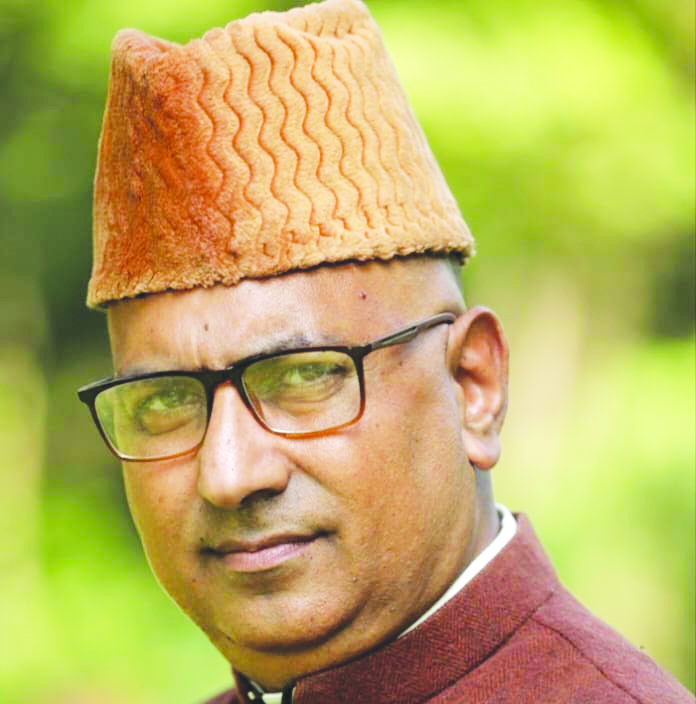
JAMMU, Aug 8: Rajya Sabha Member of Parliament (Nominated) Engineer Gulam Ali Khatana has sought a detailed account of the implementation of the Dharti Aaba Janjatiya Gram Utkarsh Abhiyan (DAJGUA) and Pradhan Mantri Janjatiya Unnat Gram Abhiyan (PM-JUGA) in Jammu and Kashmir, putting the focus on the performance, transparency and ground-level delivery of the Omar Abdullah-led administration in tribal areas.
Through a question raised in the Rajya Sabha, Khatana sought district-wise details of funds sanctioned, released and utilised, besides information on Panchayats and tribal villages covered under the programme, allocations made and works undertaken.
The BJP MP also sought details of sector-wise convergence in education, healthcare, roads, drinking water, electricity, livelihoods, digital connectivity and other basic services, along with district-wise physical and financial progress and the monitoring mechanism adopted to ensure timely implementation and effective utilisation of funds.
In its response, the Ministry of Tribal Affairs stated that Rs 39.21 crore was sanctioned for Jammu and Kashmir under PM-JUGA/DAJGUA during 2025-26, while another Rs 20.02 crore was sanctioned during 2026-27, taking the total Mother Sanction to Rs 59.23 crore for the two financial years.
The Ministry stated that Jammu and Kashmir reported expenditure of Rs 13.84 crore (Rs 1,384.97 lakh) up to July 31, 2026, against the 2026-27 sanction.
While the expenditure represents a substantial portion of the 2026-27 sanction, the parliamentary response does not provide an expenditure figure for the Rs 39.21 crore sanctioned during 2025-26 in the portion of the reply available.
The parliamentary disclosure has put the spotlight on the Omar Abdullah government’s responsibility to demonstrate tangible outcomes from centrally sanctioned funds.
The key question is no longer merely how much money has been sanctioned, but how effectively the sanctioned resources are translating into roads, healthcare facilities, drinking-water schemes, electricity infrastructure, educational facilities and livelihood opportunities for tribal communities on the ground.
With tribal communities spread across several districts of Jammu and Kashmir, public representatives and local communities are likely to seek greater clarity on the projects approved, their present status, expenditure incurred and benefits delivered.
A particularly significant aspect of the Ministry’s reply is its clarification that district-wise details of fund releases under DAJGUA are not maintained separately.
Funds are released to the Government of Jammu and Kashmir through the Mother Sanction mechanism, while their utilisation is the responsibility of the UT Government in accordance with the approved Annual Action Plan and scheme guidelines.
This raises legitimate questions about district-level transparency and public accountability. The Omar Abdullah administration should make available, wherever possible, district-wise information showing the projects sanctioned, funds utilised, works completed and benefits delivered so that the performance of the scheme can be independently assessed.
DAJGUA covers critical sectors such as education, health, Anganwadi services, roads, drinking water, electricity, livelihoods and digital connectivity. These are precisely the areas where people in remote and tribal pockets continue to demand better infrastructure and services.
Khatana’s intervention in Parliament therefore assumes significance as it seeks to establish whether the ambitious objectives of the central programme are being matched by effective implementation at the UT and district levels.
The Ministry has stated that inter-ministerial coordination meetings and regular reviews with States/UTs and district authorities are being conducted. It has also pointed to a technology-enabled monitoring framework through the PM Gati Shakti Portal.
However, the existence of a monitoring mechanism must ultimately be reflected in measurable ground-level results.
The Omar Abdullah-led government now faces the task of demonstrating that sanctioned funds are being utilised efficiently, projects are being executed within reasonable timelines and tribal communities are receiving the intended benefits.
By raising the issue in the Rajya Sabha, Engineer Gulam Ali Khatana has brought fund utilisation, project implementation and transparency into focus.
The government should provide clear district-wise and project-wise information wherever available, particularly for major tribal-population districts such as Rajouri and Poonch, to establish how much work has actually been completed and what remains pending.
The parliamentary reply, by itself, does not establish any financial irregularity or misappropriation. However, it does provide sufficient grounds for asking the Omar Abdullah administration tough questions on implementation, transparency and measurable outcomes of tribal development schemes.
For the Omar government, the challenge is clear: central funds may provide the resources, but the administration must now show the results on the ground.