
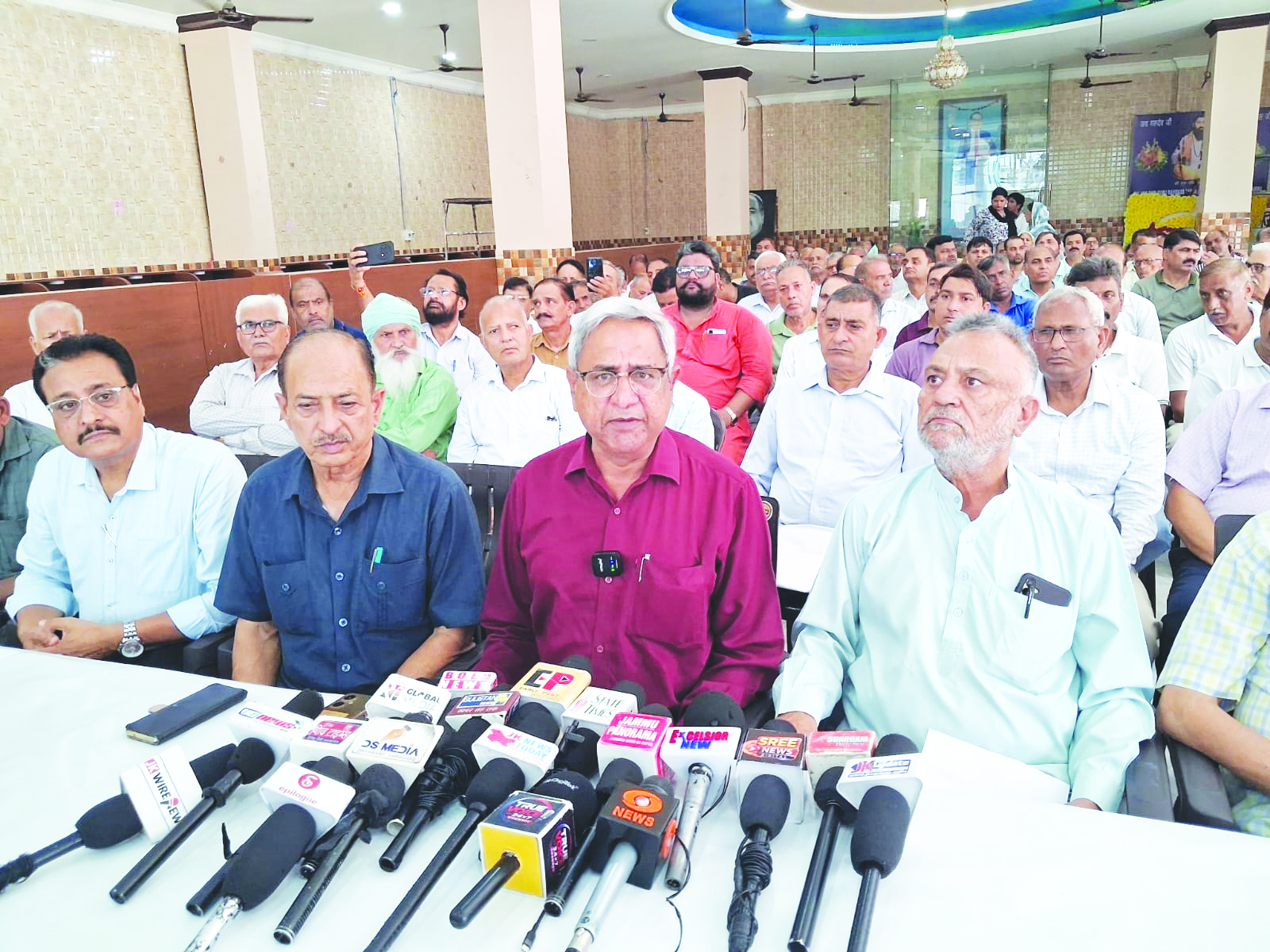
JAMMU, Aug 30: The All Jammu and Kashmir Guru Ravi Dass Sabha (AJKGRDS), Headquarters Krishna Nagar, Jammu, along with various socio-religious organisations representing SC, ST and OBC communities, strongly opposed the ongoing anti-reservation campaign at Jantar Mantar, New Delhi, and termed the demand for abolition of reservation as an attack on the constitutional rights of historically marginalised communities.
Addressing a heavily attended press conference, representatives of various socio-religious organisations, social activists, retirees and youth criticised those protesting against the reservation system and demanding its complete abolition.
The speakers maintained that reservation is not a poverty-alleviation programme but a constitutional mechanism for representation and social justice, intended to address the historical discrimination, deprivation of education, untouchability and unequal access to opportunities faced by Scheduled Castes, Scheduled Tribes and Other Backward Classes.
They said that instead of seeking to abolish reservation, efforts should be made to ensure that marginalised communities receive adequate opportunities in education, employment and other sectors. They also demanded greater representation of SC, ST and OBC communities in the private sector, where a large number of employment opportunities exist.
Er. R.C. Bhasin, President, AJKGRDS, said reservation was a constitutional measure that emerged from the historical struggle for representation and social equality. He referred to the Poona Pact and said that reservation and representation must be viewed in the context of the social conditions that prevailed before Independence.
Bhasin also expressed opposition to political reservation, arguing that it was originally provided for a limited period and has subsequently been extended. He said that the organisations would continue to oppose what he described as attempts to weaken constitutional safeguards for marginalised communities.
Prof. G.L. Thapa, Senior Vice President, AJKGRDS, said the benefits of reservation had already been substantially affected by administrative changes, privatisation and policy shifts. He criticised attempts to further reduce the scope of reservation and said that the remaining safeguards for disadvantaged communities must be protected.
S.L. Basson, President, Dalit Chetna Munch and former Corporator, traced the history of affirmative representation in India and referred to the measures introduced by Sahu Ji Maharaj in Kolhapur in 1902, followed by developments in Mysore and the political developments of the 1930s.
Basson said that constitutional provisions for reservation came into effect in 1950 and stressed the importance of representation for historically disadvantaged communities. He also raised questions regarding representation in institutions and sectors where, according to him, adequate participation of backward communities remains a concern.
He referred to issues concerning representation in temple trusts, the judiciary and senior administrative positions, and argued that the principle of representation should be applied fairly across institutions.
Prof. C.L. Shivgotra, Spokesperson, AJKGRDS, highlighted the history of reservation for SCs and STs in Jammu and Kashmir. He said that reservation for SCs and STs in direct recruitment was introduced in 1970 and 1991 respectively, and raised concerns regarding the present level of representation and changes in roster points.
He strongly opposed the demand to replace caste-based reservation with purely economic criteria, describing such a move as contrary to the constitutional purpose of reservation.
Dr. Rajinder Sambyal, President, BR Ambedkar Society, J&K, said that the Constitution provided a framework to address discrimination, inequality and injustice faced by Dalits and backward communities over centuries. He alleged that governments have not fully implemented constitutional safeguards and, in some instances, have weakened their effectiveness.
Dr. Sambyal said reservation helps bridge social and economic gaps and asserted that marginalised communities have an equal claim to opportunities in education, employment, industry and the country’s economic resources. He warned against attempts to dilute constitutional safeguards.
Er. Joginder Paul, Vice President, AJKGRDS, said that despite decades of Independence and the constitutional guarantee of equality, marginalised communities continue to face challenges in accessing opportunities. He alleged that political parties have often treated Dalits primarily as a vote bank while failing to ensure complete implementation of constitutional provisions.
He said that those holding public office must uphold the spirit and provisions of the Constitution and work towards genuine equality and social justice.
The speakers collectively maintained that reservation cannot be viewed in isolation from India’s history of social discrimination and unequal access to education and opportunities. They called for strengthening constitutional safeguards rather than dismantling them and urged the government to ensure equitable representation of SC, ST and OBC communities in education, employment and other spheres.
The press conference was attended by Thoru Ram, Rattan Lal, Bhuri Ram, Ajit Angral, Ashish Angral, Gian Chand Khullar, Master Tara Chand, Tarsem Loach, S. Surjit Singh Heer, Kuldip Thapa, B.R. Thapa, Des Raj, Sham Lal Samyal, Mahesh Shivgotra, Smt. Shivani, Smt. Seema Devi, Smt. Paramjit Kour, Bihari Lal Digra, Sham Lal Basson, Capt. Manohar Lal, Hardutt, Er. Surinder Devgowda, Er. Harbilas Bharadwaj, Prabh Dayal, Joginder Pal, Bahadur Lal, Dr. Chander Prakash, C.L. Banal, Dr. Buti Ram, Suresh Kumar Bangotra, Er. Darshan Kalsotra, ZEO Tara Nath, T.C. Babouria, Er. Madan Lal Bali, Darshan Lal, Darshan Gorka, Dev Raj Thapa, M.R. Bangotra, Garu Ram, Rangesh Hans, Er. Subash Chander, Ram Lal Bhagat, Parshotam Thapa, Prithvi Singh, Bharat Hans, besides other members and representatives of socio-religious organisations.