
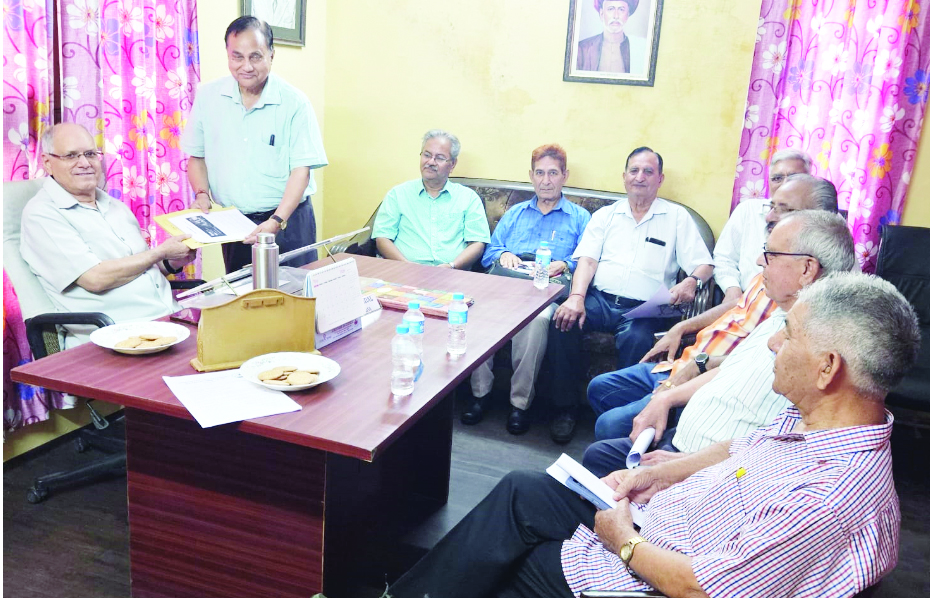
JAMMU, Jun 7: The Bhartiya Dalit Sahitya Akademy (BDSA), Roop Nagar, Jammu, today organized a function to celebrate World Environment Day 2026 on the theme “Climate Justice: Relief and Resilience for Vulnerable Communities” The programme was chaired by Shri B. R. Kundal (IAS Retd.), President, BDSA, while Er. Gagan Jyoti, Chief Engineer Mechanical (Retd.), Vice-President of the Akademy graced the occasion as the Chief Guest.
The event witnessed the presentation of three thought-provoking papers on Climate justice, environmental conservation and sustainable development by Shri Ram Lal Bhagat, Joint Director Agriculture Department (Retd.), Er. Rajesh Angural, Ex-Engineer, Jal Shakti (I&FC) Department (Retd.), and Dr. Rakesh Kumar Atri, Ph.D.
The speakers emphasized the importance of protecting natural ecosystems, conserving water and forests, reducing pollution, and adopting environmentally sustainable lifestyles.
Speaking on the occasion, Shri R. L. Bhagat, Joint Director of Agriculture (Retd.), observed that “Every day is Environment Day.” He stated that nature must be recognized as a core partner in human progress and sustainable development and emphasized that integrated decision-making at individual, community, institutional, and governmental levels is a fundamental pillar for securing a livable planet for present and future generations.
Er. Rajesh Angural, former Engineer, Jal Shakti (I&FC) Department (Retd.), presented his paper on the concept of biomimicry, emphasizing how nature serves as humanity’s greatest teacher and innovator. He highlighted the need for a mental reset and clarity of thought in addressing contemporary environmental challenges and discussed how nature inspires resilience, adaptation, creativity, and artistic expression. He emphasized that future development must be guided by ecological wisdom and technological innovation working in harmony.
Concluding his presentation, he stated, “India’s future in food security, water management, healthcare, land use, transportation, and energy transition from 2026 onward, and throughout the decade leading to 2030, will be defined by a massive shift toward a circular, climate-resilient economy.”
Dr. Rakesh Kumar Atri, Ph.D. (Environmental Sciences), emphasized that climate change is a mounting threat to humanity.
The poor and marginalized, owing to their limited adaptive capacity, are at greater risk, and hence the policy framework must be reoriented in such a way that minimal relief is directly targeted at vulnerable people. He further called for the need for micro-level vulnerability assessments, especially in Jammu and Kashmir, for effective relief policy development.
Chief Guest Er. Gagan Jyoti, Chief Engineer Mechanical (Retd.), in his brief address, emphasized that “Nature does not need us; we need nature.” He observed that environmental protection is no longer a choice but a necessity for human survival and sustainable development.
Stressing the importance of individual responsibility and collective action, he called upon citizens to adopt environmentally conscious lifestyles and contribute actively to building a greener, cleaner, and climate-resilient future for generations to come.
In his presidential address, B. R. Kundal (IAS Retd.) underlined that, in addition to institutional mechanisms, people must be empowered as real stakeholders of natural capital for decision-making and action toward environmental protection and climate adaptation.
He emphasized that shared and decentralized decision-making in the governance structure is key to community participation in addressing climate-related challenges.
He further informed that, in view of the importance of strengthening policy narratives and facilitating effective communication among people as well as between citizens and the government, the BDSA will soon be launching a magazine.
The dates for the same will be finalized and announced in the next meeting. He also informed those present there about the vital role that BDSA plays in the establishment of communication between concerned people and government. In this context, BDSA has made several correspondence with the office of chief minister as well as with other ministries to resolve citizens issues.
He observed that environmental protection is a shared responsibility and called upon all sections of society to contribute toward creating a cleaner, greener, and healthier planet. He further emphasized that the poor and marginalized, who have no role in causing human-induced climate change, are the ones at the forefront of climate-related risks. He emphasized that policies must be framed so that such marginalized groups are identified first, and targeted interventions can then be made to enhance their capacity to cope with climate change.
The meeting ended with a vote of thanks proposed by Er. Vijay Kumar Bangotra, Superintending Engineer (Retd.). He expressed his heartfelt gratitude to the Chair, Chief Guest, distinguished speakers, participants, and audience members for their valuable contributions to the successful conduct of the programme.
Others present on the occasion were Nagarmal, P. L. Bhushan, Rajesh Angural, Mohan Thappa, Sevadass Digra, S. D. Thappa, Mohan Lal Hans, Harbans Lal, Vijay Bhagat, Mohan Lal Thappa, besides others.