
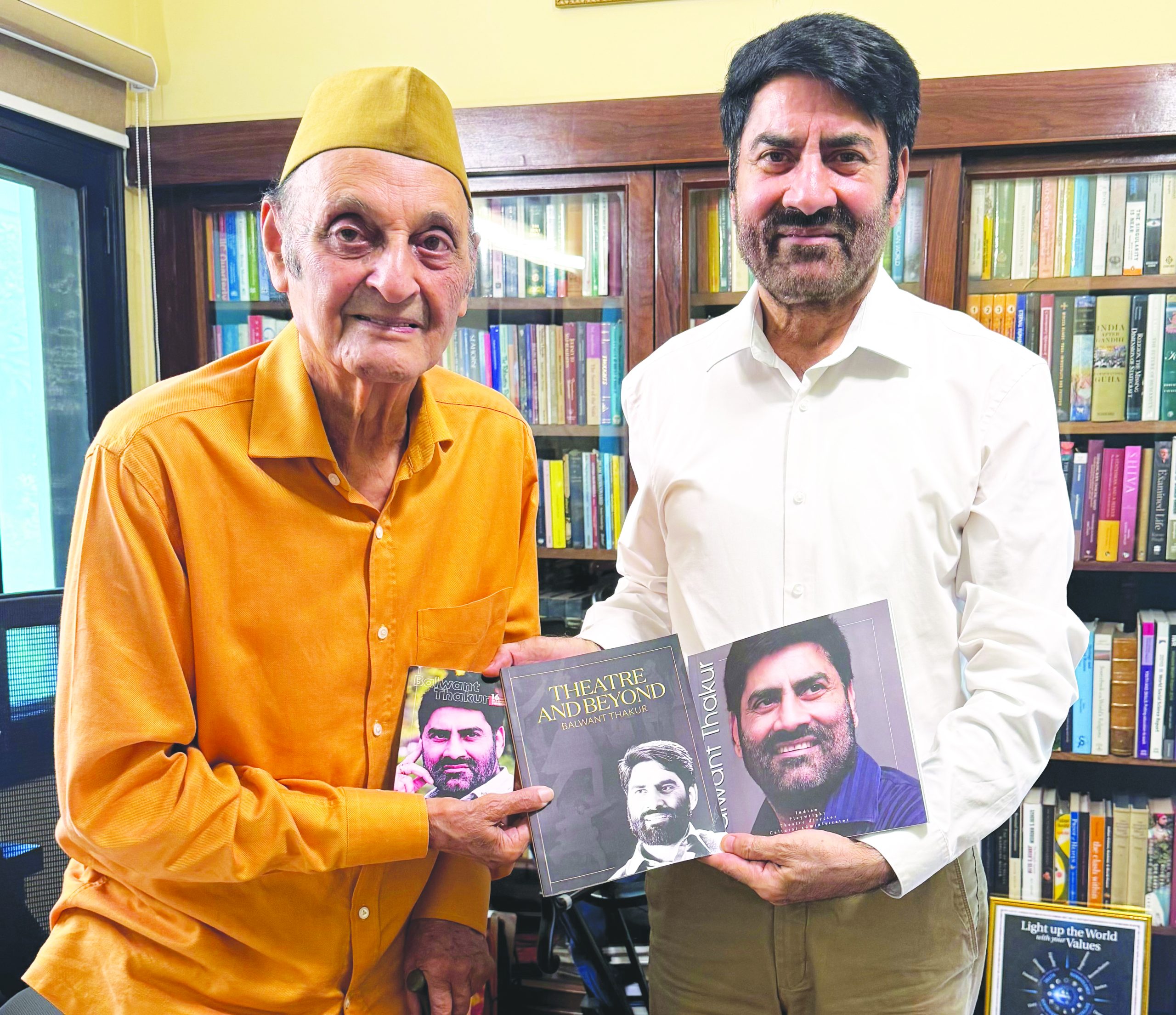
JAMMU / NEW DELHI, Aug 26: Renowned theatre director, cultural visionary and one of India’s most celebrated practitioners of contemporary theatre, Balwant Thakur, met former Sadar-e-Riyasat of Jammu and Kashmir and former Union Minister Dr. Karan Singh at his residence in New Delhi today and presented him the first copies of his latest publications, offering a comprehensive and compelling insight into his extraordinary creative journey and multifaceted contribution to Indian theatre and the arts.
Published by Avant Publishing Services Pvt. Limited and authored by the eminent scholar, writer and theatre critic S. D. Sharma, the two books—Theatre and Beyond and 16 Facets of a Cultural Visionary—explore different dimensions of Balwant Thakur’s personality, artistic vision, innovations and enduring contribution to the cultural landscape of Jammu and Kashmir as well as the national and international theatre scene.
Over the years, Balwant Thakur has emerged as a distinctive and influential voice in Indian theatre, earning recognition far beyond the geographical and linguistic boundaries of Jammu and Kashmir. His remarkable ability to transform local cultural narratives into theatre of universal appeal has earned him international appreciation, with admirers and critics describing him as the “Magic Man of Indian Theatre” for his extraordinary capacity to create theatrical experiences that transcend language, region and cultural barriers.
At the same time, his contribution to Dogri theatre has established him as the “ultimate stalwart of Dogri theatre” a distinction rooted in decades of sustained creative work, experimentation, institution building and relentless advocacy for Dogri language and culture. Through his landmark productions, innovative theatre practices and commitment to nurturing new talent, Thakur has not only enriched Dogri theatre but has helped bring it to national and international platforms, giving it a distinctive identity in the larger landscape of Indian theatre.
Theatre and Beyond examines this unique journey in considerable depth. The publication highlights Thakur’s pioneering innovations in theatre and, particularly, his remarkable success in developing new constituencies for theatre and the arts. His work has consistently challenged the conventional understanding of where theatre belongs, whom it should address and how it can engage with society. By taking theatre to unconventional spaces, diverse audiences and new cultural contexts, he has demonstrated that theatre can become a dynamic instrument of communication, community engagement and cultural transformation.
The book also throws light on Thakur’s ability to blend tradition with experimentation. His theatre draws deeply from the cultural roots of Jammu and Kashmir while employing contemporary theatrical idioms, enabling regional stories and traditions to speak to audiences across India and the world. This ability to remain rooted while simultaneously being global has become one of the defining characteristics of his creative philosophy.
The second publication, 16 Facets of a Cultural Visionary, presents an equally fascinating exploration of the many dimensions of Balwant Thakur’s personality. Through sixteen carefully examined facets, S. D. Sharma portrays him not merely as a theatre director but as an artist, innovator, institution-builder, cultural strategist, mentor, communicator and visionary whose influence extends well beyond the stage.
The presentation of the books to Dr. Karan Singh assumes special significance. Both personalities have made enduring contributions to the cultural and intellectual life of Jammu and Kashmir and have played important roles in carrying its rich cultural heritage to wider national platforms. Dr. Karan Singh has remained a distinguished voice in India’s intellectual, cultural and public life, while Balwant Thakur has devoted his creative career to transforming the cultural possibilities of Jammu and Kashmir through theatre and the performing arts.
These three publications, therefore, represent much more than a documentation of an individual’s achievements. Together, they chronicle a remarkable cultural journey from the revitalisation of Dogri theatre to the creation of new theatrical languages, audiences and platforms, and from regional cultural expression to international recognition.
Balwant Thakur’s journey is ultimately a story of imagination backed by institution-building, innovation strengthened by cultural roots, and a regional artistic vision achieving global resonance. His recognition as the “Magic Man of Indian Theatre” and the “ultimate stalwart of Dogri theatre” reflects the extraordinary range of his contribution and the lasting impact of his work.
The books are expected to become valuable reference material for theatre practitioners, scholars, researchers, students and cultural enthusiasts seeking to understand contemporary Indian theatre, the evolution of Dogri theatre and the remarkable cultural journey of one of India’s most innovative theatre personalities.