
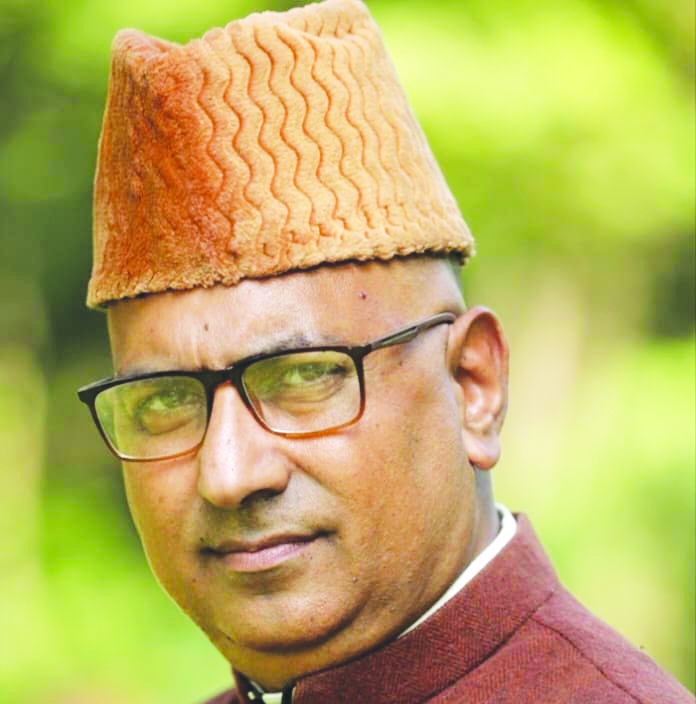
JAMMU / NEW DELHI, Aug 11: BJP Rajya Sabha MP Engineer Gulam Ali Khatana has raised questions over the implementation, financial utilisation and accountability of the Jal Jeevan Mission (JJM) in Jammu and Kashmir, with the Centre’s reply revealing a substantial gap between the funds allocated and those actually drawn under the scheme.
In response to Khatana’s question in the Rajya Sabha, the Ministry of Jal Shakti stated that Rs 18,514.25 crore had been allocated to Jammu and Kashmir under the first phase of the Jal Jeevan Mission, while only Rs 8,646.48 crore had been drawn. The figures have brought the pace of fund utilisation and implementation under renewed scrutiny, particularly as a significant number of rural households are still awaiting functional tap-water connections.
According to the Centre, when the Jal Jeevan Mission was launched in August 2019, only 5.76 lakh rural households, constituting 29.9 per cent of the total, had tap-water connections in Jammu and Kashmir.
As of July 18, 2026, the coverage had increased to 15.64 lakh households, or 81.27 per cent, out of a total of 19.24 lakh rural households. This means nearly 3.60 lakh rural households are still outside the reported tap-water coverage.
The Centre has extended the implementation timeline of the Jal Jeevan Mission up to December 2028 to ensure coverage of the remaining households.
The parliamentary response stated that funds under JJM are released to States and Union Territories, while district-wise allocations and expenditure records are maintained by the respective governments.
For JJM 2.0, Jammu and Kashmir has been allocated Rs 905.74 crore for 2026-27, against which Rs 116.06 crore has so far been released.
However, the reply does not provide a comprehensive district-wise breakup of funds sanctioned, released, drawn and utilised in Jammu and Kashmir. The absence of such details assumes significance as Khatana had sought information regarding the financial position of the scheme at the district level.
Khatana had also sought details regarding contractor-wise pending payments, reasons for delays and the expected timelines for clearing outstanding liabilities.
The Ministry stated that project-wise details and records relating to pending contractor payments are maintained at the State/UT level.
This leaves questions regarding the total amount pending, the districts in which payments remain outstanding, the duration of such delays and whether pending payments are affecting the execution and completion of water-supply projects.
The Centre also outlined the monitoring mechanism for dealing with complaints, sub-standard work and financial irregularities.
According to the Ministry, grievances are dealt with at the State/UT level and monthly inspections of JJM schemes are conducted to assess construction quality, adherence to timelines, functionality and resolution of deficiencies. Inspection reports are uploaded on the JJM-IMIS portal.
However, the parliamentary response does not provide details regarding the number of complaints received, irregularities established, disciplinary or legal action taken against officials or contractors, or the amount of money recovered in cases where financial irregularities were established.
The response also covered irrigation projects under the Pradhan Mantri Krishi Sinchayee Yojana (PMKSY)-AIBP). The government stated that three irrigation projects in Jammu and Kashmir had been completed, benefiting Pulwama, Jammu, Samba and Kathua districts.
No Central assistance was released for these projects during the last five years, while Rs 277.76 crore in Central assistance was released during the period for the Shahpur Kandi Dam National Project, which benefits Jammu and Kashmir and Punjab.
Catch the Rain, the Ministry clarified that the campaign does not have a separate budget and is implemented through convergence of funds under various Central, State and local schemes. It also stated that the Atal Bhujal Yojana, being a pilot scheme, was not implemented in Jammu and Kashmir.
The Centre’s reply highlights the substantial expansion of tap-water coverage in Jammu and Kashmir since 2019. At the same time, the figures raise questions over fund utilisation, pending contractor payments, project quality, completion timelines and action against irregularities.
The issue assumes greater significance as the Centre maintains that drinking water is a State subject and that project-level records are maintained by the UT administration. Greater public disclosure of district-wise expenditure, pending liabilities and inspection findings could therefore provide a clearer picture of the implementation of JJM.
Ultimately, the success of the Jal Jeevan Mission will be measured not merely by the number of connections recorded, but by whether households receive regular and adequate drinking water, whether infrastructure meets prescribed standards and whether public funds are utilised transparently.
With Rs 18,514.25 crore allocated under the first phase and Rs 8,646.48 crore drawn, while around 3.60 lakh rural households remain outside tap-water coverage, Khatana’s parliamentary intervention has placed the implementation and financial accountability of Jal Jeevan Mission in Jammu and Kashmir firmly under scrutiny.