
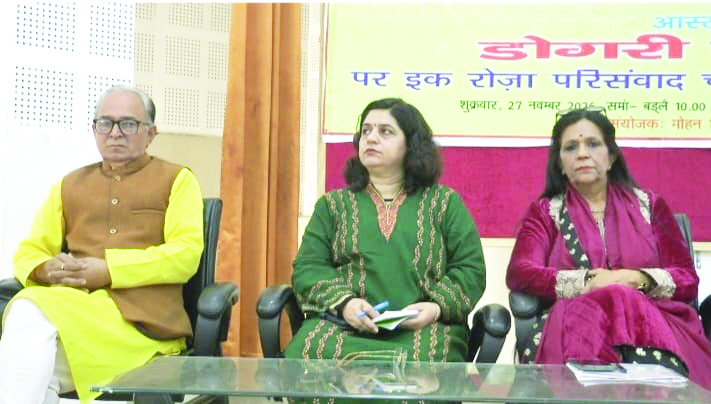
JAMMU, Nov 27: Sahitya Akademi, New Delhi, in collaboration with Government College of Education, Jammu, organised a one-day symposium on the theme “Dogri Ghazal” at K.L. Saigal Hall of the Jammu and Kashmir Academy of Art, Culture and Languages, Jammu, on Friday. The symposium aimed at exploring the evolution, contemporary trends and creative dimensions of Dogri Ghazal while providing a platform for meaningful literary discourse and exchange of ideas.
Jyoti Parihar, Principal, Government College of Education, Jammu, attended the programme as the Chief Guest. Eminent Dogri litterateur Sushil Begana delivered the keynote address, while noted Dogri writer Vijay Verma presided over the programme. The vote of thanks was presented by Shalini Rana, Member, Dogri Advisory Board, Sahitya Akademi.
In his keynote address, Sushil Begana highlighted the theme of the symposium and emphasised the importance of understanding the development and changing trends of Dogri Ghazal as a significant literary expression. The programme commenced with a welcome address by Mohan Singh, Convener, Dogri Advisory Board, Sahitya Akademi, who is a recipient of the Sahitya Akademi Award and Padma Shri. He highlighted the Akademi’s commitment to promoting and preserving recognised regional languages through various literary initiatives.
Mohan Singh also elaborated on initiatives such as Gramalok, which provides a platform to poets from rural and remote areas, and Asmita, which promotes women’s empowerment and encourages women writers. He also highlighted programmes designed to provide opportunities to young and emerging poets.
The symposium was conducted in two sessions. The first session was chaired by Dogri writer Surjit Hosh Badsali, during which T.R. Magotra and Sunil Sharma presented their research papers. The second session was chaired by noted Dogri writer Puran Chand Sharma, with Khajur Singh and Naseeb Singh Manhas presenting their respective papers.
The research presentations examined emerging trends in Dogri Ghazal, its creative and visual dimensions, and the evolution of this literary form over the years. The discussions generated considerable interest among readers, researchers and language enthusiasts, who actively participated in the deliberations and gained insights into the changing literary landscape of Dogri poetry.
The symposium concluded by reinforcing the importance of preserving, promoting and critically examining Dogri literature. It provided a valuable platform for literary interaction, scholarly exchange and deeper appreciation of the rich and evolving tradition of Dogri Ghazal.