
JAMMU, Nov 28 (Agencies): Invoking a Kashmiri proverb, “Patim mashraav, bronth kun nazar thaav” (forget the past and look towards the future), Defence Minister Rajnath Singh on Saturday called for a forward-looking approach to Jammu and Kashmir, asserting that the abrogation of Article 370 weakened terrorism and separatism while accelerating the region’s development.
Singh said the constitutional change in 2019 marked a turning point for the Union Territory, removing longstanding impediments to people’s rights, security and development.
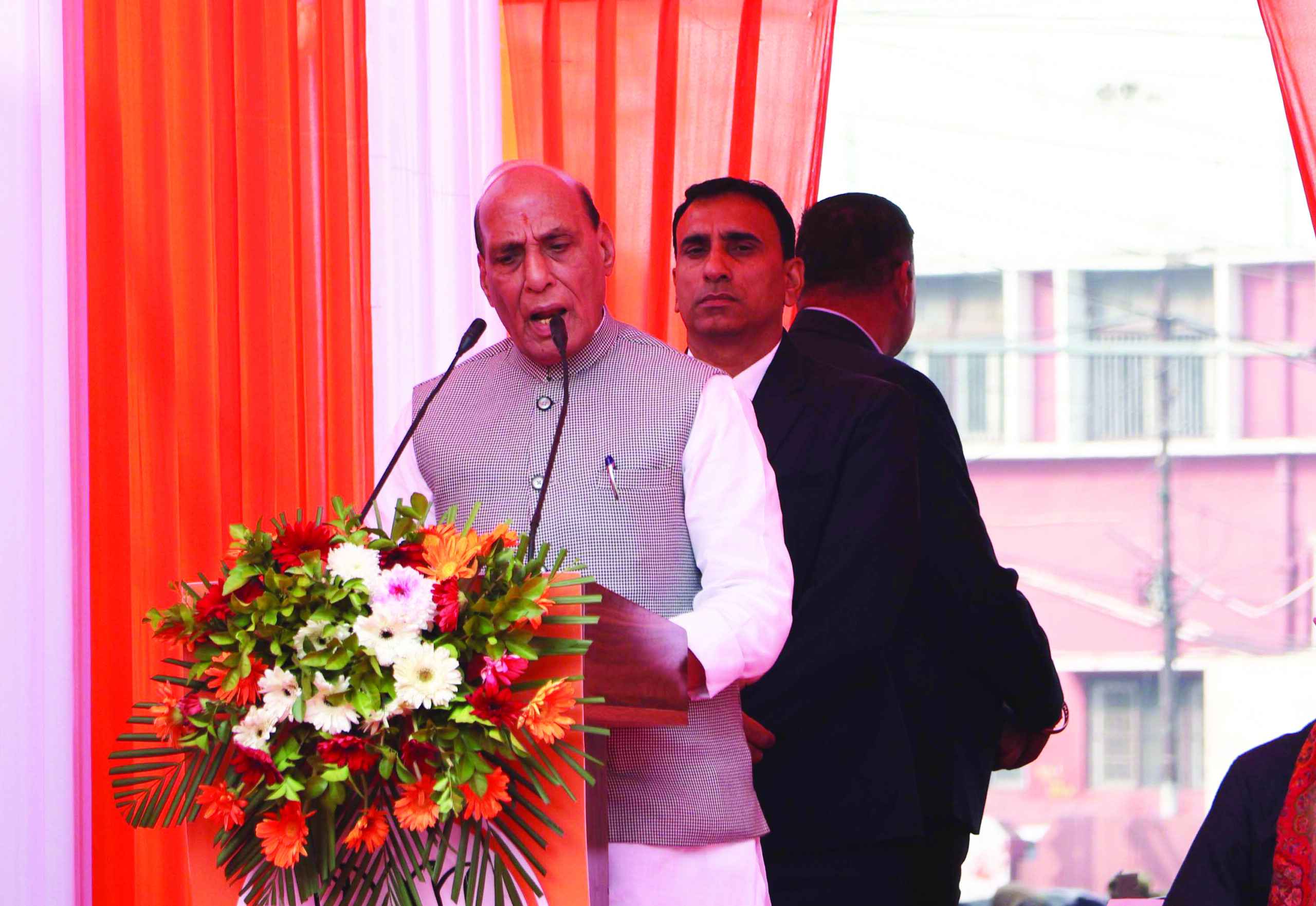
“There is a Kashmiri saying…’Patim mashraav, bronth kun nazar thaav’. Do you understand what it means? Perhaps not. It means, ‘Forget the past and look towards the future.’ In other words, the outlook of Jammu and Kashmir must be forward-looking. We must move ahead and focus on the future,” the defence minister said, addressing a public rally after leading the BJP’s ‘Loktantra Bachao, Arajakta Hatao’ (‘Save Democracy, End Anarchy’) foot march here.
A sizeable number of BJP leaders and supporters from Kashmir attended the event, though the gathering was largely dominated by Dogras, including a significant presence of women.
He said the proverb captured the need to leave behind the years of uncertainty and focus on peace, progress and prosperity.
Linking this vision with the abrogation of Article 370, Singh asserted, “After the abrogation of Article 370, no power in the world can stop Jammu and Kashmir from becoming a developed state of India.”
Blaming the Congress for “historical mistakes”, Singh said the party had taken several wrong decisions soon after Independence, including the introduction of Article 370.
Holding the provision responsible for the prolonged problems faced by Jammu and Kashmir, he remarked, “As the saying goes, a mistake committed in a moment can result in punishment lasting for centuries…but our Prime Minister Narendra Modi declared that enough was enough.”
Singh said the BJP had consistently opposed Article 370 since the time of Shyama Prasad Mukherjee and the Dogra leadership, promising to revoke the provision once it secured a clear majority in Parliament.
“And you have seen it for yourselves. We did what we had promised. There is no difference between our words and our actions,” he said, describing the 2019 decision under Modi’s leadership as the fulfilment of Mukherjee’s vision.
Singh argued that Article 370 had kept Jammu and Kashmir behind other parts of the country, alleging that rights and entitlements available to citizens elsewhere were denied to people in the region. He also claimed that the provision had encouraged terrorism and separatism.
“I also want to remind you that our leader, the late Atal Bihari Vajpayee, had emphasised the principles of Insaniyat (humanity), Jamhooriyat (democracy) and Kashmiriyat (the distinctive ethos of Kashmir). However, for several decades in Kashmir, humanity continued to suffer defeat at the hands of terrorism. We had resolved that we would not rest until terrorism was wiped out.
“I can say that we have achieved considerable success in eliminating terrorism from the soil of Jammu and Kashmir,” he said, adding the abrogation of Article 370 had led to the gradual weakening of terrorism, separatism and separatist forces in Kashmir, while creating conditions for faster development.
To underline the discriminatory nature of the earlier constitutional arrangement, Singh referred to an account in the book ‘Kashmir Under 370: A Personal History’, by former Jammu and Kashmir DGP Mahendra Sahrawal.
According to the account cited by him, even the President was once reportedly told that he was a non-state subject when he sought registration of a piece of land in Jammu and Kashmir.
“Just imagine! A person occupying the highest constitutional office in the country, who is also the Supreme Commander of the three armed forces, was told that even the President of India was a non-state subject in Jammu and Kashmir,” Singh said, clarifying that he was citing the book and not making the claim independently.
Recalling earlier administrative arrangements, he said IAS and IPS officers posted in Jammu and Kashmir were sometimes asked, “Are you going to India?” When they were due for transfer, suggesting that such practices conveyed the impression that the region was not part of India.
The defence minister said the abrogation of Article 370 had extended rights and entitlements to people in Jammu and Kashmir that had earlier remained unavailable to them.
He maintained that development activities had also gathered momentum since the constitutional change.
He also highlighted tourism growth, stating that Jammu and Kashmir received 4.76 crore tourists over a three-year period between 2017 and 2018, compared with 7.85 crore tourist arrivals during 2023-2025.Jammu Kashmir Travel
Singh said tourist arrivals generated economic activity beyond the hospitality sector, as visitors purchased local products and goods from shops and markets, thereby benefiting traders and strengthening the local economy.
“This is the transformation Jammu and Kashmir has witnessed following the abrogation of Article 370,” he said, adding that the region was now setting new records in development.
Taking a swipe at opposition leaders, Singh said that instead of taking pride in the achievements, some were engaged in damaging India’s image.