
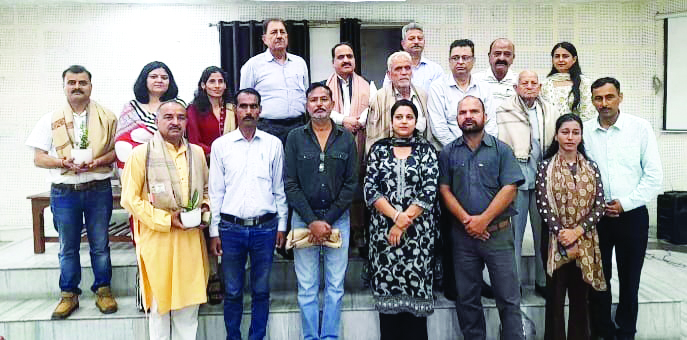
JAMMU, Sep 13: We The Humans Forum for Nature and Mankind, a public charitable trust, organised a one-day conference of farmers and citizens at the Forest Media Centre, Vikram Chowk, Jammu, to deliberate on growing environmental and public health concerns linked to intensive agrochemical use and rapid infrastructural development in Jammu and Kashmir. The conference brought together farmers, scientists, legal experts, social activists and environmentalists to discuss safer, diversified agriculture and effective environmental mitigation measures.
R. S. Jasrotia, District and Sessions Judge, attended the conference as the Chief Guest, while Prof. Rajinder Peshin, former Director Education, SKUAST Jammu, Samardev Singh Charak, Secretary, Dogra Educational Trust, and social activist-author Meenu Ajay Sawhney were the Guests of Honour. The speakers stressed the urgent need to reconsider excessive dependence on chemical pesticides and promote farming practices that are safer for farmers, consumers and the environment.
During the conference, speakers highlighted that Jammu and Kashmir records approximately 3.69 kg of chemical pesticides per hectare, significantly higher than the reported figures for Punjab and Haryana at around 0.62 kg per hectare, Himachal Pradesh at approximately 0.50 kg per hectare and the national average of around 0.22 kg per hectare. They expressed concern over the potential health and environmental consequences of indiscriminate and unsafe agrochemical use and called for greater adoption of natural farming, integrated pest management and disease-resistant crop varieties.
Capt. Lalit Sharma (IFS, Retd), Vice Chairman, and K. Y. S. Manhas, Chairman of the trust, drew attention to the deteriorating condition of water bodies and declining tree cover in the region. They said rivers and lakes including the Jhelum, Wular, Dal, Tawi, Devika and Basanter are facing growing pressure from encroachments and pollution caused by municipal waste, untreated sewage, heavy metals and toxic chemicals. They also expressed concern over the large-scale felling of indigenous trees for ring roads, highways and expressways and urged the UT Government to implement comprehensive environmental mitigation measures.
The speakers suggested that at least 10 lakh native trees should be planted along the ring roads of Jammu and Srinagar as a compensatory environmental measure. Prof. Sadiq Nargal, a food technologist, stressed the importance of safe agriculture and ensuring a contamination-free food chain from farm to consumer.
Prof. (Dr.) Sanjay Khajuria, Head, KVK Samba, and Balkar Singh, President, Bhartiya Kissan Sangh, J&K, encouraged farmers to adopt modern agricultural techniques and diversify their crops. They highlighted opportunities in high-density mango cultivation, jackfruit, strawberry, dragon fruit, litchi, exotic vegetables, turmeric and ginger, which can provide farmers with additional sources of income while reducing dependence on hazardous agrochemicals.
The conference also showcased successful examples of diversified and innovative farming in Jammu and Kashmir. Anshuman Singh, described by the organisers as a progressive farmer, shared his experience of visiting nine countries to study innovative agricultural practices. His farm at Bajalta has developed cultivation of dragon fruit, export-quality strawberries, Kesar and Alphonso mangoes, organic turmeric, blueberries and high-value exotic vegetables, along with agri-tourism activities.
Reva Rajput, Director of Devi Pindi FPO Ltd, shared her experience of transforming a small organic processing unit into a branded enterprise with a pan-India market. She said the venture now provides her with an income of more than ₹1 lakh per month and encouraged farmers to move beyond conventional farming and become agri-entrepreneurs.
Several progressive farmers who have adopted safe agricultural practices, diversified cropping and agri-tourism were also honoured with shawls for their contribution and efforts. The organisers said such examples demonstrate that sustainable agriculture can provide economic opportunities while protecting soil, water, biodiversity and public health.
We The Humans Forum for Nature and Mankind stated that it remains committed to restoring degraded human values and addressing environmental damage caused by unsustainable growth, development and the side effects of chemical-intensive agriculture. The conference concluded with a call for stronger cooperation among farmers, scientists, government agencies and citizens to build a safer, diversified and environmentally sustainable agricultural future for Jammu and Kashmir.