
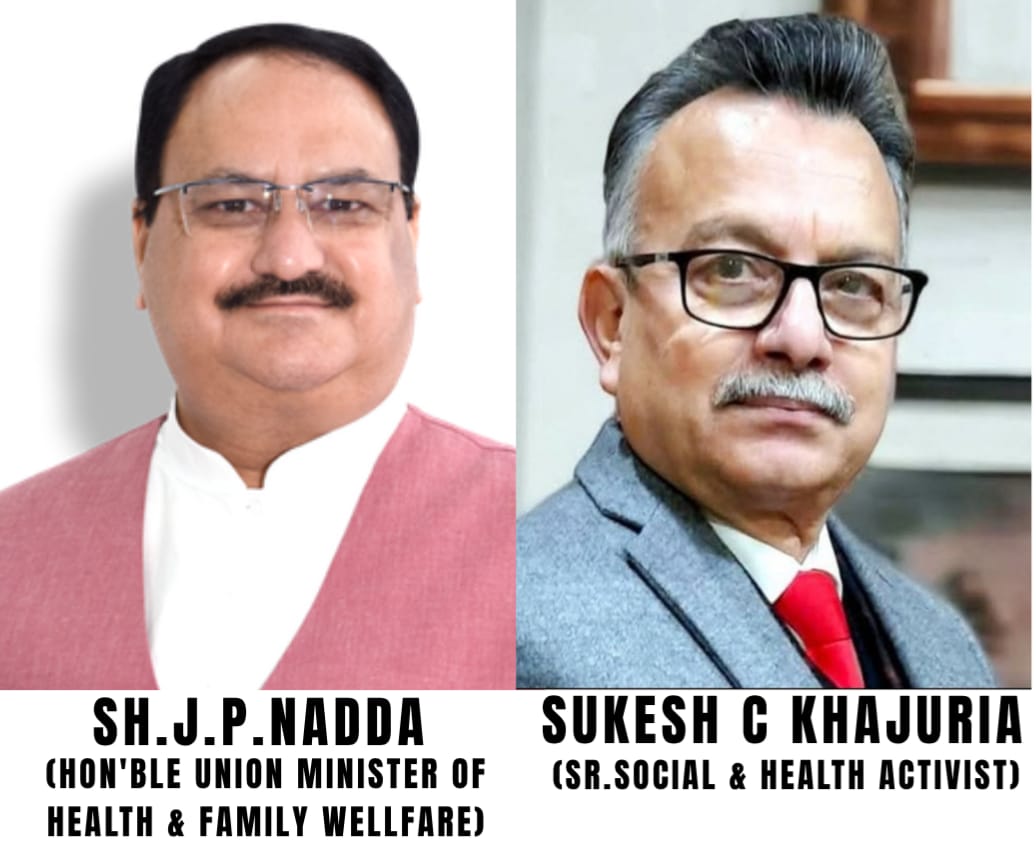
JAMMU, Jul 20: Senior social and health activist Sukesh C. Khajuria has urged the Union Government to introduce a “One Nation, One Policy” framework for compulsory service bonds for postgraduate medical specialists (MD/MS) graduating from Government Medical Colleges and other publicly funded institutions, proposing a mandatory five-year public service to bridge the shortage of specialist doctors in rural and underserved areas.
In a detailed representation submitted to Union Health and Family Welfare Minister Jagat Prakash Nadda, Khajuria stressed that despite the expansion of medical education infrastructure across the country, specialist healthcare services continue to remain concentrated in urban centres, leaving rural, tribal, hilly, border and other remote regions without adequate access to quality medical care.
He stated that medical education in Government Medical Colleges is heavily subsidized through taxpayers’ money and, therefore, specialists trained at public expense should serve society through a reasonable period of mandatory public service. Such a policy, he said, would ensure optimum utilisation of public investment while addressing the chronic shortage of specialists in government healthcare institutions.
Referring to Article 21 of the Constitution of India, Khajuria said access to quality healthcare is an integral part of the Right to Life and that equitable distribution of specialist healthcare services is essential for achieving the vision of a “Healthy India, Strong India.”
he representation calls upon the Ministry of Health and Family Welfare to initiate consultations with all States and Union Territories to formulate a uniform national framework governing compulsory service obligations for MD/MS specialists. The proposed policy seeks standardised guidelines on service duration, deployment, remuneration, incentives, career progression and transparent enforcement mechanisms across the country.
Khajuria proposed that specialists be deployed in District Hospitals, Sub-District Hospitals, Community Health Centres, Government Medical Colleges and other public healthcare institutions facing acute shortages, with special priority given to rural, tribal, remote, hilly and border areas.
A key recommendation of the proposal is a five-year compulsory public service for all MD/MS specialists graduating from Government Medical Colleges and publicly funded institutions. The suggested framework includes two years of service in the State or Union Territory where the doctor completed postgraduate studies, two years in the doctor’s home State or Union Territory, and one year in any State, Union Territory or region identified by the Central Government based on national healthcare priorities and specialist shortages.
To make the policy effective and attractive, Khajuria recommended competitive salaries, additional incentives, improved infrastructure, better working conditions, adequate support systems and enhanced career advancement opportunities for specialists serving in difficult and underserved areas.
The representation also proposes a uniform enforcement mechanism to ensure compliance with service obligations. It recommends recovery of bond amounts along with substantial financial penalties for unjustified non-compliance. In appropriate cases, the penalty could extend up to ₹1 crore, or such amount as prescribed by law, to compensate for public expenditure incurred on specialist medical education.
According to Khajuria, a well-structured national policy would strengthen India’s public healthcare system, reduce regional disparities in access to specialist medical services and ensure that public investment in medical education directly benefits the people.
He said the proposal is in line with the Government’s vision of “Barah Saal Vishwas Ke, Vikas Ke, Jan-Kalyan Ke”, as it seeks to strengthen public institutions, promote equitable healthcare and ensure that quality specialist treatment reaches every citizen irrespective of geographical location.
Copies of the representation have also been forwarded to Union Ministers of State for Health Anupriya Patel and Prataprao Ganpatrao Jadhav, Union Health Secretary Punya Salila Srivastava, National Medical Commission Chairman Dr. Abhijat Chandrakant Sheth, and NMC Secretary Dr. Raghav Langer for consideration and appropriate action.