
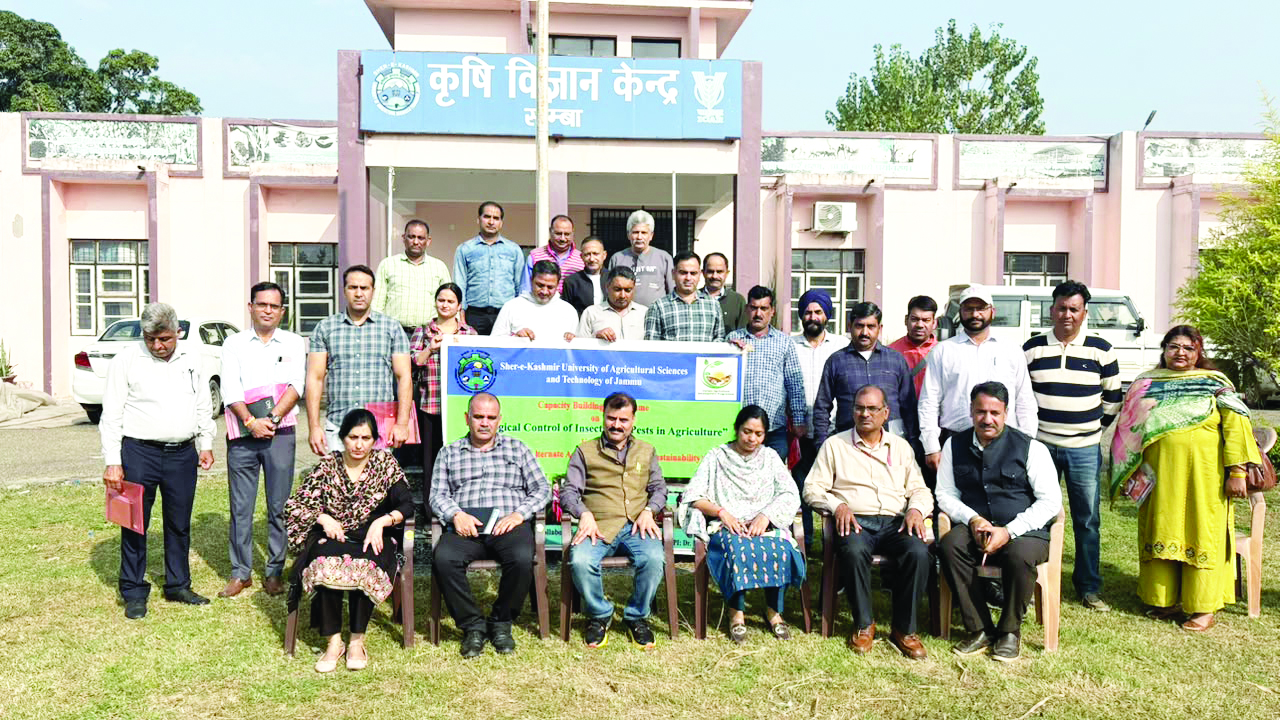
SAMBA, Nov 13: Sher-e-Kashmir University of Agricultural Sciences and Technology of Jammu (SKUAST-J organised a one-day training programme on “Biological Control of Insect Pests” for field officers of the Agriculture and Horticulture Departments at Krishi Vigyan Kendra (KVK), Samba.
The programme was organised under the stewardship of Prof. B.N. Tripathi, Vice-Chancellor, SKUAST-Jammu, and the able guidance of Prof. S.K. Gupta, Director Research, and Prof.Amrish Vaid, Director Extension, SKUAST-Jammu. The training was conducted under HADP Project No. 16, with Dr.Balbir Dhotra as Principal Investigator.
The programme was presided over by Prof. Sanjay Khajuria, Chief Scientist & Head, KVK Samba. Dr. Rakesh Khajuria, Chief Agriculture Officer, Samba, and Prof. S.K. Singh, In-charge, Centre of Organic Farming (CONF), SKUAST-Jammu, were the chief resource persons.
During the technical sessions, Dr. Rakesh Khajuria shared his valuable experience and expertise on the identification and management of insect pests affecting various agricultural and horticultural crops. He appreciated the initiatives undertaken by SKUAST-Jammu and KVK Samba for strengthening the technical capacity of field functionaries and assured all possible support and cooperation whenever required.
Prof. S.K. Singh delivered an informative lecture on the biological management of insect pests in Rabi crops. He highlighted the importance of adopting eco-friendly and sustainable pest management practices and creating awareness about the use of biological control agents and biopesticides. He also informed the participants that various types of biopesticides are available for sale at the Centre of Organic Farming (CONF), Chatha Campus, SKUAST-Jammu.
Prof. Sanjay Khajuria delivered a special technical lecture on “Role of Agroforestry in Management of Insect Pests”. He elaborated on how scientifically designed agroforestry systems can contribute to ecological balance and natural regulation of insect pest populations. He highlighted the role of diversified tree-crop combinations in providing habitats and shelter to beneficial insects, natural enemies and pollinators, thereby strengthening natural biological control mechanisms. He also emphasised that integration of suitable tree species with agricultural and horticultural crops can enhance biodiversity, improve ecosystem resilience and reduce excessive dependence on chemical pesticides. He urged the field officers to promote agroforestry as an important component of integrated pest management and sustainable agriculture in the region.
Dr.Neerja Sharma, Chief Scientist (Horticulture), deliberated on the scientific and organic cultivation of vegetables, highlighting the importance of safe production practices and the use of environment-friendly technologies.
Dr. Ajay Kumar, SMS (Agriculture Extension), sensitised the participants about the growing role of social media and digital platforms in agricultural extension, knowledge dissemination and timely transfer of technologies to farming communities.
Dr. Shalini Khajuria, SMS (Soil Science), elaborated on the importance and application of various biofertilizers for improving soil health, enhancing nutrient availability and promoting sustainable crop production.
While presiding over the programme, Prof. Sanjay Khajuria emphasised the need to popularise biological pest management technologies at the grassroots level. He stressed that field officers must act as an effective link between agricultural scientists and farmers to ensure the wider adoption of eco-friendly crop protection measures, reduce dependence on chemical pesticides and minimise environmental hazards. ARTI Devo Project Assistant and Rahul Kumar actively supported the programme.
The training programme provided an important platform for interaction, technical knowledge sharing and capacity building of field functionaries of the Agriculture and Horticulture Departments. It reaffirmed SKUAST-Jammu’s commitment towards promoting sustainable agriculture, integrated pest management and environmentally responsible farming practices in the region.