
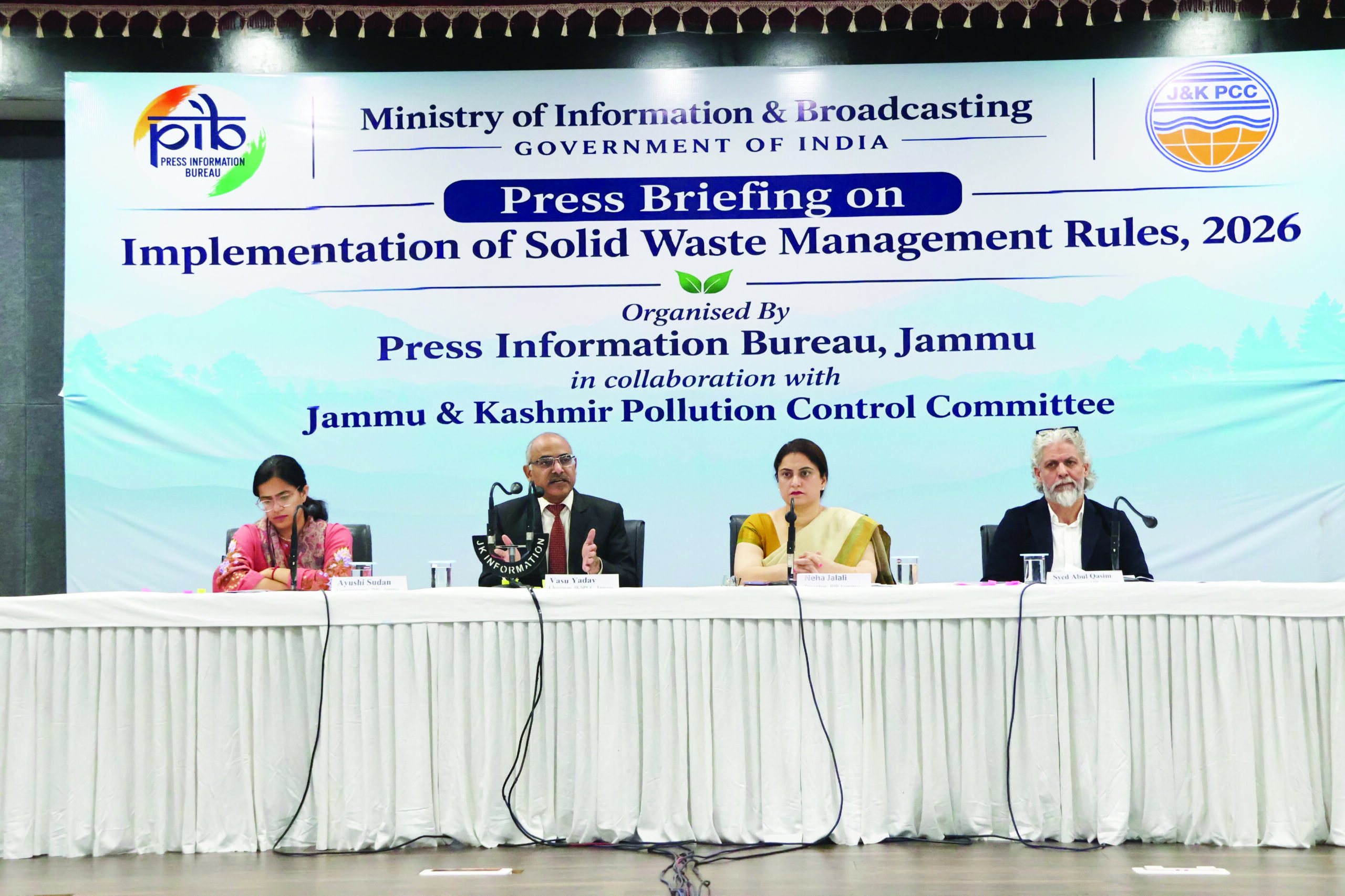
JAMMU, Nov 19: The Supreme Court of India has issued a comprehensive set of directions to States, Union Territories, local bodies and concerned Central Ministries to ensure effective implementation of the Solid Waste Management Rules, 2026. The directions, issued in Civil Appeal No. 6174 of 2023, Bhopal Municipal Corporation v. Dr. Subhash C. Panday & Ors., emphasise stricter enforcement, mandatory waste segregation, accountability of bulk waste generators, infrastructure development and time-bound disposal of legacy waste.
The Court has stressed the importance of public participation and segregation of waste at source into four categories, namely wet, dry, sanitary and special-care waste. Elected representatives, including Mayors, Councillors, Chairpersons, Corporators and Ward Members, have been directed to act as lead facilitators in educating the public about source segregation. Greater participation of elected representatives of Gram Panchayats, Municipalities and Municipal Corporations has also been emphasised to strengthen implementation at the grassroots level.
A major focus of the directions is the identification and regulation of Bulk Waste Generators (BWGs). District Collectors, in coordination with local bodies, have been directed to identify all bulk waste generators within their respective jurisdictions within six weeks and inform them about the consequences of non-compliance. These consequences may include temporary disconnection of water or electricity supply until the waste generated is managed in accordance with the prescribed rules. Bulk waste generators failing to process wet waste on-site or obtain the required Extended Bulk Waste Generator Responsibility (EBWGR) certificates by April 1, 2026, will be liable for immediate Environmental Remediation and Compensation under Rule 17.
The Court has also assigned a significant enforcement role to District Collectors, directing them to identify implementation-related challenges, conduct audits and communicate their findings to the Chief Secretary. Dedicated Special Cells are to be constituted at the district level to supervise implementation and issue necessary directions. Action, including penal measures, has also been emphasised against vehicles and their operators violating the prescribed waste management requirements. Further, the Ministry of Environment, Forest and Climate Change (MoEFCC) has been directed to delegate relevant powers under the Environment (Protection) Act to Deputy Commissioners for one year to facilitate supervision and enforcement of the Rules.
To strengthen monitoring, the directions provide for the establishment of multi-tiered monitoring task forces by March 15, 2026. A Supreme Court-empowered Monitoring Committee (SCMC) has also been constituted to oversee implementation. States and Union Territories have been directed not to exceed the timelines committed before the Committee for the disposal of legacy waste. The Committee will also issue directions to different zones of the Indian Railways and apprise the Court of their obligations under the new framework.
Recognising the importance of education in bringing behavioural change, the Court has emphasised the integration of solid waste management practices into the educational curriculum. The State Education Department has been directed to submit a binding timeline for incorporating these protocols in accordance with Rule 33. Departments of School and Higher Education have also been asked to introduce theoretical and practical knowledge of waste management with immediate effect. The initiative aims to enable students to educate their family members and encourage teachers to function as trainers and awareness facilitators.
On infrastructure development, local self-governments have been directed to upgrade waste collection and transportation systems and ensure the use of completely covered vehicles for secondary transportation. A comprehensive audit and upgradation of existing infrastructure have also been emphasised to bring waste management facilities in line with the prescribed standards. High-footfall and garbage-prone areas must be identified and addressed through appropriate interventions. Fresh dumping at legacy dumpsites has been prohibited, while the committed timelines for their remediation and disposal must be strictly followed.
The Court has further highlighted the role of corporate participation in strengthening waste management initiatives, urging States to make effective use of Corporate Social Responsibility (CSR) support from corporate organisations.
The Solid Waste Management Rules, 2026, notified by MoEFCC through S.O. 388(E) on January 27, 2026, under the Environment (Protection) Act, 1986, came into force on April 1, 2026, superseding the 2016 Rules. The new framework extends to urban and rural local bodies as well as establishments such as Special Economic Zones, railways, airports, ports and defence establishments.
Under the revised framework, every waste generator is required to segregate waste into four streams: wet waste, including kitchen and organic waste; dry waste, including plastic, paper, metal, glass, wood and rubber; sanitary waste, such as diapers and sanitary pads; and special-care waste, including batteries, expired medicines, CFLs, paint containers and certain household medical waste. Open burning, burying and disposal of waste in drains, water bodies and public places are prohibited.
The Rules also introduce expanded accountability for bulk waste generators, a centralised online portal developed by the Central Pollution Control Board (CPCB) for digital tracking of waste generation and disposal, and formal recognition of Material Recovery Facilities (MRFs). Industries such as cement plants and waste-to-energy units using solid fuels are required to increase their substitution of conventional fuels with Refuse-Derived Fuel (RDF) from five per cent to 15 per cent over six years.
The revised framework also imposes stricter restrictions on landfilling, limiting it to inert waste and waste that is neither recyclable nor suitable for energy recovery. It provides for higher landfill charges on unsegregated waste, annual landfill audits by State Pollution Control Boards and Pollution Control Committees, and time-bound biomining and bioremediation of legacy dumpsites.
Special provisions have also been incorporated for hilly regions and islands, including tourist user fees, regulation of tourist inflow according to waste-handling capacity, non-biodegradable waste collection points and decentralised wet-waste processing facilities for hotels and restaurants. Pollution Control Boards and Committees have also been empowered to impose Environmental Compensation for violations such as operating without registration, submitting false information, using forged documents and improper waste disposal.
The comprehensive directions underline the need for coordinated institutional action, stronger accountability and active public participation to transform solid waste management practices. The emphasis is on moving beyond waste collection towards scientific processing, resource recovery, environmental protection and the development of sustainable and cleaner communities.