
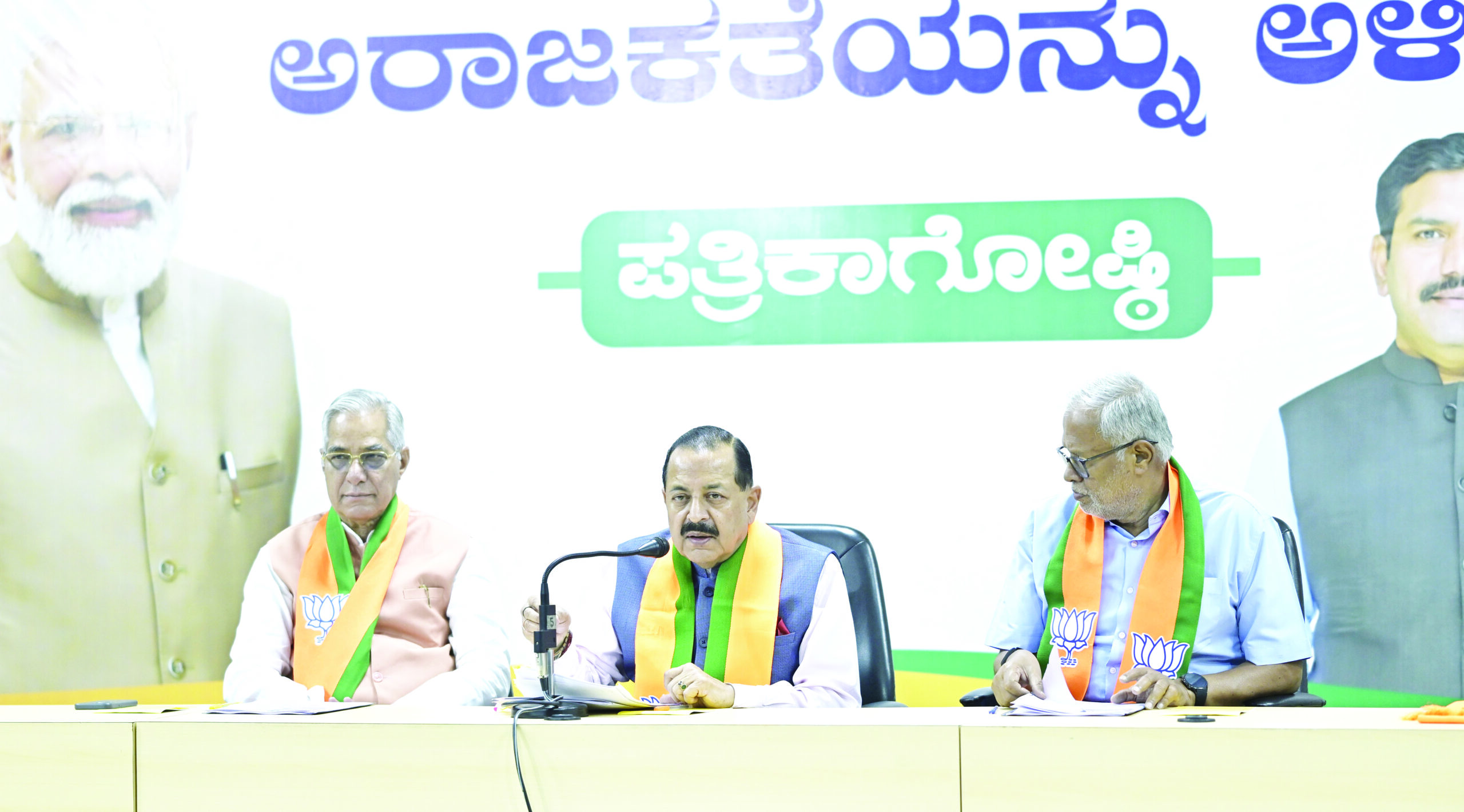
JAMMU / BENGALURU, Nov 3: Union Minister of State (Independent Charge) for Science & Technology and Earth Sciences, and MoS PMO, Personnel, Public Grievances, Pensions, Atomic Energy and Space, Dr. Jitendra Singh today mounted a strong rebuttal to Congress and Opposition allegations about the Special Intensive Revision (SIR) of electoral rolls, asserting that the exercise is a constitutional responsibility of the Election Commission of India (ECI), aimed at safeguarding electoral integrity and ensuring that every eligible Indian citizen retains the right to vote.
Taking a dig at the Congress party, Dr Jitendra Singh said that the people of Karnataka have, through the result of recently held legislative council election, proved that even in an election held with ballot paper, Congress stands no chance before BJP. That explodes the opposition claim that instead of EVM, if ballot paper is used , BJP would not win an election.
Addressing a press conference in Bengaluru, Dr Jitendra Singh said that attempts to portray a legitimate electoral roll verification exercise as an assault on democracy were politically motivated and reflected the Opposition’s reluctance to accept institutional accountability and electoral outcomes.
Suresh Kumar , BJP MLA and former State Cabinet Minister, and Lahar Singh Rajya Sabha member sat alongside Dr Jitendra Singh at the press conference.
Dr. Jitendra Singh said that Congress’s present opposition to SIR stands in stark contrast to its own record in government. Of the 12 instances of Special Intensive Revision undertaken in independent India, 10 were conducted under Congress-led Governments, making the party’s present attempt to question the legitimacy of the same exercise a glaring example of political double standards. He said that SIR was neither a new initiative nor a partisan intervention, but a longstanding electoral process necessitated by demographic changes, migration, deaths, duplicate registrations and inaccurate voter records.
The Minister said that electoral rolls cannot remain static for decades while population movements and other changes continue to take place. Intensive revision is essential to ensure that electoral participation is based on accurate and verified records, and that the sanctity of every genuine vote is protected. He recalled that former Delhi Chief Minister and Congress leader Kapil Sibal had defended the deletion of 13.58 lakh invalid voter entries in Delhi as routine electoral maintenance, raising questions about why the same principle was being questioned today.
Responding to the Opposition’s campaign around the figure of 13 crore deletions, Dr. Jitendra Singh said that the narrative deliberately conflates entries flagged for verification with actual deletion of legitimate voters. The figure represents entries identified at the draft-stage for scrutiny, including approximately 6.3 crore permanently shifted voters, 3 crore persons absent during verification, 2.8 crore deceased voters and 1 crore duplicate registrations. These categories cannot be equated with 13 crore genuine voters being disenfranchised.
The Minister said that electoral verification is accompanied by procedural safeguards, including Booth Level Officer visits, participation of Booth Level Agents representing political parties, publication of draft rolls, claims and objections, hearings and appellate mechanisms. No eligible voter should be denied the opportunity to establish his or her eligibility through the prescribed process. He said that the distinction between verification and deletion must be understood clearly, rather than being deliberately blurred to generate political outrage.
Dr. Jitendra Singh said that the Bihar SIR, which resulted in the removal of approximately 47 lakh entries relating to absent, shifted or deceased persons, demonstrated the importance of rigorous electoral verification. He also referred to the addition of approximately 2.37 crore young electors aged 18–28 since 2025, saying that the electoral system continues to expand participation even as it undertakes the necessary exercise of cleaning up electoral records.
Dr. Jitendra Singh said that the SIR process has been subjected to judicial scrutiny and that the Supreme Court has upheld the Election Commission’s authority to undertake electoral roll revision. He referred to the Court’s interventions in Bihar and West Bengal, including judicial oversight of claims and objections, deployment of judicial officers and mechanisms for adjudicating disputed entries, as evidence of safeguards designed to ensure procedural fairness.
The Minister said that questioning electoral processes cannot become an excuse for undermining constitutional institutions or intimidating officials entrusted with their responsibilities. Referring to incidents involving BLOs, electoral personnel and police officers during anti-SIR demonstrations, he said that allegations of assault, obstruction, harassment and personal targeting of public servants were deeply concerning. He also referred to reported incidents involving women police personnel and journalists during political protests, questioning the credibility of those claiming to defend democratic values while allegedly mistreating individuals performing their professional duties.
He said that the Election Commission, the judiciary and frontline electoral personnel must be allowed to discharge their constitutional responsibilities without intimidation, personal attacks or politically motivated pressure.
Dr. Jitendra Singh said that Congress’s attempt to attribute its electoral setbacks to SIR ignored a political decline that began long before the current exercise. Between 2014 and 2025, Congress lost 56 State Assembly elections, according to the figures presented by the Minister, demonstrating that its electoral challenges cannot be explained by a revision process introduced subsequently. He said that the party had repeatedly questioned EVMs, raised allegations of vote theft and challenged electoral institutions, only to adopt a different position when electoral outcomes favoured it.
Referring to Congress’s electoral success in Karnataka and Telangana, and its victory in Keralam in an election conducted after SIR, the Minister questioned the consistency of the Opposition’s allegations. He said that electoral outcomes are determined by voters and that political parties must accept the people’s mandate rather than repeatedly blame institutions and processes for their defeats.
Dr. Jitendra Singh also expressed concern over attempts to portray domestic electoral disputes as part of a broader campaign of destabilisation. Referring to statements and activities of certain protest groups, activists and organisations, he said that allegations of foreign funding, calls for regime change and efforts to erode public confidence in democratic institutions warranted serious scrutiny. He said that India is a sovereign democracy with strong constitutional institutions and that electoral reforms cannot be held hostage to political mobilisation or narratives designed to undermine public trust.
The Minister said that electoral roll purification must be viewed as an essential democratic safeguard rather than a political confrontation. Every eligible Indian citizen must have the opportunity to vote, while deceased, duplicate, permanently shifted and otherwise ineligible entries must be subject to lawful verification. He said that the answer to electoral integrity lies in transparent processes, due procedure and institutional accountability, and not in manufactured controversy.
Dr. Jitendra Singh said that India’s democracy is strengthened when citizens place their confidence in constitutional institutions and when political parties respect the people’s mandate. Protecting electoral rolls, he said, is ultimately about protecting the sanctity of every genuine vote and preserving the foundations of a strong, sovereign and democratic India.