
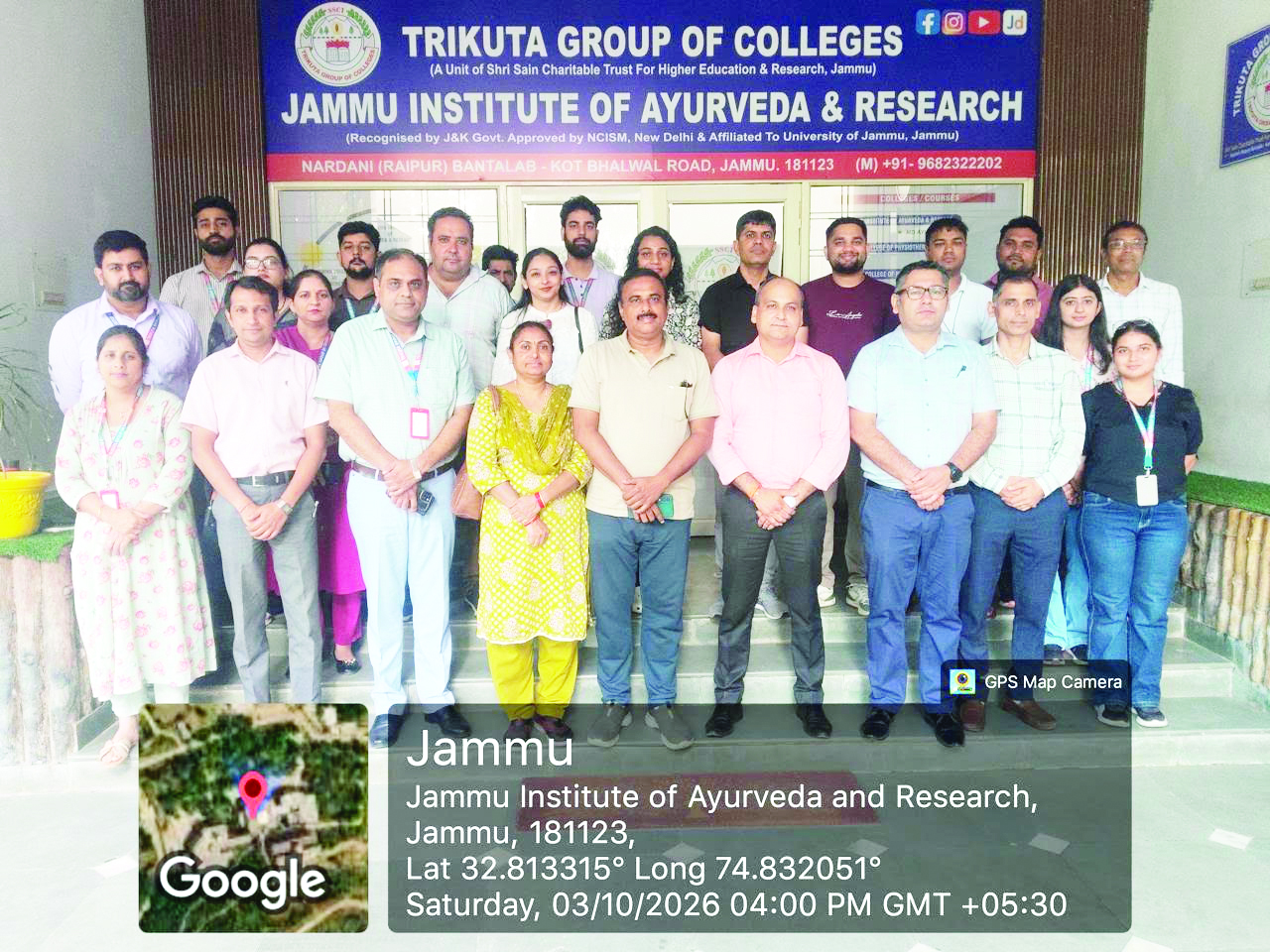
JAMMU, Oct 4: The Jammu Institute of Ayurveda & Research (JIAR), Jammu, hosted an academic visit by the Department of Shalya Tantra, National Institute of Ayurveda (NIA), Jaipur, led by Prof. (Dr.) P. Hemantha Kumar, Pro-Vice Chancellor and Head, Department of Shalya Tantra, NIA Jaipur.
The visiting delegation, comprising faculty members, postgraduate scholars and officials, was warmly received by the management, faculty and students of JIAR. The visit provided an important platform for academic interaction, exchange of clinical experiences and strengthening educational collaboration between the two reputed institutions.
During the interaction, the Department of Shalya Tantra, JIAR, briefed the visiting delegation about its academic and clinical activities. The faculty highlighted various surgical and parasurgical procedures undertaken by the department, along with its initiatives aimed at extending healthcare services to the community.
Prof. (Dr.) P. Hemantha Kumar addressed the faculty members and postgraduate scholars of JIAR and shared valuable academic and clinical insights from his extensive experience in the field of Ayurveda and Shalya Tantra. He emphasised the importance of academic exchange and sharing of clinical knowledge in strengthening the quality of teaching, training and patient care.
The interaction also provided scholars and faculty members with an opportunity to discuss contemporary developments, clinical practices and educational approaches in the field of Shalya Tantra. The visit was seen as a meaningful step towards enhancing professional engagement and fostering stronger institutional ties between JIAR and NIA Jaipur.
The academic programme concluded with the felicitation of the visiting delegation, followed by a vote of thanks. The guests and members of the host institution subsequently attended lunch.
The visit underscored the growing importance of inter-institutional academic collaboration in promoting knowledge sharing, clinical learning and the further advancement of Ayurveda education and healthcare practices.