
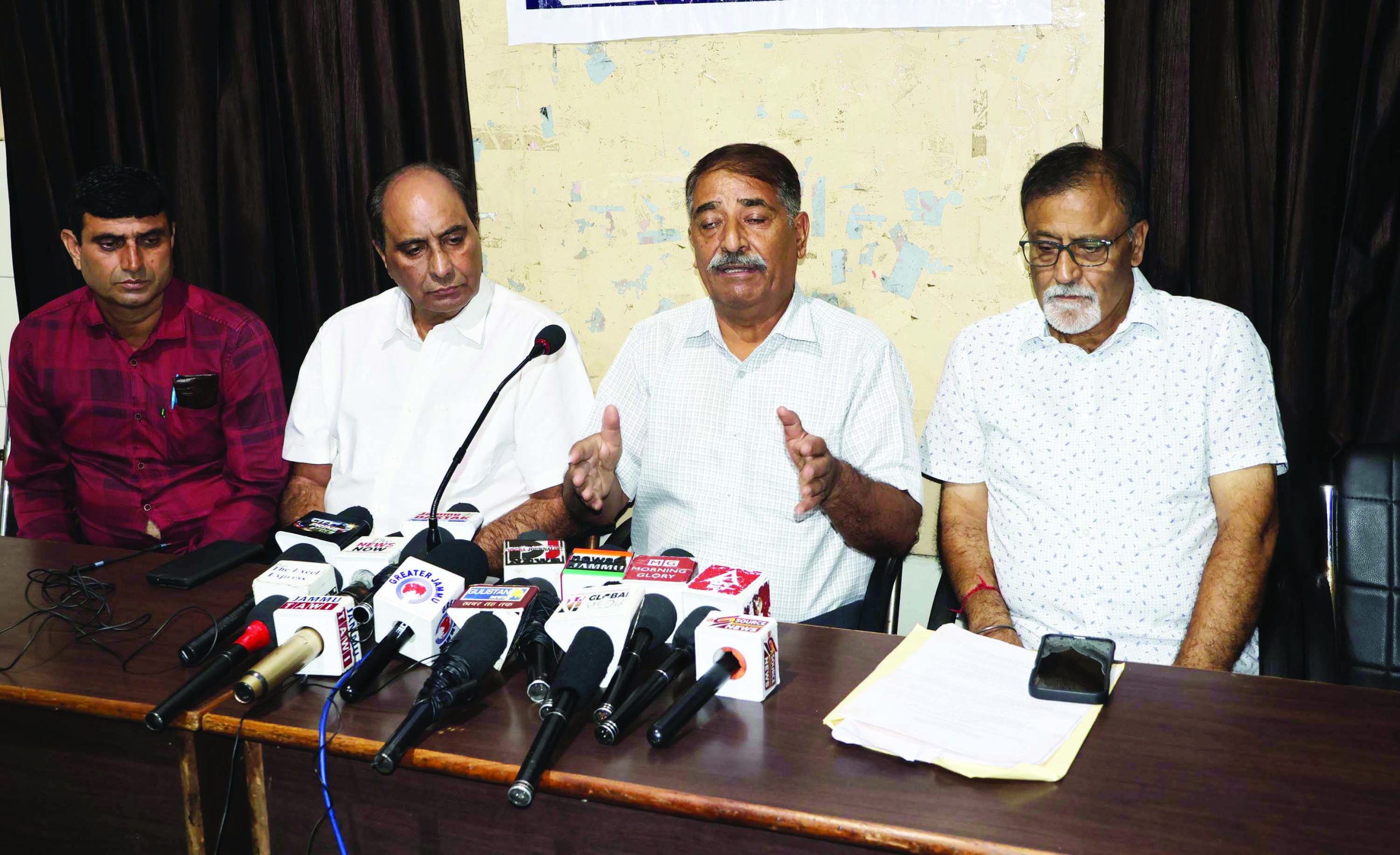
JAMMU, Sep 24: The Migrant Immovable Property Reclaim Association (MIPRA), an apolitical body representing Kashmiri migrant property owners, has called for effective implementation of the existing legal framework governing migrant properties and urged the administration to ensure that genuine property claims are resolved through a transparent, simple and time-bound mechanism.
The Association said the migration of thousands of Kashmiri families during the disturbed conditions before and after 1990 left behind residential houses, agricultural land, orchards, shops and commercial properties. According to MIPRA, migration did not extinguish the lawful ownership rights of property holders, but many migrant owners continue to face difficulties relating to alleged encroachments, unauthorised occupation, disputed mutations and transactions, missing revenue records, prolonged proceedings and non-implementation of official orders.
MIPRA said its concerns are particularly significant for widows, orphans, senior citizens, persons with disabilities and economically weaker property owners who may find it difficult to pursue their claims in the Valley. The Association maintained that such property owners require an accessible mechanism through which genuine claims can be examined and decided without prolonged administrative and legal delays.
MIPRA recently submitted a detailed memorandum to the Lieutenant Governor, Chief Justice of the J&K and Ladakh High Court, Chief Minister, senior administrative authorities and all Deputy Commissioners of Kashmir, including the Relief & Rehabilitation Commissioner (Migrants). The memorandum seeks effective enforcement of the J&K Migrant Immovable Property (Preservation, Protection and Restraint on Distress Sales) Act, 1997, and stronger administrative mechanisms for protecting migrant properties.
On September 23, a four-member MIPRA delegation led by Convenor Avtar K. Koul met the Divisional Commissioner, Kashmir. The Association said the delegation was given a patient hearing and that the Divisional Commissioner expressed willingness to assist within his administrative remit. A direct channel of communication was also opened, while the concerns raised by MIPRA were to be conveyed to the higher authorities.
According to MIPRA, the Divisional Commissioner informed the delegation that the administration had already identified around 70,000 kanals of land belonging to migrants in the Kashmir Valley. The Association said details were available at the district, tehsil and village levels and that the Divisional Commissioner’s office would share the relevant information with MIPRA. The Association appreciated the response and said it expected visible and time-bound action on the issues raised.
MIPRA maintained that the principal concern is not merely the existence of statutory protection but its effective implementation. It referred to the J&K Migrant Immovable Property Act, 1997, and argued that legal protection can achieve its intended purpose only when complaints are examined promptly and lawful orders are implemented effectively.
The Association alleged that several encroachment cases involving migrant properties remain pending for prolonged periods and that repeated adjournments in District Magistrate courts can further delay resolution. It called for greater accountability across the Revenue machinery, particularly at and below the Tehsildar level, in cases involving unexplained delays, non-cooperation or failure to implement lawful orders.
MIPRA has also raised concerns regarding alleged fraudulent or questionable post-exodus mutations and transactions involving migrant properties. It has demanded a district-wise audit of such mutations and transactions and their scrutiny against original revenue records. The Association has further called for examination of cases where provisions of the J&K Agrarian Reforms Act, 1976, were allegedly invoked in relation to agricultural land, orchards and residential properties, stating that such matters require systematic, record-based investigation.
The Association has also sought immediate scrutiny of transactions involving migrant properties carried out through Powers of Attorney. According to MIPRA, transactions found to have been executed unlawfully or in violation of applicable law should be dealt with in accordance with the legal process.
MIPRA has expressed concerns about the functioning of certain District Magistrate offices in relation to migrant-property cases, particularly in Srinagar, and has called for appropriate supervisory scrutiny where repeated delays or adjournments are alleged. It has also urged the Relief & Rehabilitation Commissioner (Migrants) to assume a more active institutional role in monitoring unresolved property cases and facilitating their timely resolution.
Among its major demands, MIPRA has called for strict implementation of the 1997 Act, accountability within the Revenue Department, preservation and digitisation of original revenue records, a district-wise audit of post-exodus mutations and transactions, and mechanisms to prevent multiplicity of litigation involving the same property. It has also sought consideration of a centralised mechanism at Jammu and examination of the feasibility of a Special Migrant Property Tribunal for the time-bound disposal of long-pending cases.
The Association has further demanded independent examination of recurring complaints concerning questionable mutations, alienations and administrative failures, along with appropriate legal action wherever deliberate manipulation, fraudulent conduct or wilful disregard of lawful orders is established. It has also called for protection of migrant properties recovered from encroachment until they are lawfully restored to their owners or otherwise dealt with in accordance with applicable law.
MIPRA has additionally proposed a separate judicial mechanism for dealing with the large number of migrant property cases pending before different courts for years. The Association said such a mechanism could help ensure focused and time-bound adjudication while reducing prolonged litigation.
MIPRA reiterated that it does not seek confrontation or preferential treatment but enforcement of the existing law. It maintained that a migrant property owner should not have to spend decades establishing ownership while disputed possession continues. The Association stressed that displacement should not be treated as abandonment of property and that administrative delay should not become a means of prolonging disputes over ownership and possession.
The Association expressed hope that the concerns placed before the Divisional Commissioner and the Union Territory Administration would be acted upon promptly and that the recent interaction would lead to concrete administrative measures for protecting the lawful property rights of migrant owners.