
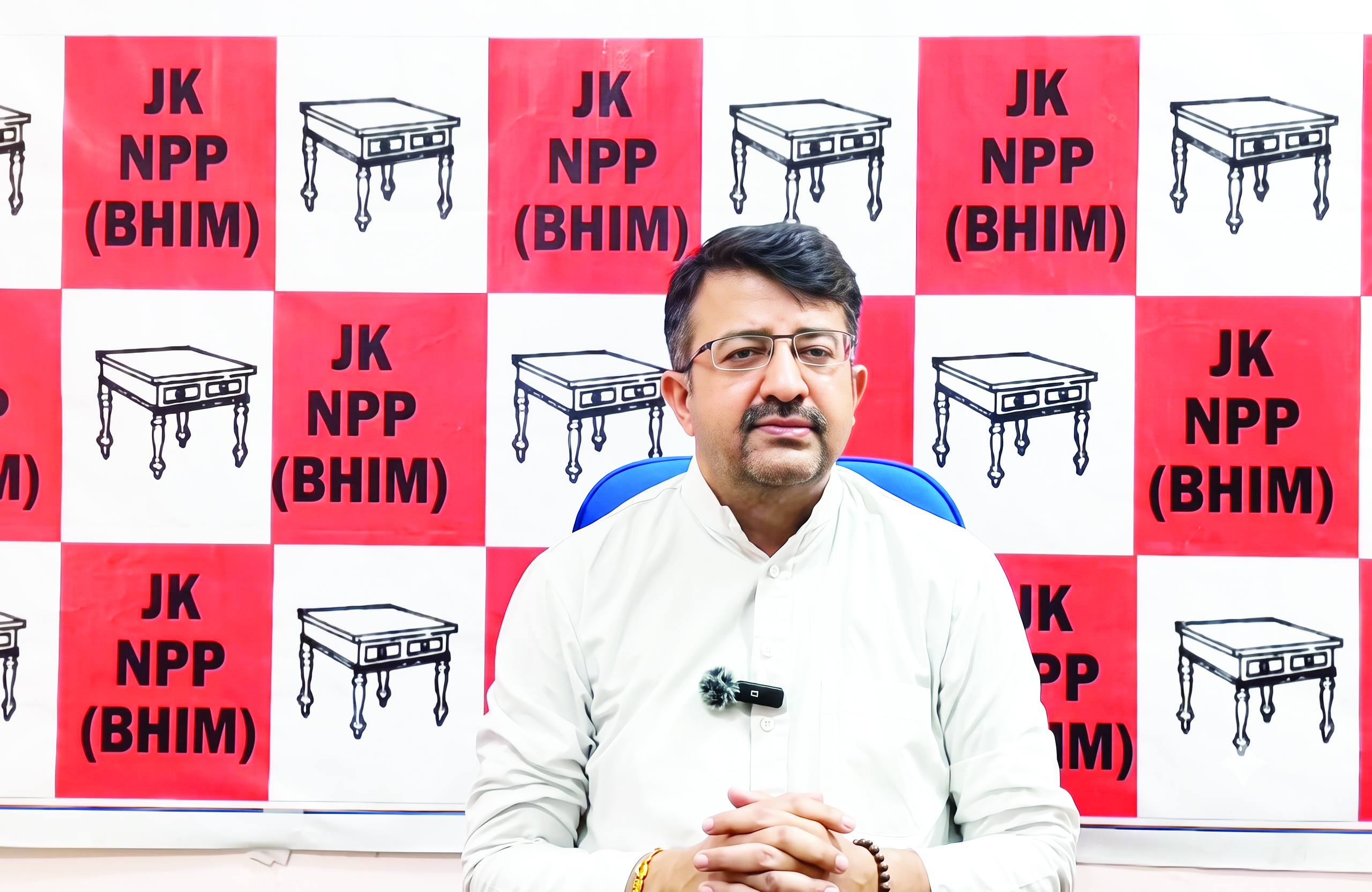
JAMMU, Sep 12: President of JKNPP Bhim, Vilakshan Singh, has urged the Chief Minister of Jammu & Kashmir to make the House Rent Allowance (HRA) uniform for Government employees posted in urban as well as rural areas, stating that the existing disparity is unintentionally encouraging employees to prefer urban postings and is adversely affecting the delivery of Government services in rural areas.
In a representation submitted to the Chief Minister, Singh said that while the difference in HRA may have been introduced keeping in view variations in rental costs, it has now created an additional incentive for employees to seek postings in urban centres. Government employees, like any other citizens, naturally prefer to settle in urban areas where their families have better access to educational institutions, healthcare, transportation and other essential facilities. This preference, coupled with higher HRA in urban areas, is contributing to an increasing reluctance among employees to serve in rural and far-flung areas.
Singh said the education sector is among the worst affected by this urban-centric tendency. While several urban schools have adequate or, in some cases, surplus teaching staff, many rural, hilly and remote schools continue to face shortages of teachers. The resulting imbalance directly affects the quality of education available to children in rural areas.
“A child studying in a rural school has the same right to quality education as a child studying in an urban school. The geographical location of a student should not determine the quality of education available to him or her,” Singh said.
He further pointed out that in a large number of cases, teachers posted in rural areas continue to reside in urban centres and commute to their places of posting. Such employees incur additional expenditure on fuel, transportation and travel and also lose considerable time in commuting. In contrast, an employee who both resides and serves in an urban area enjoys the benefit of urban facilities as well as higher HRA. Singh said that this aspect also needs to be taken into account while reviewing the existing HRA structure.
According to Singh, the issue should not be viewed merely as a matter concerning an allowance to Government employees. It is fundamentally an issue of equitable distribution of Government manpower and equal access to public services. Rural residents are entitled to the same quality of education, healthcare and other Government services as people living in urban centres.
He said that the existing HRA structure is contributing to the concentration of employees in urban areas. He urged the Government to consider uniform HRA for urban and rural postings as a policy measure to reduce the financial preference for urban postings. He also called for rational deployment of surplus staff from urban institutions to understaffed rural institutions, particularly Government schools.
Singh said that rural and remote postings often involve greater inconvenience, longer travel and fewer basic amenities, and therefore Government employees serving in such areas should not be placed at a disadvantage merely because their place of posting falls outside an urban classification.
“Government services must reach the people who need them most. If our urban schools have surplus teachers while rural schools are struggling for adequate teaching staff, the system needs correction. The ultimate sufferers are our children, particularly those belonging to rural and economically weaker sections,” he said.
The President of JKNPP Bhim appealed to the Chief Minister to consider the matter sympathetically and initiate a comprehensive review of the HRA policy, along with rationalisation of staff and a transparent transfer policy, so that Government employees are deployed according to public requirement rather than merely their preference for urban postings.
Singh expressed hope that the Government would take a positive decision in the larger public interest and ensure that no student in rural Jammu & Kashmir is deprived of quality education because of an avoidable shortage of teachers.