
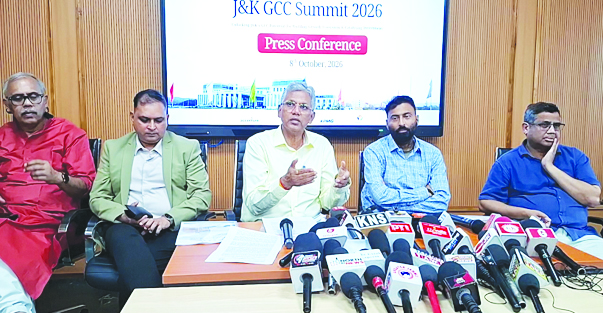
JAMMU, Oct 8: Jammu and Kashmir is set to take a significant step towards establishing itself as an emerging destination for Global Capability Centres (GCCs) with the J&K GCC Summit 2026, being organised by the Indian Institute of Management Jammu (IIM Jammu) in collaboration with the Government of Jammu and Kashmir, with NASSCOM as the Knowledge Partner.
A press conference was held today ahead of the two-day summit, scheduled for October 9–10 at Mandapam, IIM Jammu, providing an overview of the summit’s objectives, focus areas and vision of creating a sustainable GCC ecosystem in the Union Territory.
The summit, themed “Unlocking J&K’s GCC Potential for Building Growth Ecosystem & Catalyzing Investment,” is expected to bring together more than 300 delegates, around 45 companies and over 55 industry leaders, besides senior policymakers, investors, academics and representatives of the technology and innovation ecosystem.
The event will feature senior personalities including Chief Secretary J&K Atal Dulloo, IIM Jammu Director Prof. B.S. Sahay, NASSCOM President Rajesh Nambiar, Chairman of NIIT Padma Bhushan Rajendra Singh Pawar, Secretary Labour and Employment Kumar Rajeev Ranjan, and senior representatives from government, industry and academia.
The summit seeks to position J&K as a credible location for GCCs, which have evolved from traditional offshore and cost-optimisation units into strategic centres handling high-value functions such as artificial intelligence, product engineering, research and development, enterprise analytics and global technology operations.
With GCC activity increasingly expanding into Tier-II and Tier-III cities, the summit will explore how Jammu and Kashmir can leverage its talent pool, academic institutions, infrastructure, technology capabilities, innovation potential and quality of life to attract such investments.
Speaking at the press conference, Prof. B.S. Sahay, Director, IIM Jammu, said that institutions such as IIMs, IITs and NITs have a responsibility that goes beyond awarding degrees and must contribute to regional and national development.
He said IIM Jammu was working closely with the Government of Jammu and Kashmir in areas including policy formulation, capacity building and government-industry engagement. He noted that four policies developed through the Centre for Innovation and Transformation in Governance (CiTaG), IIM Jammu, including the successful Mission YUVA, had been accepted.
Prof. Sahay said the GCC ecosystem could become an important avenue for employment generation and economic development in J&K. He clarified that the summit was not merely an investment summit, but an initiative to create awareness about J&K’s potential as a GCC destination and facilitate meaningful interaction between government and industry.
He stressed the importance of preparing local youth with industry-relevant skills and highlighted the role of institutions such as IIM Jammu and IIT Jammu in developing the talent required by emerging industries. Business meetings and parallel interactions with participating organisations will also be held to explore possibilities of establishing operations in the region.
Kumar Rajeev Ranjan, IAS, Secretary, Labour and Employment Department, Government of Jammu and Kashmir, said the summit comes at an important juncture when J&K is seeking new avenues for employment and economic opportunities.
He emphasised that the government cannot be the sole source of employment for the region’s growing educated workforce and said GCCs could create substantial opportunities in finance, human resources, technology, analytics and other knowledge-based sectors.
He underlined the need to build a strong local talent pool aligned with emerging industry requirements. He also highlighted J&K’s natural environment, climatic conditions and connectivity with the National Capital Region as factors that could support the development of a GCC ecosystem.
According to him, GCC investments could generate a wider multiplier effect by creating direct and indirect employment and strengthening supporting businesses and services.
Prof. Jabir Ali, Dean, Faculty and Research, IIM Jammu, said the summit would strengthen collaboration between industry, academia and government while creating opportunities for research, innovation, knowledge exchange and talent development.
Prof. Nitin Upadhyay, Dean Academics, IIM Jammu, said Jammu and Kashmir had an important role to play in the vision of Viksit Bharat through technology and innovation. He observed that the establishment of a GCC ecosystem assumes particular significance as IIM Jammu completes a decade.
Dr. Sandeep Ananthanarayanan, CEO, CiTaG, IIM Jammu, said the summit would connect technology, innovation and governance perspectives with industry and policy priorities, helping develop actionable pathways for making J&K a competitive GCC destination.
The two-day programme will feature six high-level panel discussions covering industry-government collaboration, India’s GCC growth story, investment and employment, technology, workforce transformation and the roadmap for making J&K the next GCC destination.
The discussions will bring together senior representatives from organisations including Accenture, Barclays, Planview, KPMG, Grant Thornton, PwC, Baker Hughes, DuPont, Amazon Web Services, Palantir, Dixon Technologies, Northern Trust, Marsh, Zydus Lifesciences, Zoho Corp, Consilio and RTX, among others.
The panels will deliberate on critical issues including policy stability, infrastructure, incentives, connectivity, land availability, digital infrastructure, AI, cloud technology, research and development, workforce transformation and industry-aligned education.
A major focus will also be placed on strengthening industry-academia linkages through internships, experiential learning, industry-aligned curricula, applied research and leadership development.
The summit is expected to explore tangible outcomes such as Memoranda of Understanding, anchor investment commitments and employment proposals, with the deliberations feeding into a proposed J&K GCC roadmap and incentive architecture.
The inaugural programme on October 9 will begin with a campus tour and sapling plantation by dignitaries, followed by addresses by Chief Secretary Atal Dulloo, Prof. B.S. Sahay and Kumar Rajeev Ranjan. NASSCOM President Rajesh Nambiar will deliver the plenary address.
The summit will also showcase Jammu and Kashmir’s rich cultural heritage through “Colors of Jammu,” a cultural programme by Padma Shri Balwant Thakur.
Overall, the J&K GCC Summit 2026 is being positioned as a strategic platform to move beyond discussion and build a concrete ecosystem for investment, employment, skill development, innovation and economic diversification, with the larger ambition of putting Jammu and Kashmir firmly on India’s emerging GCC map.