
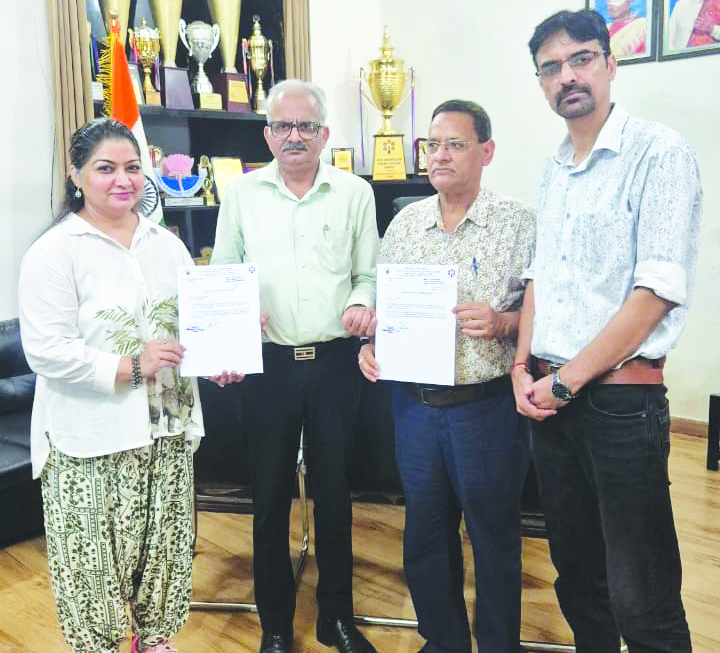
JAMMU, Aug 12: The Departments of Botany and Zoology, GGM Science College, under the guidance of Principal GGM Science College Jammu, Prof. (Dr.) Romesh Kumar Gupta, organised an awareness programme on World Elephant Day 2026 under the theme “Elephant conservation, ecological significance and responsible wildlife stewardship”. The programme was conducted as part of the 1710th Elephant Day Tree Talk initiative at the college.
The programme featured O.P. Sharma Vidyarthi, IFS (Retd.), as the resource person, who delivered an elaborate and insightful lecture on the elephant as India’s National Heritage Animal. He acquainted the students with the three extant elephant species—the African Savanna Elephant (Loxodonta africana), African Forest Elephant (Loxodonta cyclotis) and Asian Elephant (Elephasmaximus)—and discussed the food preferences and ecological importance of elephants. He also highlighted several plants associated with elephants, including Elephant Creeper, Elephant Bush, Elephant Ear Fig, Elephant Yam, Elephant Apple and Elephant’s Foot.
He further highlighted the cultural representation of elephants in Indian art and traditions, including their association with Dussehra celebrations.An interesting historical dimension was added with the reference to a fossilised elephant tusk discovered at Galander, Kashmir, during railway excavation, identified as Palaeoloxodon turkemenicus, which is presently preserved in the museum of the University of Jammu.
At the outset, Dr. B.P. Singh, Head, Department of Botany, delivered the welcome address and highlighted the importance of World Elephant Day in creating awareness about wildlife conservation, biodiversity and ecological sustainability. Dr. Rahul Kait, Head, Department of Zoology, emphasised the role of awareness programmes in sensitising the younger generation towards biodiversity conservation and responsible environmental stewardship.
Vidyarthi further emphasised the major threats faced by elephants, including habitat loss, human-elephant conflict, poaching, ivory trade, railway accidents and the absence of wildlife corridors. He also highlighted concerns relating to the captivity, isolation and improper treatment of elephants, stressing that conservation must ensure both the protection and welfare of the species.
He apprised the students of important conservation measures, including Project Elephant launched in 1992, the role of CITES in regulating international ivory trade and India’s efforts towards restricting the ivory trade.
Pooja Kapoor Suri, renowned herbal innovator, also interacted with the students and shared valuable insights, adding an engaging dimension to the programme.
The Principal of the college Prof.(Dr.)Romesh Kumar Gupta, appreciated the Departments of Botany and Zoology for organizing the programme and emphasized that such initiatives help students understand the intricate relationship between wildlife, plants, ecosystems and human society and stressed the need for protecting biodiversity, ecosystems and the delicate balance of nature.
Dr. Brinder Kumar, Prof. Vishal Sharma, Prof. Mehnaz Bano, Prof. Sushil Kumar and Prof. Arvind Kumar were also present during the event. The programme concluded with a vote of thanks proposed by Dr. Rozy Bamba.