
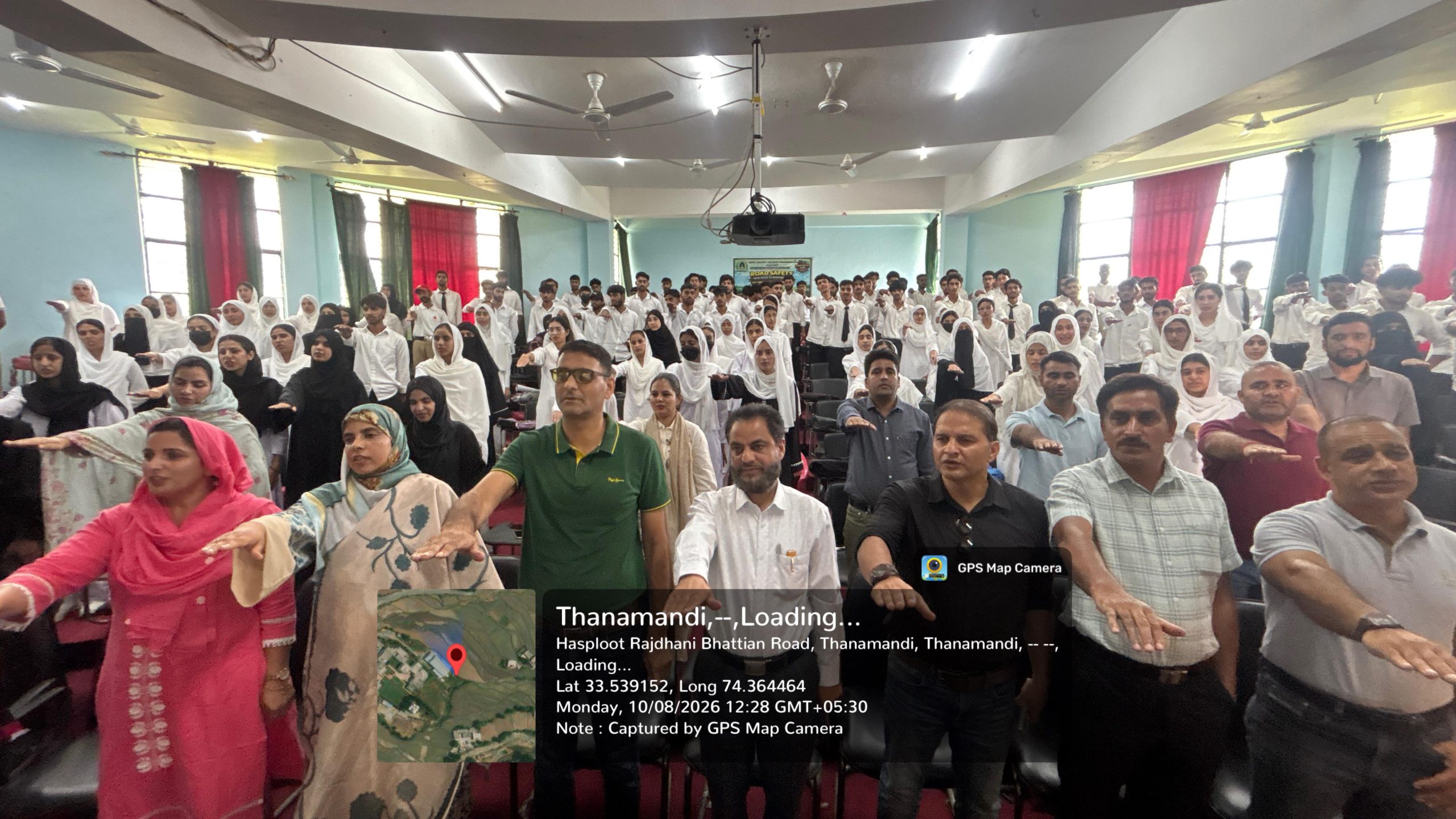
THANNAMANDI, Aug 11: The Women Development Cell of Government Degree College Thannamandi, in coordination with the NSS Unit and NCC Unit of the College, under the guidance of College Principal Prof. (Dr.) Shamim Ahmed Azad, organised an awareness programme on “Stop Dowry, Protect Women’s Rights”. The programme was aimed at sensitising students and faculty members about the social, legal and emotional consequences of the dowry system and encouraging them to contribute towards building a dowry-free society.
The programme commenced with an introductory address by Prof. Fatima Parveen, Convener Women Development Cell, who briefed the audience about the objectives and significance of the awareness programme. She explained that dowry is not merely an outdated social custom but a serious social evil that can lead to financial pressure, humiliation, mental cruelty, harassment, domestic violence and, in extreme cases, loss of life. She sensitised the students about the need to reject the normalisation of dowry demands in the name of tradition, social status or family honour.
The keynote address was delivered by Prof. Rizwana Kouser, who elaborated upon the seriousness of dowry-related offences with particular reference to the Hon’ble Supreme Court judgment in State of U.P. v. Ajmal Beg & Another, decided on 15 December 2025. She explained the circumstances and legal significance of the case and sensitised the students about the consequences of dowry-related cruelty and demands. The Dowry Prohibition Act, 1961 prohibits the giving, taking and demanding of dowry. She also discussed the constitutional values supporting the fight against dowry, particularly equality, non-discrimination, dignity and protection of life. The students were encouraged to understand that marriage should be based on mutual respect, consent, equality and trust rather than financial transactions.
Prof. Rizwana Kouser emphasised that even demands for seemingly small amounts of money, jewellery, vehicles, furniture or other articles can gradually develop into pressure, harassment, humiliation and cruelty. She urged students not to justify such practices by describing them as tradition or by saying that “everyone does it.” She stressed that women enter marriage as equal members of society and not as financial burdens on their families.
The keynote speaker also explained the distinction between dowry and mahr in Islamic marriage. She stated that mahr is a financial right of the bride, given by the groom to the bride, and is fundamentally different from a demand made from the bride’s family for the benefit of the groom or his family. The programme also addressed the responsibility of young women and young men in challenging the practice of dowry.
As part of the programme, all participants collectively took a pledge to oppose the practice of dowry and promote equality and dignity in marriage. The pledge was:
“We will neither demand dowry nor support its giving. We will respect the dignity and equality of every woman. We will question harmful traditions, support those who face pressure, and speak against dowry wherever we see it. We will strive to promote marriages based on trust, dignity, equality and mutual respect rather than financial transactions.”
The pledge served as a collective commitment by the students and faculty members to reject dowry and to contribute towards creating awareness in their families, institutions and communities. The programme concluded with a Vote of Thanks to the Principal, WDC team, NCC and NSS volunteers, faculty members and students.