
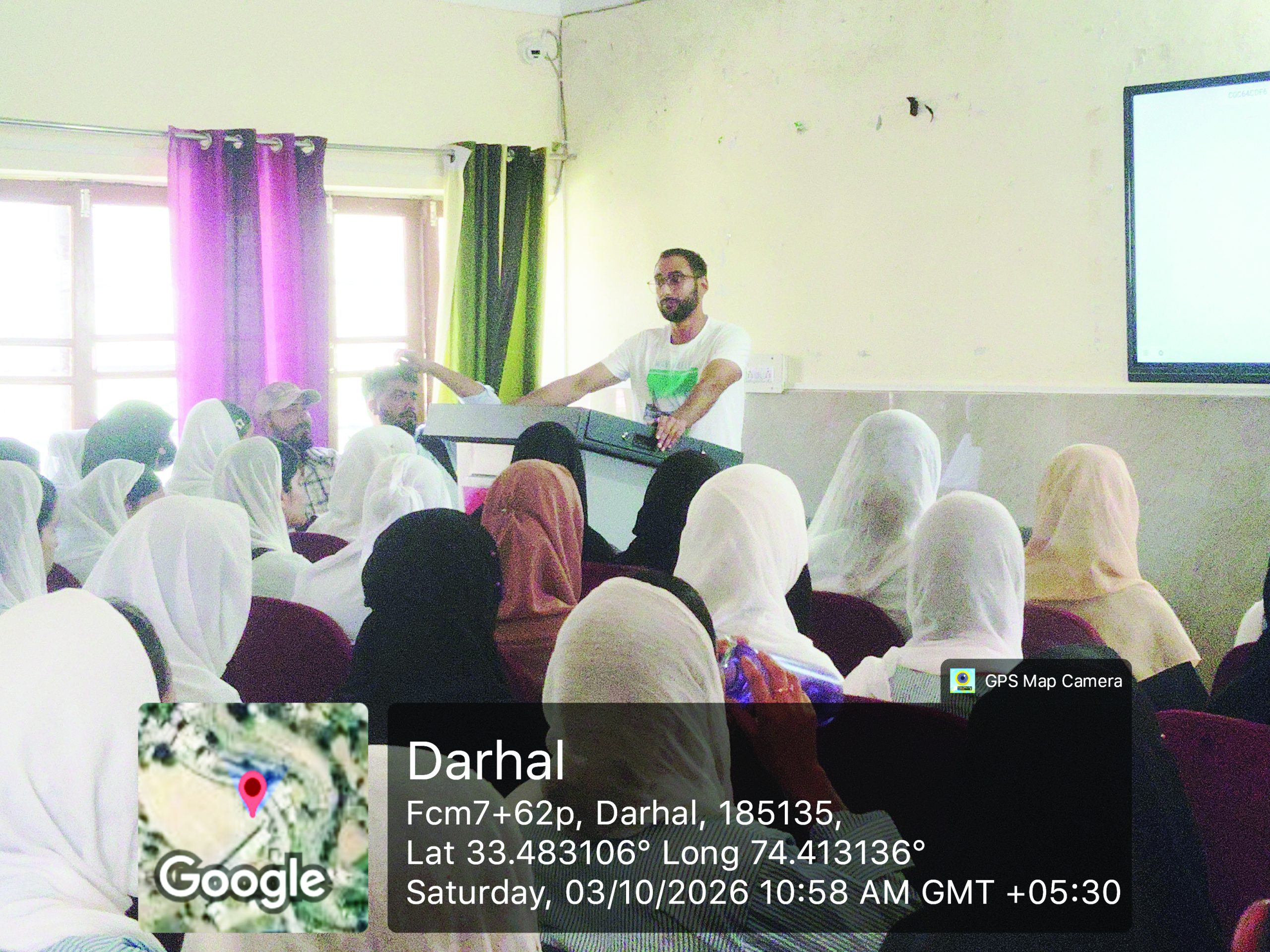
DARHAL, Oct 3: Government Degree College Darhal celebrated Gandhi Jayanti with great enthusiasm and solemnity to commemorate the birth anniversary of Mahatma Gandhi, one of the foremost leaders of India’s freedom struggle and a globally recognized advocate of truth, non-violence, peace and human dignity. The programme was organized by the College Cultural and Literary Committee under the patronage and guidance of the Principal, Prof. Zamir Ahmed Mirza.
The programme aimed to acquaint students with the life, philosophy and contributions of Mahatma Gandhi and to encourage them to reflect upon the enduring values of *truth, non-violence, peace, tolerance, communal harmony, social justice and responsible citizenship.
The intellectual highlight of the programme was an extended and thought-provoking lecture delivered by Dr. Atta Ul Rehman Malik, HOD, Department of Political Science, GDC Darhal, who explored the life, ideas and enduring legacy of Mahatma Gandhi and their relevance in contemporary society.
Speaking on the occasion, Dr. Atta Ul Rehman Malik elaborated upon Gandhi’s remarkable journey from a young lawyer to one of the most influential leaders of India’s freedom struggle. He discussed Gandhi’s philosophy of Satyagraha, Ahimsa, truth, self-discipline, simplicity and moral courage, explaining how these principles became powerful instruments of political and social transformation.
Dr. Atta Ul Rehman Malik emphasized that Gandhi’s contribution to India’s freedom struggle cannot be understood merely in terms of political leadership. He presented Gandhi as a leader who sought to connect the struggle for political freedom with social reform, ethical conduct, communal harmony, dignity of labour and the upliftment of marginalized sections of society.
He explained how Gandhi transformed the freedom movement into a mass movement by bringing ordinary people, including peasants, workers and women, into the mainstream of the national struggle.
While discussing the concept of Satyagraha, Dr. Malik explained that it was not merely a method of political protest but a broader philosophy rooted in truth, moral courage and non-violent resistance. He highlighted the significance of major movements associated with Gandhi, including the Non-Cooperation Movement, Civil Disobedience Movement and Quit India Movement, and placed them within the wider context of India’s struggle for independence.
He also elaborated upon Gandhi’s philosophy of Ahimsa emphasizing that non-violence, in Gandhi’s understanding, represented moral courage, self-restraint and respect for human dignity rather than weakness. He encouraged students to understand non-violence as a broader social principle capable of promoting dialogue, tolerance, peaceful coexistence and constructive resolution of conflicts.
Dr. Malik further highlighted Gandhi’s commitment to communal harmony and social equality. He discussed Gandhi’s efforts towards Hindu-Muslim unity and his campaigns against untouchability and social discrimination. He also touched upon Gandhi’s ideas concerning education, village development, Swadeshi, self-reliance, dignity of labour and ethical public life, explaining their significance in understanding Gandhi as a social and political thinker.
Connecting Gandhi’s philosophy with contemporary challenges, Dr. Atta Ul Rehman Malik urged students to move beyond merely remembering Gandhi on October 2 and instead strive to incorporate values such as truthfulness, compassion, discipline, tolerance, respect for others and civic responsibility into their everyday lives. He emphasized that the meaningful remembrance of Gandhi lies in understanding and practising the values associated with his life.
The lecture also encouraged students to critically engage with Gandhi as a historical and political thinker and to appreciate the complexity of his ideas within the broader context of India’s freedom movement and the making of modern India. Students were encouraged to develop a habit of reading and engaging with original writings and ideas of important thinkers and leaders of the national movement.
The programme witnessed the active participation of faculty members, including Dr. Taseem Ahmed, Dr. Mohd Akhlaq,Prof. Anzar Ahmed, Dr. Mohd Shakoor, Dr. Zarkha Sultan, Dr. Inam Ul Haq, Dr. Atta Ul Rehman Malik, Dr. Tariq Bhat, Dr. Zahid Hussain, Sadam Hussan*, along with other teaching and non-teaching staff and students of the college.
The celebration provided students with an opportunity to reflect upon the historical significance of Gandhi’s life and the continuing relevance of values such as truth, non-violence, peace, tolerance, social responsibility and human dignity. The programme concluded with a renewed commitment to uphold these values and contribute towards building a peaceful, inclusive, responsible and progressive society.
The event reaffirmed that Gandhi Jayanti is not merely a commemoration of a historical personality, but also an occasion to reflect upon the values of ethical citizenship, peaceful coexistence, social responsibility and human dignity that continue to hold significance in contemporary society.