
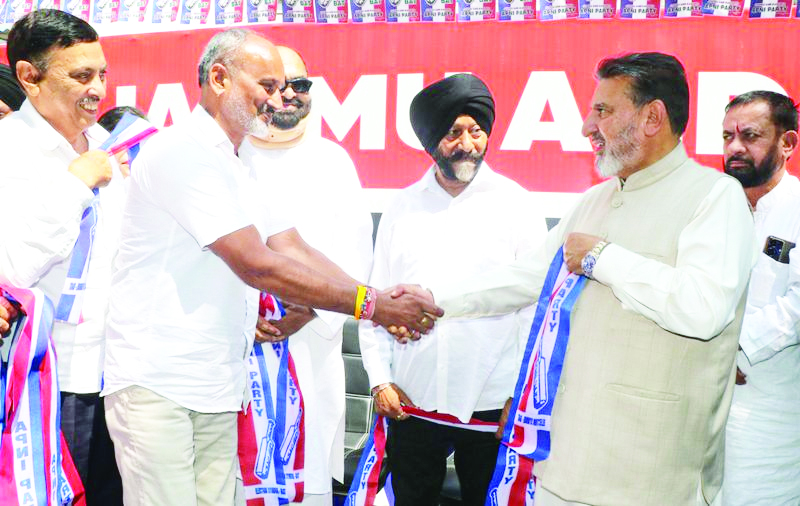
JAMMU, Sep 16: Jammu and Kashmir Apni Party (JKAP) President Syed Mohammad Altaf Bukhari called upon young people to take a greater role in the political and social affairs of Jammu and Kashmir, saying that issues such as employment, healthcare, electricity, drinking water and accountable governance should remain central to public discourse.
Bukhari was addressing a joining programme at the party headquarters in Gandhi Nagar, Jammu, where former NSUI Joint Secretary Tavleen Singh, along with nearly 200 youths and around 100 prominent citizens from Arnia, joined the Apni Party. Among those who joined were Rajwant Singh Raji, Sagar Singh Charak, Buta Singh, Alyas, Irfan and Jaskaran.
The programme was organised by J&K Apni Party Jammu Provincial President S. Manjit Singh.
Welcoming the new entrants, Bukhari said that the youth should not remain spectators in political affairs and urged them to participate actively in public life. He said the new members had joined a political platform to serve their communities and encouraged them to remain connected with people at the grassroots.
Tavleen Singh said his decision to join the party was influenced by what he described as its emphasis on raising issues affecting the people.
During his interaction with reporters, Bukhari spoke about several issues, with healthcare and the ongoing National Health Mission (NHM) employees’ agitation among the key concerns. NHM employees in Jammu and Kashmir have recently held protests over issues including pay revision, job security and retirement benefits, with the agitation affecting services at some health facilities.
Bukhari described the NHM employees’ demands as legitimate and called upon the administration to address their grievances. He said the Chief Secretary and health administration should take serious note of the concerns being raised by healthcare workers.
He also raised concerns about healthcare infrastructure and manpower in remote and hilly areas. Referring to Bani, he claimed that a sub-district hospital had faced a prolonged shortage of a gynaecologist and that diagnostic equipment had remained unused because of a shortage of personnel. These remarks were presented by Bukhari as concerns requiring administrative attention.
Bukhari also raised allegations regarding the functioning of Government Medical College and Associated Hospital, Rajouri, including shortages of doctors and paramedical staff, delays in diagnostic services and patient referrals. Similar concerns about staffing and medical facilities in Rajouri were raised by Apni Party district leaders at a review meeting on September 15; the party has called for an impartial examination of the allegations.
On unemployment, Bukhari said Jammu and Kashmir has a large number of educated young people seeking employment and maintained that job creation and livelihood opportunities should receive priority.
He also raised concerns about electricity charges and supply, questioning the burden on consumers and calling for attention to the gap between power availability and the bills faced by households.
On drinking water, he questioned whether announcements regarding tap-water connections were translating into reliable supplies on the ground and said access to safe drinking water should be treated as a basic public requirement.
Bukhari also called for greater transparency and accountability in government offices, saying citizens should be able to access legitimate public services without unnecessary delays or difficulties.
On the restoration of statehood to Jammu and Kashmir, Bukhari said the issue should be pursued through dialogue and democratic engagement with the Union Government rather than confrontation.
He also said that political leaders from Jammu and Kashmir have the right to meet Union leaders to present the concerns of the people, arguing that such engagement is part of democratic politics.
Responding to criticism that the Apni Party maintains close links with the BJP, Bukhari rejected the allegation that engagement with Union leaders amounted to political subservience. He said the Apni Party was intended to function as a political platform for the people.
On the Uniform Civil Code, Bukhari said that immediate attention should be given to issues such as healthcare and basic public services. He questioned the priority given to broader political debates when people continue to face difficulties in accessing essential medical facilities.
Bukhari urged the younger generation to become more politically aware and participate in shaping the future of Jammu and Kashmir. He said political discourse should focus on practical issues affecting people’s daily lives rather than unrealistic promises.
He also called for people to move beyond politics based solely on religious or regional divisions and focus on common concerns affecting communities across Jammu and Kashmir.
Meanwhile, S. Manjit Singh welcomed Tavleen Singh and the other new entrants and said the party would support them in their organisational work. He attributed the party’s expansion to grassroots engagement and direct interaction with people.
Among those present were former MLA and Senior Vice President Faqir Nath, Kissan Wing State President Badri Nath Sharma, Provincial Secretary and Trade Wing In-charge Ajaz Kazmi, SC Wing President Bodh Raj Bhagat, Vice President Arun Chibber, Provincial President Women Wing Pavneet Kour, Youth President Vishal Singh Naryania, Jammu District President Abhay Bakaya, R.S. Pura District President Harpreet Singh and Rural District President Pushdev Uppal, besides other party leaders and workers.