
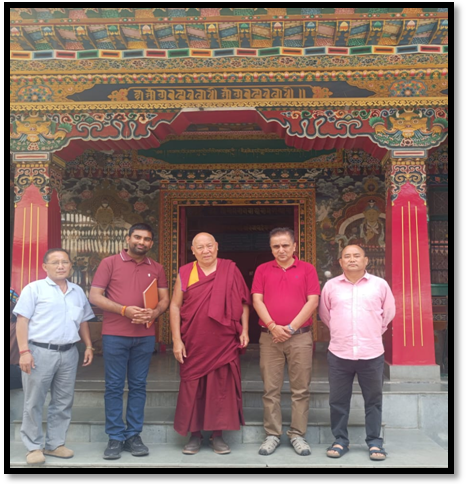
JAMMU, Jun 12: In a significant move to align traditional theological education with the contemporary demands of the National Education Policy (NEP) 2020, faculty members from the Department of Buddhist Studies, University of Jammu, recently concluded a high level strategic meeting with Geshe Lhakdor, Director of the Library of Tibetan Works & Archives (LTWA), and Tsering Phuntsok, Managing Director of the Norbulingka Institute, Dharamshala.
The meeting signals a paradigm shift in how classical disciplines are taught in the 21st century. Led by Dr. Vivek Sharma and Dr. Rajesh Sharma, the delegation’s objective was to design a roadmap for the seamless management of vocational education, practical training, research collaborations, and exchange programs for both students and faculty. These initiatives are specifically aimed at the smooth conduct of the Postgraduate (PG) course in Buddhist Studies at the University of Jammu.
Speaking after the deliberations, Dr. Vivek Sharma emphasised that NEP 2020 demands a decisive move away from rote learning. “Buddhist Studies can no longer remain confined to philosophical abstraction. The new policy requires us to embed vocational and practical components into every PG program. Our students must graduate not only with textual knowledge but with the ability to manage archives, curate exhibitions, document oral traditions, and work in cultural heritage sectors.”
Dr. Rajesh Sharma added that the collaboration with LTWA and Norbulingka Institute provides a living laboratory for students. “Geshe Lhakdor’s expertise in Tibetan textual preservation and Sh. Tsering Phuntsok’s experience in running a world‑class institute for traditional arts and crafts offer our students unparalleled opportunities for hands‑on learning. We are designing credit‑based internships, joint research projects, and faculty exchange modules that will make our PG course a model for NEP‑compliant humanities education.”
The PG course will now include compulsory practical papers on archival management, digital documentation of manuscripts, and monastery/heritage site administration. A formal exchange protocol was agreed upon MOU, allowing University of Jammu students to undertake residencies at LTWA and Norbulingka Institute for fieldwork, and enabling LTWA/Norbulingka scholars to teach specialized modules at Jammu. Joint Research Programmes: Both sides will collaborate on documenting and preserving endangered Tibetan Buddhist texts and artefacts, with joint publications and conferences planned. Internship Pathways: Students will complete a mandatory vocational internship at Norbulingka Institute’s art and conservation studios or LTWA’s library and archive sections, gaining practical skills in heritage management.
Geshe Lhakdor, Director of LTWA, welcomed the initiative: “This partnership is a perfect embodiment of NEP 2020’s spirit. The Library of Tibetan Works & Archives has always been a bridge between tradition and modernity. By working with Deptt. Of Buddhist Studies, University of Jammu, we can train a new generation of scholars who are equally comfortable reading a pecha and managing a digital database.” Sh. Tsering Phuntsok, Managing Director of Norbulingka Institute, noted: “Vocational education in the arts and humanities is not a compromise—it is an enrichment. Our institute has shown that traditional thangka painting, sculpture, and woodcarving can be taught as professional, livelihood‑generating skills. We are excited to extend this model to postgraduate Buddhist Studies, ensuring students graduate job‑ready while honouring their heritage.”
The Department of Buddhist Studies is now poised to become a national benchmark for NEP‑driven transformation in classical disciplines. By integrating vocational and practical education into the PG course—from manuscript preservation to heritage tour management—the department is ensuring that the study of Buddhism contributes directly to cultural entrepreneurship and the creative economy. Dr. Vivek Sharma and Dr. Rajesh Sharma will now lead a curriculum review committee to formally integrate these outcomes into the PG syllabus, with the first cohort of students expected to begin the new vocational track in the upcoming academic session.