
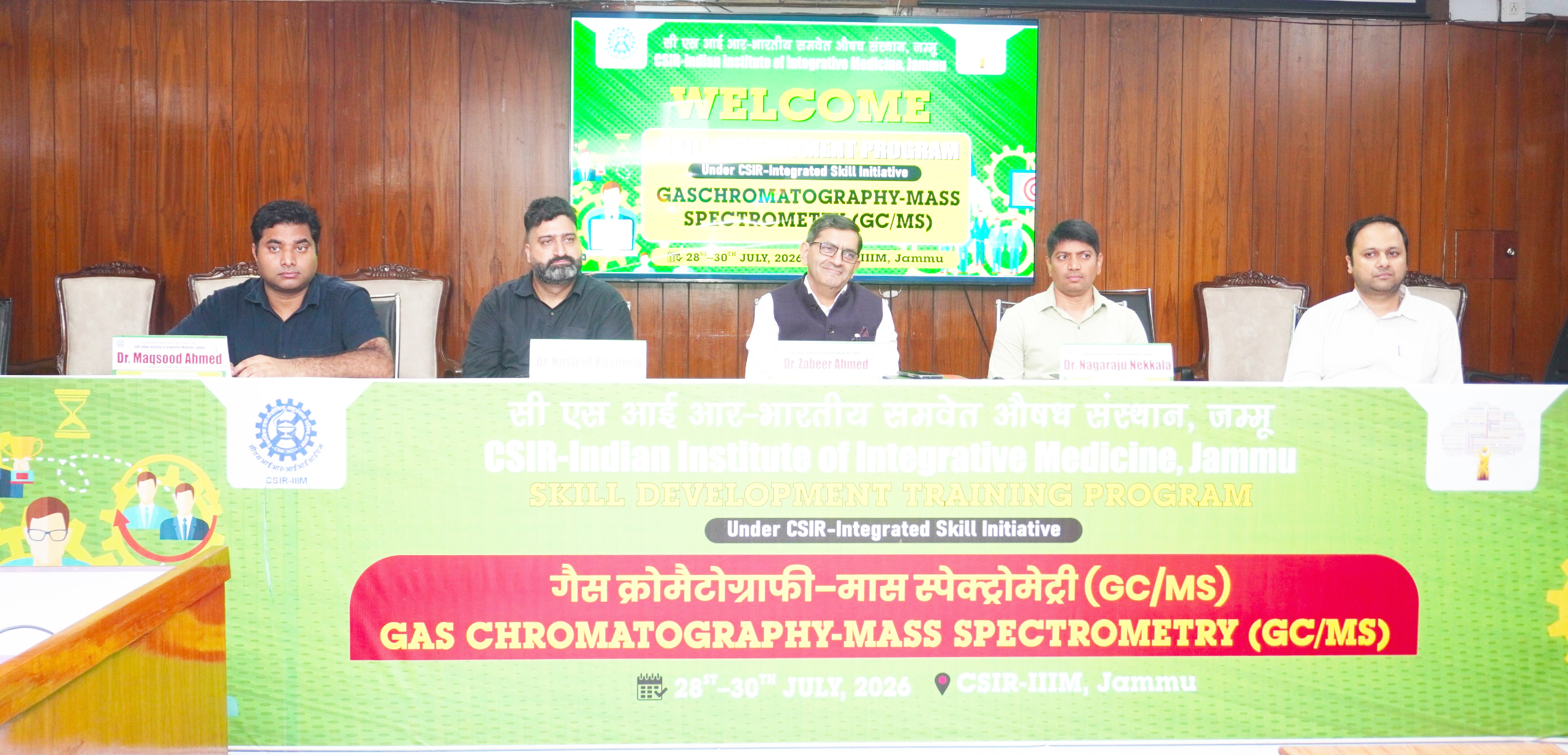
JAMMU, Jul 29: The CSIR-Indian Institute of Integrative Medicine (CSIR-IIIM), Jammu on Tuesday inaugurated a three-day Skill Development Training Programme on Gas Chromatography-Mass Spectrometry (GC-MS) under the CSIR-Integrated Skill Initiative, aimed at equipping students, research scholars and young professionals with practical expertise in one of the most advanced analytical techniques used in research and industry.
The programme, being held from July 28 to 30, has attracted participants from academic institutions, research organisations and industry across different parts of the country.
Designed as an intensive hands-on training programme, it focuses on enhancing participants’ practical knowledge of GC-MS and improving their employability in scientific and industrial sectors.
Addressing the inaugural session, Director, CSIR-IIIM Jammu, Dr. Zabeer Ahmed said the institute has evolved into a multidisciplinary scientific organisation that not only carries out cutting-edge research but also actively contributes to societal development through skill-building initiatives, entrepreneurship support and farmer-centric programmes.
He said the gathering reflected a unique blend of participants from diverse academic and professional backgrounds, creating an ideal environment for the exchange of ideas and scientific knowledge.
Emphasising the importance of skill development, Dr. Ahmed urged participants to make the best use of the institute’s advanced research facilities and interact actively with scientists during the training.
He said scientific temper and practical skills are essential for addressing future challenges and that the country’s progress depends on a generation of skilled and innovative young professionals.
He also highlighted the growing demand for such programmes and noted that many trainees from previous skill development courses have secured employment in research institutions and industries.
Earlier, Scientist Dr. Nagaraju Nekkala presented an overview of the three-day programme, outlining the academic sessions and practical training planned for participants.
He said the programme would cover the principles and instrumentation of GC-MS, laboratory orientation, method development, instrument setup, sample preparation, batch analysis, data processing, interpretation of analytical results and demonstrations on the analysis of essential oils and pesticide residues.
The training has been designed to provide participants with comprehensive practical exposure to modern chromatographic techniques widely used in pharmaceuticals, food testing, environmental monitoring and research laboratories.
Delivering the welcome address, Principal Scientist and Programme Coordinator Dr. Nasir-ul-Rasheed said CSIR-IIIM has significantly expanded its skill development initiatives in recent years by introducing both short-term and long-term industry-oriented training programmes.
He said the institute has shifted its focus beyond conventional academic training to programmes that equip graduates and postgraduates with specialised technical skills demanded by industries.
Such initiatives, he added, are helping bridge the gap between academic education and employment opportunities while supporting the national mission of creating a skilled workforce.
The inaugural session concluded with a vote of thanks, during which appreciation was expressed to the institute’s leadership, organising team, scientific and technical staff, and all participants for contributing to the successful launch of the programme.
Participants were encouraged to actively engage in the training and make optimum use of the learning opportunities available during the three-day course.
Following the inaugural session, the first day featured a technical lecture introducing the principles, instrumentation and applications of Gas Chromatography-Mass Spectrometry, followed by laboratory orientation that familiarised participants with the analytical facilities and instrument components.
In the afternoon, trainees participated in hands-on practical sessions on GC-MS analysis of essential oils, gaining first-hand experience in sample handling and instrument operation.
The programme will continue over the next two days with advanced practical modules covering sample preparation, method development, analytical data processing and interpretation, providing participants with comprehensive exposure to modern analytical techniques.