
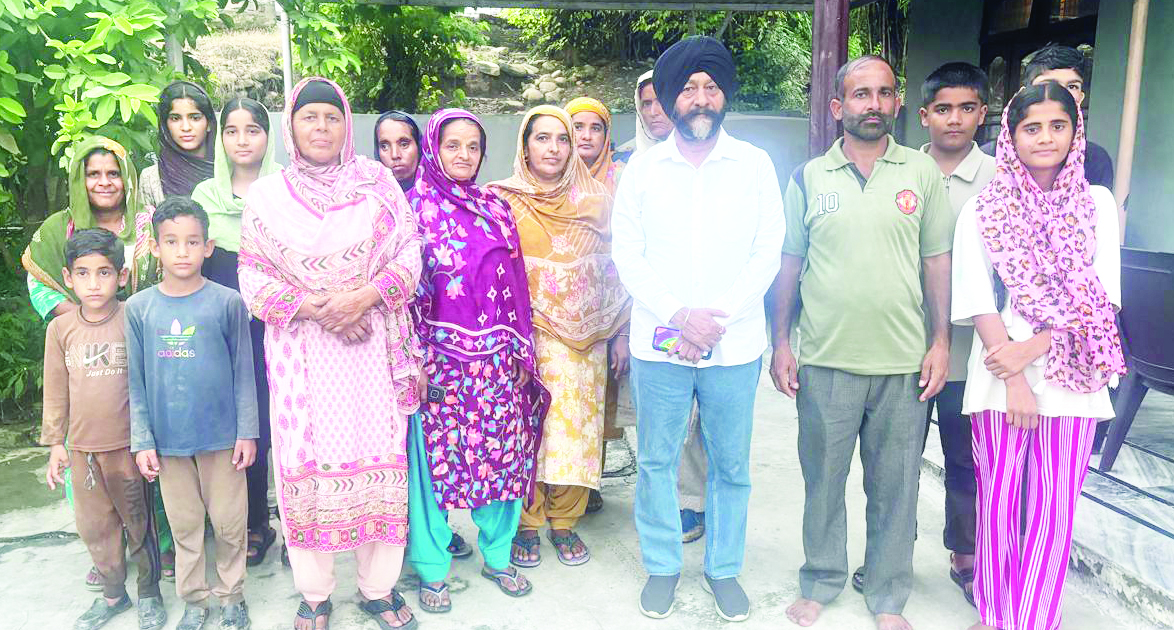
SAMBA, Sep 18: J&K Apni Party Provincial President S. Manjit Singh today visited the Scheduled Tribe habitation of Marhi Khui in Anandpur Panchayat of Purmandal Block, Samba district, and expressed serious concern over the lack of basic civic amenities and infrastructure in the area.
During his visit, Manjit Singh interacted with local residents and heard their grievances regarding drinking water, electricity supply, road connectivity, mobile communication and access to essential public services. He said the situation in the area highlighted the need for focused attention towards remote tribal habitations, where geographical challenges often compound deficiencies in basic infrastructure.
Manjit Singh said that ST families living in such areas should not be compelled to struggle for facilities that are fundamental to a dignified life. He stressed that the success of development should ultimately be judged by the difference it makes to ordinary people, particularly those living in remote and underserved habitations.
Taking a sharp dig at the government’s claims of doing “a lot” for the Scheduled Tribe community, Manjit Singh said that the situation on the ground presents a starkly different picture. He said that while announcements and claims about tribal welfare and development continue to be made, the condition of habitations such as Marhi Khui raises serious questions about how effectively these initiatives are reaching the people for whom they are intended.
“The government may claim that a great deal is being done for the ST community, but the reality on the ground is entirely different. The reality is ugly. If an ST habitation still struggles for a concrete road, reliable drinking water, uninterrupted electricity and basic connectivity decades after Independence, then the government must answer why these fundamental facilities have not reached the people,” Singh said.
Singh said development cannot be established through statements, figures and announcements alone, but must be visible in the daily lives of tribal families. According to him, the difficulties faced by residents of Marhi Khui demonstrate the need to bridge the gap between government claims and ground-level implementation.
Singh said the government should undertake a transparent assessment of basic infrastructure in tribal habitations and ensure that sanctioned schemes and welfare programmes translate into tangible benefits for the people.“The ST community does not need assurances alone; it needs roads, water, power, education, healthcare and connectivity. These are basic rights of citizens, not political favours,” he said.
Singh said it was a matter of concern that even after decades of Independence, the people of Marhi Khui are still waiting for proper concrete road connectivity. According to residents, the problem becomes particularly acute during the rainy season, when movement is severely affected and the habitation can remain virtually cut off from the surrounding areas for days.He said the consequences are felt by every section of society, but school-going children are among those who face particular hardship. Heavy rains and poor road conditions can disrupt their daily movement and make it difficult for them to attend school regularly.
“It is unfortunate that even today, children and families living in an ST habitation have to face isolation whenever heavy rains occur. A concrete, all-weather road is not a luxury; it is a basic necessity. It determines whether children can reach school, patients can reach hospitals, farmers can access markets and families can remain connected with the rest of society,” Manjit Singh said.He urged the administration to treat road connectivity to the habitation as a priority infrastructure requirement and take necessary steps towards establishing reliable all-weather connectivity.
Manjit Singh said his visit was aimed at understanding the problems of people at the grassroots and ensuring that their concerns receive appropriate attention from the administration.He reiterated that the Apni Party would continue to raise issues affecting ordinary people and seek accountability on matters directly connected with their everyday lives, particularly where deficiencies in basic infrastructure continue to affect education, healthcare, livelihoods and social connectivity.