
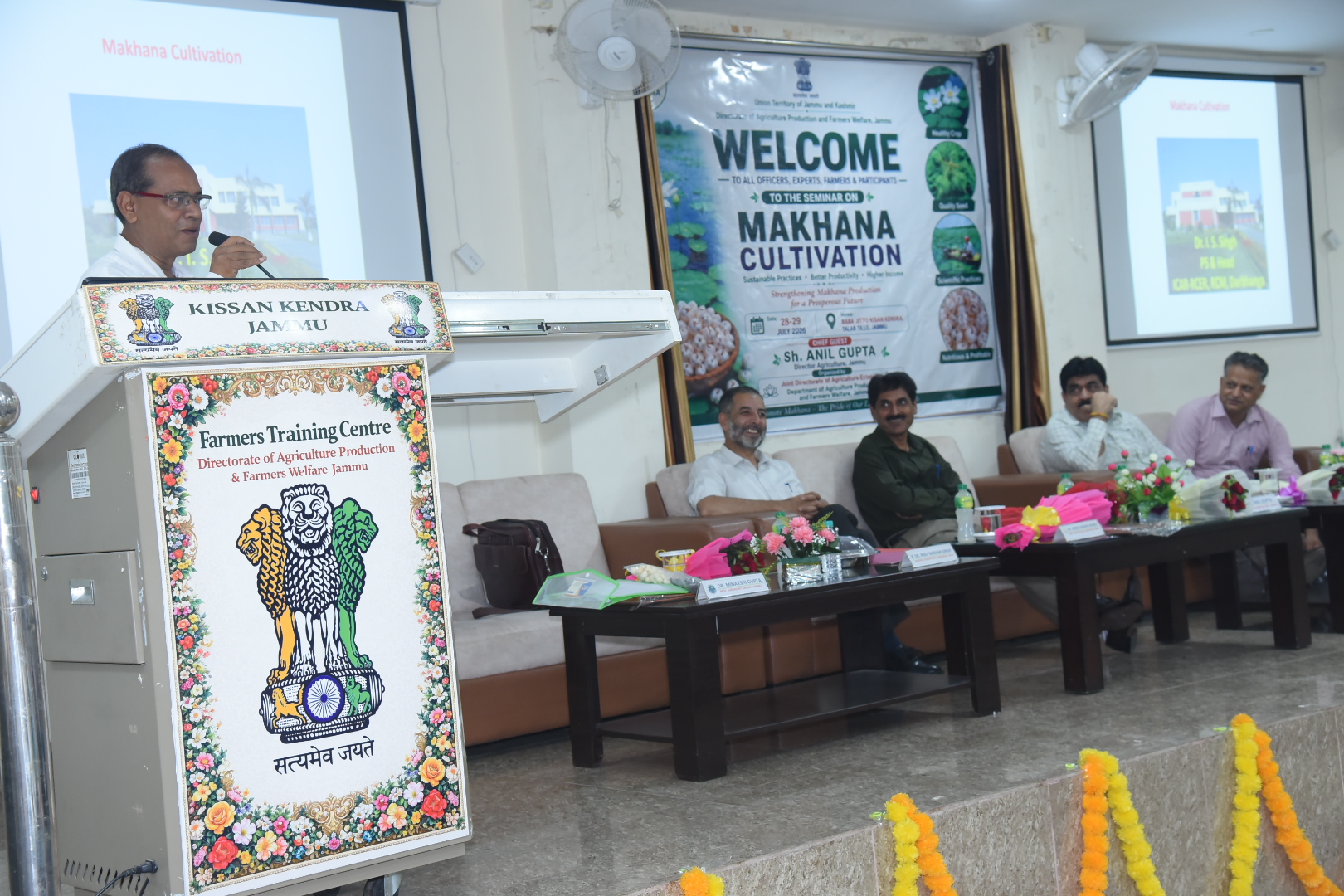
JAMMU, Jul 28: The Directorate of Agriculture Production and Farmers Welfare, Jammu, under the guidance of Director Agriculture Jammu and Nodal Officer for Makhana Cultivation in Jammu and Kashmir, Anil Gupta, on Tuesday organised a two-day seminar on Makhana Cultivation at Baba Jitto Kissan Kendra, Talab Tillo, Jammu.
The seminar was organised with the objective of promoting Makhana as a high-value crop and creating awareness among officers, experts and farmers regarding its scientific cultivation, production technologies, value addition and income-generation potential.
The inaugural session was attended by Joint Director Agriculture (Inputs), Sanjay Anand; Joint Director Agriculture (SLUB/Farms), Aman Jyoti Sharma; Joint Director Agriculture (Extension), Idrees Bashir Ahmed; Chief Agriculture Officer, Jammu, Manohar Lal Sharma; Agriculture Economist, Tilak Raj Sharma; Deputy Directors; Sectoral Heads; Regional-Level Subject Matter Specialists; Subject Matter Specialists at district and sub-divisional levels; Agricultural Extension Officers (AEOs); Junior Agricultural Extension Officers (JAEOs); Agricultural Extension Assistants (AEAs); agripreneurs; progressive farmers; and scientists and faculty members from SKUAST-Jammu.
Dr. Indu Shekhar Singh, Principal Scientist and Head, ICAR–Research Centre for Makhana (RCM), Darbhanga, Bihar, was the key resource person, while the proceedings of the programme were conducted by Rajeev Katoch, SMS-DL.
Delivering the welcome address, Joint Director Agriculture (Extension), Idrees Bashir Ahmed, welcomed the distinguished resource persons, officers, scientists and farmers and highlighted the Department’s efforts towards promoting crop diversification and introducing high-value crops such as Makhana in suitable agro-climatic regions of Jammu and Kashmir.
He expressed confidence that the seminar would provide participants with valuable technical knowledge and practical insights for the successful promotion of Makhana cultivation.
He also urged the participating officers to effectively utilise the knowledge gained during the seminar for developing successful Makhana production clusters and creating sustainable livelihood opportunities for farmers.
The keynote technical session was delivered by Dr. Indu Shekhar Singh, Principal Scientist and Head, ICAR–Research Centre for Makhana (RCM), Darbhanga, Bihar, who served as the main resource person for the seminar.
He delivered an extensive presentation on the scientific cultivation of Makhana, covering its agro-climatic requirements, soil suitability, water management, temperature, rainfall, relative humidity, crop establishment, nutrient management, harvesting and post-harvest handling.
He informed the participants that about 85 per cent of India’s Makhana cultivation is presently concentrated in Bihar, while Jammu Division possesses favourable agro-climatic conditions for expanding its cultivation in suitable pockets.
Highlighting the economic potential of the crop, Dr. I.S Singh stated that India’s Makhana industry is currently valued at around Rs 3,000 crore, while the global Makhana market is estimated at nearly USD 138 million, indicating significant opportunities for production, value addition and exports.
He also interacted extensively with farmers and departmental officers during an interactive question-and-answer session, addressing their queries on cultivation techniques, economics and marketing of the crop.
The seminar, being organised on July 28–29, 2026, comprises a series of technical sessions focusing on sustainable cultivation practices, quality seed production, scientific crop management, value addition, processing and marketing strategies to enable farmers to diversify towards profitable and climate-resilient farming systems.
The seminar is expected to equip officers, extension functionaries and progressive farmers with the necessary technical expertise for the successful promotion and adoption of Makhana cultivation, thereby contributing to sustainable agricultural development, crop diversification and enhanced farm incomes in Jammu and Kashmir.