
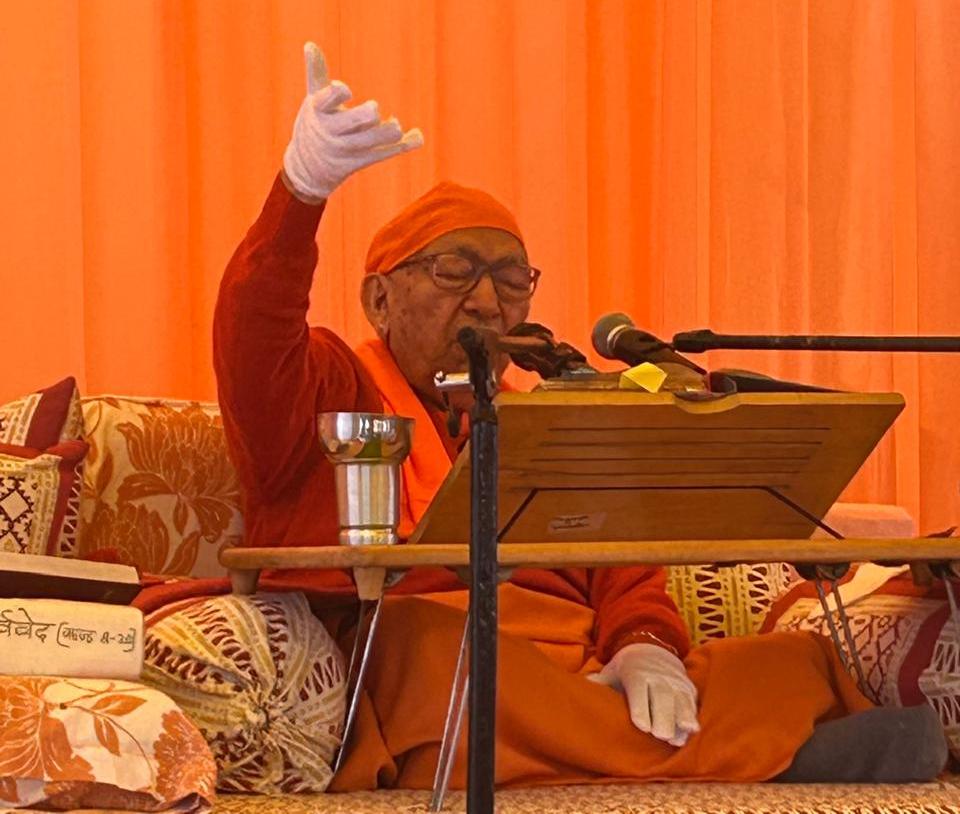
KATHUA, May 12 : On the 31st day of the ongoing 78-day Vedic Yajna dedicated to the study of all four Vedas at Veda Mandir, Yol (Himachal Pradesh), Yogacharya Swami Ram Swaroop addressed devotees and delivered a detailed discourse on the eternal relevance of Vedic knowledge in understanding creation, governance, and human life.
He explained that in the present era, different countries possess their own distinct histories, constitutions, and cultural identities. However, he emphasised that according to Vedic philosophy, after the dissolution (pralaya) period, when the Supreme Being recreates the universe through primordial nature as described in Rigveda Mandal 10, Sukta 129, there exists only one universal ruler of the entire Earth. Therefore, he said, the true understanding of creation, ancient culture, and universal governance can only be derived from the knowledge contained in the Vedas.
Swami Ram Swaroop further stated that the Vedas, originating from the infinite knowledge of God as referenced in Rigveda Mantra 10/181/1–2, are the only authentic source of wisdom capable of explaining cosmic creation and universal laws. He asserted that no human being, other than the Supreme Being, possesses the capacity to provide such profound knowledge of the universe. He added that this is why the study of all four Vedas remains essential for understanding the true nature of existence.
Expressing concern over contemporary spiritual practices, he said that in the present age, people have largely moved away from the ancient Guru–Shishya tradition established since the time of Brahma for Vedic learning. Instead, individuals have created their own independent paths of worship, leading to fragmentation of spiritual understanding. Citing Goswami Tulsidas from Ramcharitmanas (Uttarkand, Doha 100), he remarked that people, under the influence of illusion, abandon the true Vedic path and instead create multiple belief systems.
He further referred to the philosophical principle of Sankhya Shastra, stating that what is proven through valid evidence cannot be rejected merely on the basis of imagination. He emphasised that the teachings of the Vedas, Yoga philosophy, Upanishads, Bhagavad Gita, and Valmiki Ramayana collectively establish eternal truth, as also practiced by ancient sages, Lord Rama, and Lord Krishna. According to him, any attempt to oppose Vedic knowledge without scriptural evidence is merely imaginative and lacks logical or spiritual foundation.