
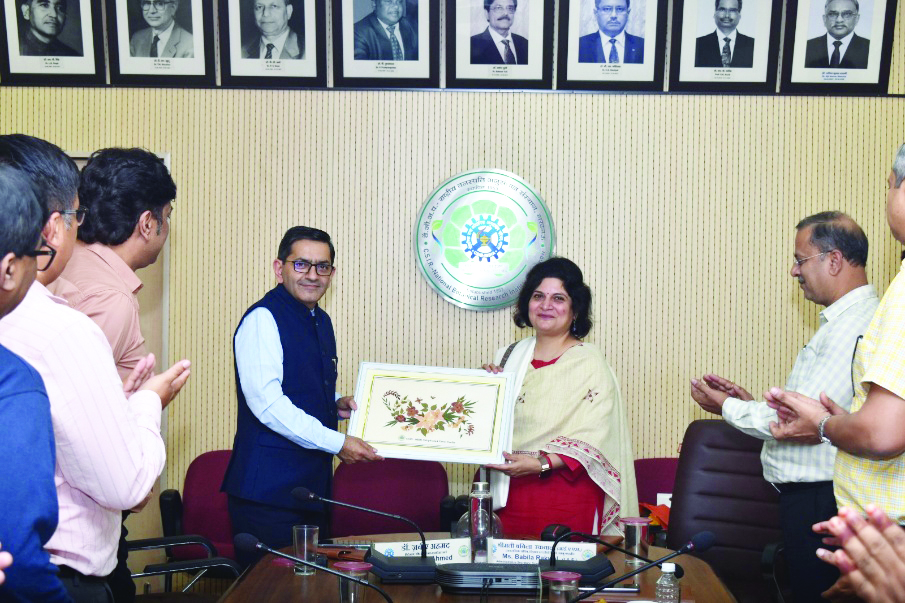
JAMMU / LUCKNOW, Nov 20: The CSIR-National Botanical Research Institute (CSIR-NBRI), Lucknow, has proposed the establishment of a State Floriculture Mission for Jammu and Kashmir while exploring a comprehensive research and development collaboration with the J&K Government to promote floriculture, medicinal plants, biodiversity conservation and sustainable livelihood opportunities for tribal communities.
The proposal emerged during an interaction meeting between Ms. Babila Rakwal, IAS, Administrative Secretary, Science and Technology Department, Government of Jammu and Kashmir, and Dr. Zabeer Ahmed, Director, CSIR-NBRI, held at Lucknow on November 19, 2026.
The discussions focused on utilising the scientific expertise of CSIR-NBRI and CSIR-Indian Institute of Integrative Medicine (CSIR-IIIM), Jammu, to develop region-specific programmes benefiting farmers, tribal communities, rural entrepreneurs and other stakeholders.
During the interaction, scientists from CSIR-NBRI presented the institute’s research activities, particularly the Ministry of Tribal Affairs-supported project titled Integrated Conservation, Agro-Technology and Bioresource Enterprise Development for Sustainable Tribal Livelihoods in Tribal Hotspots of India, along with the CSIR Floriculture Mission.
Recognising Jammu and Kashmir’s diverse agro-climatic conditions and commercial floriculture potential, the institute proposed a dedicated State Floriculture Mission to promote high-value flower crops, quality planting material, improved cultivation techniques and scientific post-harvest management. The initiative would also encourage floriculture clusters, community nurseries, value addition, floral craft enterprises and market linkages, with special emphasis on women and rural youth.
A major focus was also placed on extending the Ministry of Tribal Affairs-supported project’s benefits to tribal areas of Jammu and Kashmir. The proposed interventions include conservation and scientific propagation of medicinal plants, documentation and validation of traditional knowledge possessed by tribal healers, and development of community-based bioresource enterprises. Equitable benefit-sharing and recognition of traditional knowledge holders were also emphasised.
The meeting further explored integrated research opportunities between CSIR-NBRI and CSIR-IIIM in medicinal and aromatic plants, biodiversity conservation, phytochemical investigations, natural product research, herbal formulations and phytopharmaceutical development.
Other proposed areas include technology transfer, skill development, improved propagation techniques, product standardisation, processing facilities and market-oriented value chains.
Dr. Zabeer Ahmed highlighted the potential of CSIR laboratories to address regional developmental challenges through scientific interventions. The interaction underscored the importance of connecting research with grassroots requirements to strengthen agricultural diversification, tribal empowerment and rural entrepreneurship.
The proposed collaboration aims to translate scientific expertise into sustainable economic opportunities and position Jammu and Kashmir as a significant centre for high-value floriculture and medicinal plant-based enterprises.