
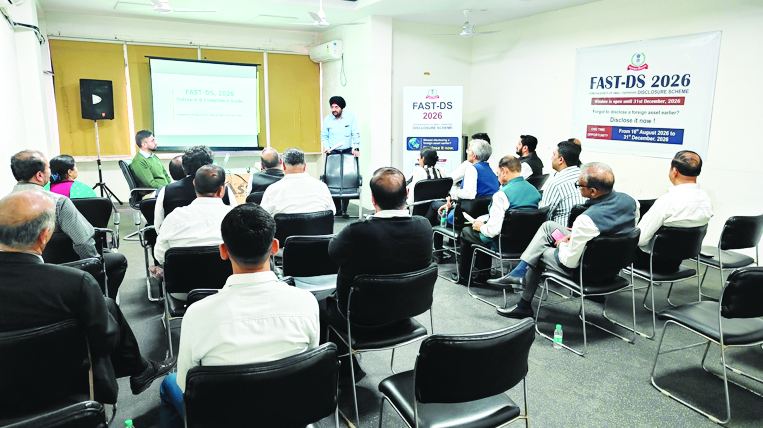
JAMMU, Nov 16: The Income Tax Department, Jammu, organised an interactive outreach-cum-discussion session on the Foreign Assets of Small Taxpayers Disclosure Scheme (FAST-DS), 2026, to create awareness among taxpayers and tax professionals about the provisions, benefits and compliance requirements of the scheme.
The session witnessed active participation from prominent tax counsels and taxpayers from across the region. It was presided over by Satbir Singh, Additional Commissioner of Income Tax, Range-1, Jammu, in the presence of Durga Koul, Income Tax Officer (ITO).
Addressing the gathering, Satbir Singh highlighted the important role played by tax professionals in strengthening coordination between the Income Tax Department and taxpayers. He urged tax counsels to proactively educate and guide their clients about the benefits, eligibility conditions and timelines of the one-time voluntary compliance window. He emphasised that greater awareness and timely compliance would help eligible taxpayers regularise their foreign asset disclosures in accordance with the provisions of the scheme.
During the session, Anjesh Bharatiya, ITO, delivered a detailed PowerPoint presentation explaining the legal framework, eligibility criteria, monetary thresholds, tax structure and online filing procedure under FAST-DS, 2026.
He informed participants that the scheme had been introduced under Chapter IV, Sections 130 to 144 of the Finance Act, 2026, providing a one-time opportunity for voluntary disclosure of specified foreign assets and income, along with immunity from penalty and prosecution under the Black Money (Undisclosed Foreign Income and Assets) and Imposition of Tax Act, 2015, subject to the prescribed conditions.
Explaining the compliance timeline, he stated that declarations under the scheme could be submitted from August 16 to December 31, 2026. The Fair Market Value (FMV) of eligible foreign assets would be calculated as on March 31, 2026.
The presentation also explained the eligibility provisions covering resident taxpayers who had failed to disclose foreign income or assets in their income tax returns. The scheme also extends to Non-Resident Indians (NRIs) and Residents but Not Ordinarily Resident (RNORs) in specified circumstances, where they were residents of India during the financial year in which the foreign asset was acquired or undisclosed income accrued.
Elaborating on the two categories, Bharatiya explained that Category I covers undisclosed foreign assets or foreign-source income having an aggregate value of up to ₹1 crore, where the declarant is required to pay 30 per cent tax along with an additional levy of 30 per cent, taking the total liability to 60 per cent of the asset value or income.
Under Category II, foreign assets worth up to ₹5 crore, acquired through already-taxed Indian income or income earned abroad during NRI status, where the only default was non-disclosure in Schedule FA of the income tax return, can be regularised by paying a flat fee of ₹1 lakh.
He further explained the digital compliance procedure, under which declarations are submitted online through Form 1 on the Income Tax e-filing portal. The designated authority determines the payable amount through Form 2, followed by payment through Challan ITNS 289. Taxpayers are then required to submit online intimation through Form 3, after which the final completion certificate is issued in Form 4.
The session also highlighted exclusions, including assets or income representing proceeds of crime under the Prevention of Money-Laundering Act, 2002, and cases where assessment proceedings have already been completed under the Black Money Act, 2015.
The presentation was followed by an interactive question-and-answer session, during which departmental officers addressed queries raised by tax practitioners and taxpayers regarding asset valuation, documentation requirements, eligibility and online filing procedures.
The outreach initiative aimed at strengthening taxpayer awareness, encouraging voluntary compliance and facilitating a better understanding of FAST-DS, 2026, among eligible taxpayers.