
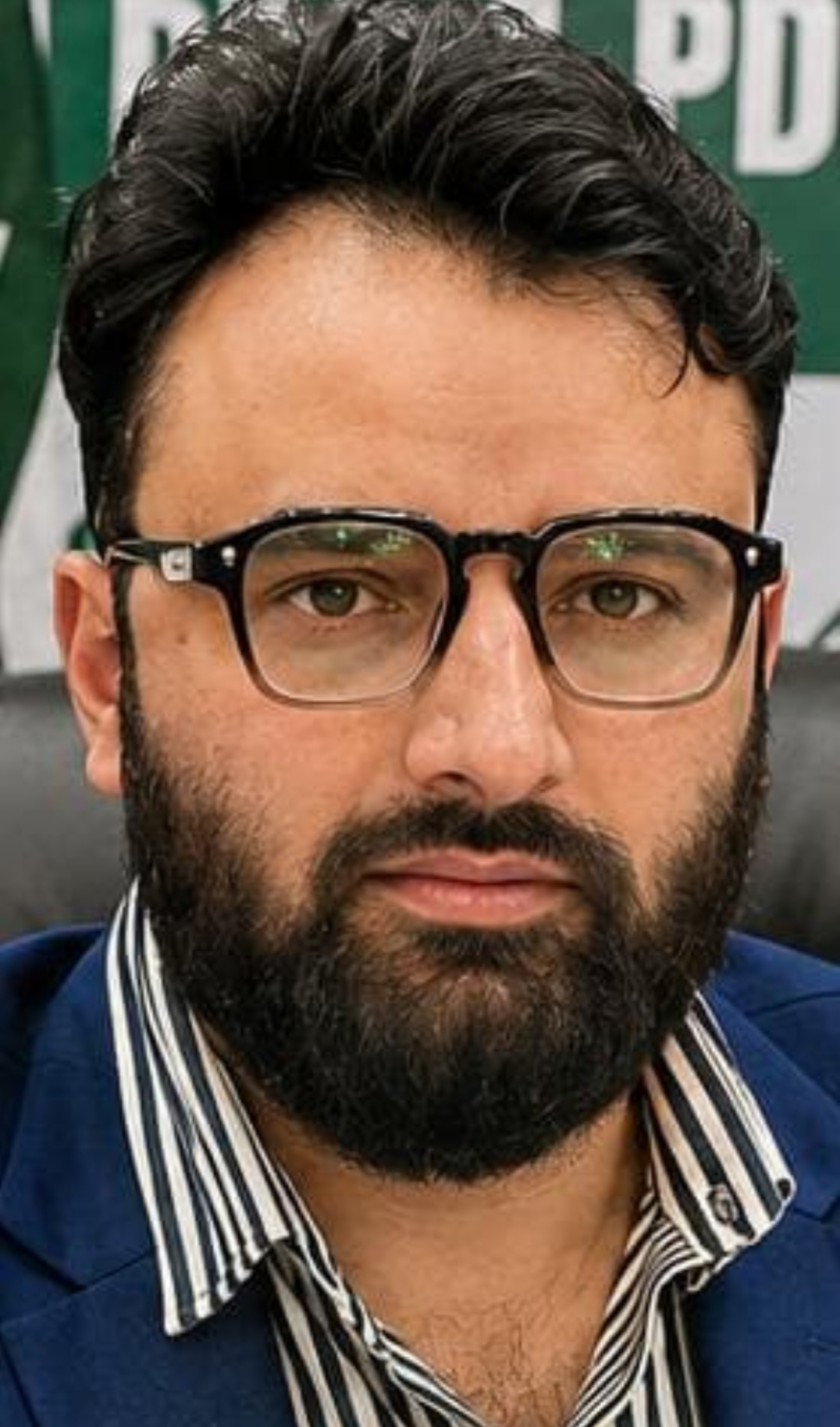
JAMMU, Nov 14: Jammu and Kashmir Peoples Democratic Party (PDP) State Secretary (Youth) and In-Charge Chenab Valley, Mohsin Khan, has demanded equal legal protection and recognition of genuine historical land rights for citizens across Jammu and Kashmir, calling for a comprehensive review of land-related laws, government orders and revenue records.
Khan urged the Jammu and Kashmir Government to ensure that eligible beneficiaries in Jammu, Kashmir, Chenab Valley, Pir Panjal and other regions receive equal consideration under the same legal provisions, irrespective of their geographical location, economic condition or political influence.
He said equality before the law must be reflected in the actual implementation of land and revenue laws rather than remaining confined to official statements. Referring to Government Order No. LB-6/C of 1958, S-432 of 1966, the Agrarian Reforms Act, 1976, and historical provisions relating to Shamilat-Deh and Hak Shamilat, he called for a detailed examination of their implementation and the present status of eligible beneficiaries.
Khan maintained that historical land matters should not be decided by treating every occupant as an encroacher without examining the complete legal and revenue-record background. He stressed the need to distinguish between ordinary occupation, lawful possession, recognised tenancy, community ownership and legally established proprietary rights.
Raising concerns over regional disparities, he sought a transparent comparative assessment of land-rights cases in Jammu, Srinagar, Ramban, Banihal, Doda, Kishtwar, Rajouri, Poonch and other districts. He questioned why similarly situated beneficiaries should receive different treatment under the same legal framework.
Referring specifically to LB-6 and S-432, Khan demanded a district-wise assessment of registered cases, recognised tenants-at-will, beneficiaries granted proprietary rights, pending applications, rejected claims and the legal status of heirs of deceased beneficiaries.
He also called for a comprehensive examination of Shamilat-Deh classifications, particularly Dafa 4 and Dafa 5, and rights associated with Hak Shamilat. He said historical settlement records, village documents, ownership shares and relevant revenue entries must be examined before determining the claims of individuals and village communities.
Emphasising the concerns of economically weaker families, Khan said land was not merely an economic asset but was closely connected with livelihood, agriculture, shelter and social security. He clarified that his demand was not for blanket ownership rights over government or forest land, but for the lawful recognition of genuine claims under applicable legislation and valid judicial decisions.
He also acknowledged that the Roshni Act, having been declared unconstitutional by the High Court, could not serve as a continuing legal basis for ownership claims.
Khan urged the Lieutenant Governor’s Administration and the J&K Government to constitute a high-level committee comprising senior Revenue Department officials and legal experts to review historical land-rights cases across the Union Territory.
Among the measures proposed were district-wise inventories of LB-6 and S-432 cases, digitisation and preservation of historical revenue records, time-bound disposal of pending applications, legal assistance for economically weaker families and clear guidelines for examining the claims of legal heirs.
“Our demand is justice, not favour. No poor family should be deprived of a genuine legal right simply because it lives in a remote village or lacks political influence. If historical laws and government orders created rights for eligible people, the same legal principles must be examined and applied fairly wherever similar circumstances exist,” Khan said.
He reiterated that the PDP would continue to raise issues concerning ordinary citizens, particularly poor agricultural families, landless households and residents of remote areas, while seeking accountability, transparency and equal treatment in matters relating to their lawful rights.
He maintained that justice in historical land matters must be determined by law and documentary evidence, not by region, influence or political considerations.