
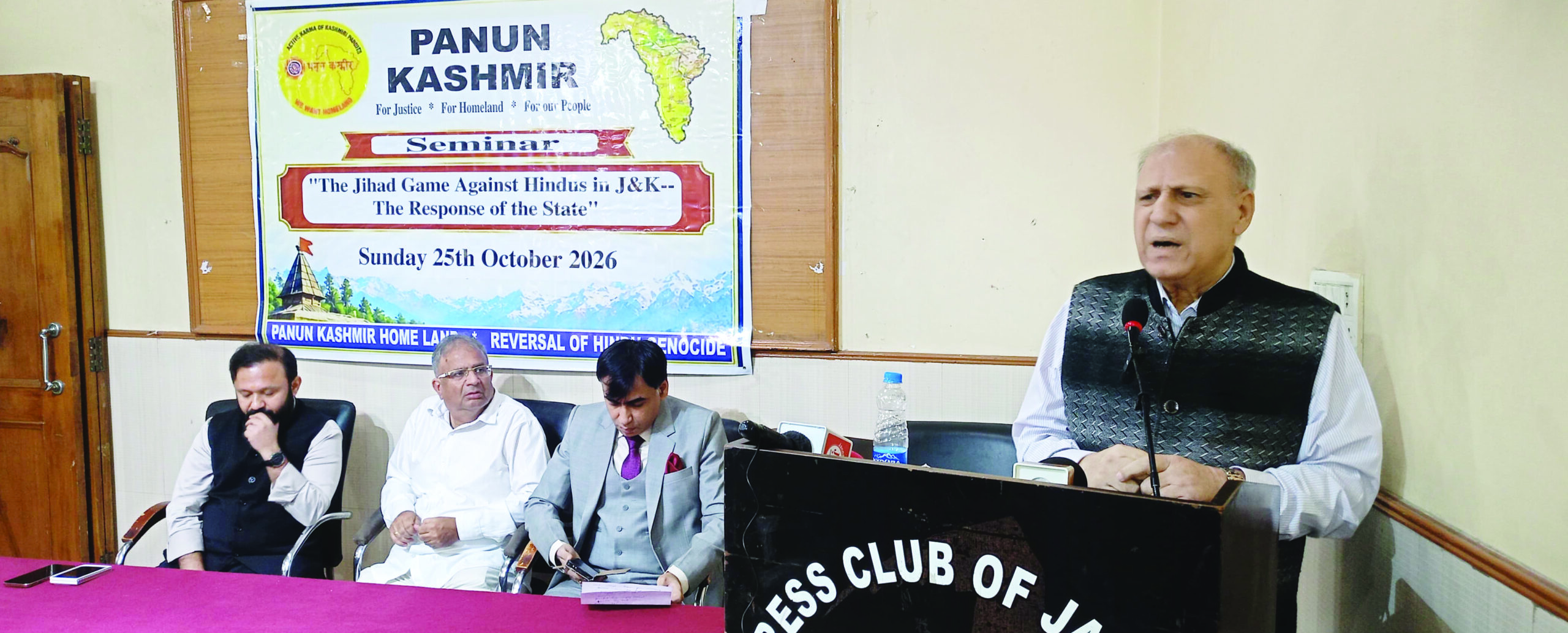
Speakers call for comprehensive strategy to address radicalization, emerging security threats
JAMMU, Oct 25: Panun Kashmir organised a seminar titled “The Jihad Game Against Hindus in J&K – The Responses of the State” at the Press Club Jammu on Sunday, bringing together speakers to discuss terrorism, radicalisation and security challenges in Jammu and Kashmir.
Dr Abhinav Pandya, a scholar of terrorism and counterterrorism in Jammu and Kashmir, was the guest of honour and the main speaker. He has written extensively on terrorism and regional security, including The Jihad Game: Inside Pakistan’s Dark Game, Inside the Terrifying World of Jaish-e-Mohammed and Radicalization in India.
In his keynote address, Dr Pandya expressed concern over what he described as the growing radicalisation of sections of society and the continuing threat posed by terrorist networks. He argued that the situation required a practical and clearly defined government strategy to prevent recruitment, counter extremist ideologies and address the evolving nature of terrorism.
Dr Pandya also warned that jihadist extremism in Jammu and Kashmir had reached what he termed a critical stage of “enrichment,” which he described as a phase in which the threat could become self-sustaining or operate with limited external direction. He called for sustained efforts to counter radicalisation and prevent the emergence of new forms of terrorist activity.
Another speaker, advocate Ankur Sharma, a BJP spokesperson and commentator on internal security and politics in Jammu and Kashmir, drew attention to what he described as the expansion of terrorist activities into the Jammu region. Referring to encounters involving terrorists, he said the security situation required continued attention and a comprehensive response.
Sharma also raised concerns about demographic changes and narcotics-related activities, arguing that security challenges in the Union Territory extended beyond conventional terrorism. His remarks highlighted the need to examine the various factors that speakers believed could contribute to instability in the region.
Dr Ajay Chrungoo, chairman of Panun Kashmir and a commentator on politics and internal security, delivered the concluding presentation. He said terrorist violence had targeted both civilians and security personnel and called for a broader assessment of the factors contributing to militancy.
Chrungoo criticised what he described as misconceptions about normalcy, the sources and ideological dimensions of terrorism, and the belief that tourism alone could demonstrate the defeat of militancy. He also alleged that the genocidal campaign against Kashmiri Hindus and the denial of that history remained unresolved issues requiring serious policy attention.
Calling for a comprehensive response, Chrungoo argued that the Government of India should explicitly address the objectives of jihadist terrorism and place the reversal of the displacement and suffering of Kashmiri Hindus at the centre of its policy. He advocated further reorganisation of Jammu and Kashmir, including separating Jammu from Kashmir and dividing the Kashmir Valley to create a Union Territory for the rehabilitation of internally displaced Kashmiri Hindus.
The seminar featured discussions on security policy, radicalisation, the protection of civilians and the rehabilitation of displaced Kashmiri Hindus. The speakers presented their respective assessments and proposals for addressing the region’s continuing security challenges.
Daya Krishen Koul conducted the proceedings of the seminar.