
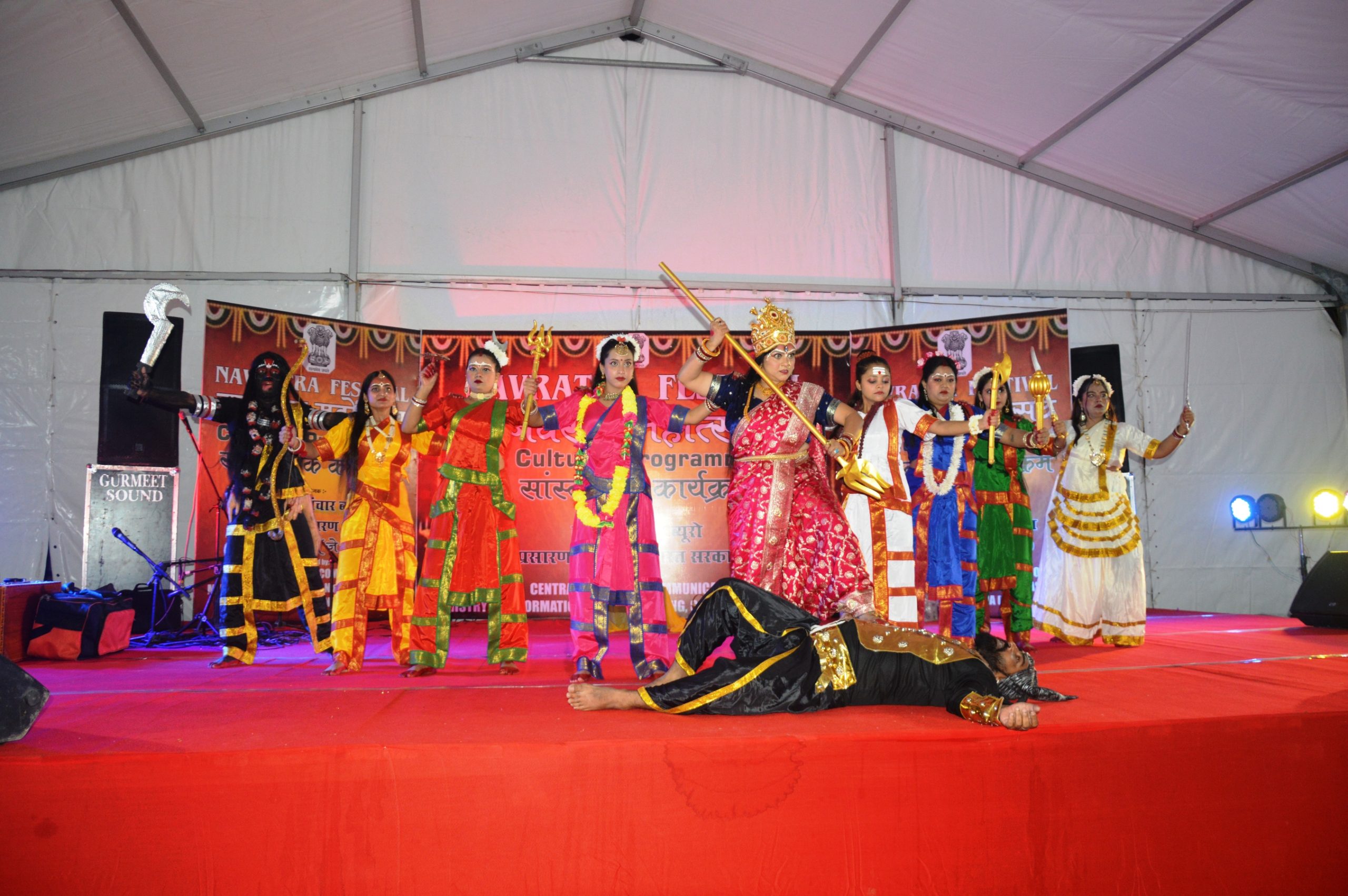
KATRA, Oct 20: Bhartiya Lok Sangeet Kala Sansthan (BLSKS) presented glimpses of its mega cultural programme, ‘Maa Vaishno Devi’, on the concluding day of the Navratra Festival at Government Higher Secondary School, Katra, on October 19, promoting the traditional Duggar culture and rich cultural heritage of Jammu and Kashmir.
The programme was organised by the Central Bureau of Communication (CBC), Ministry of Information and Broadcasting, Government of India, and featured colourful cultural performances, traditional folk songs and presentations based on Hindu mythology.
Jugal Kishore Sharma, Member of Parliament from the Jammu Parliamentary Constituency, attended the closing ceremony as the Chief Guest. Several dignitaries and CBC officials, including Vijay Matto, Neeraj Verma, Durga Parkash and Ram Lal, were also present. Sunita Atri, an official of CBC, conducted the programme.
The cultural presentation commenced with the special attraction, ‘Mahishasur Vadh’, depicting the victory of Goddess Durga over the demon Mahishasura. The programme featured traditional folk songs, including ‘Jhula Satrangia’, ‘Paranda La Ladiye’, ‘Surma Nima Nima’, ‘Jana Jammu Bazar’ and ‘Jagrana’.
The performances were presented by artistes and cultural troupes associated with the Ministry of Information and Broadcasting, including Sudesh Kumari and Party, Nagani Cultural Troupe, J&K Bhoomi Welfare Society and Chinar Art Foundation, Jammu. Artistes dressed in colourful traditional costumes also participated in the Shobha Yatra, adding vibrancy to the festival celebrations.
All programmes were conducted under the overall direction of Neha Jalali, Director of the Central Bureau of Communication and Press Information Bureau, Ministry of Information and Broadcasting.
Addressing the gathering, Chief Guest Jugal Kishore Sharma highlighted the religious and cultural significance of the Navratra Mahotsav and its association with the spiritual values of Sanatan Dharma. He also called upon people to work collectively towards making Jammu and Kashmir and the entire country Nasha Mukt (free from drugs).
The cultural programme was also recorded and uploaded online to enable the wider public to watch the performances and benefit from the cultural presentations.
Dr. M.L. Dogra, former Regional Director of the Song and Drama Division, Ministry of Information and Broadcasting, Government of India, and Chairman of BLSKS, briefed the gathering about the history of the Navratra Festival. He explained that the festival was conceived and organised in 1990 by the erstwhile media units, including the Directorate of Field Publicity and the Song and Drama Division of the Ministry of Information and Broadcasting, in coordination with the local administration of Katra and the Shri Mata Vaishno Devi Shrine Board.
Dr. Dogra highlighted the spiritual importance of Shri Mata Vaishno Devi, who is revered as an incarnation of the three supreme energies: Maha Kali, representing dissolution; Maha Lakshmi, representing maintenance; and Maha Saraswati, representing creation.
The nine-day festival concluded with a laser show depicting the multifaceted forms and personalities of Goddess Durga and conveying the message of eliminating social evils and negative energies from society.
The programme highlighted the role of folk music, traditional dance and cultural performances in preserving the Duggar heritage of Jammu and Kashmir while promoting spiritual awareness, social harmony and the region’s rich artistic traditions.