
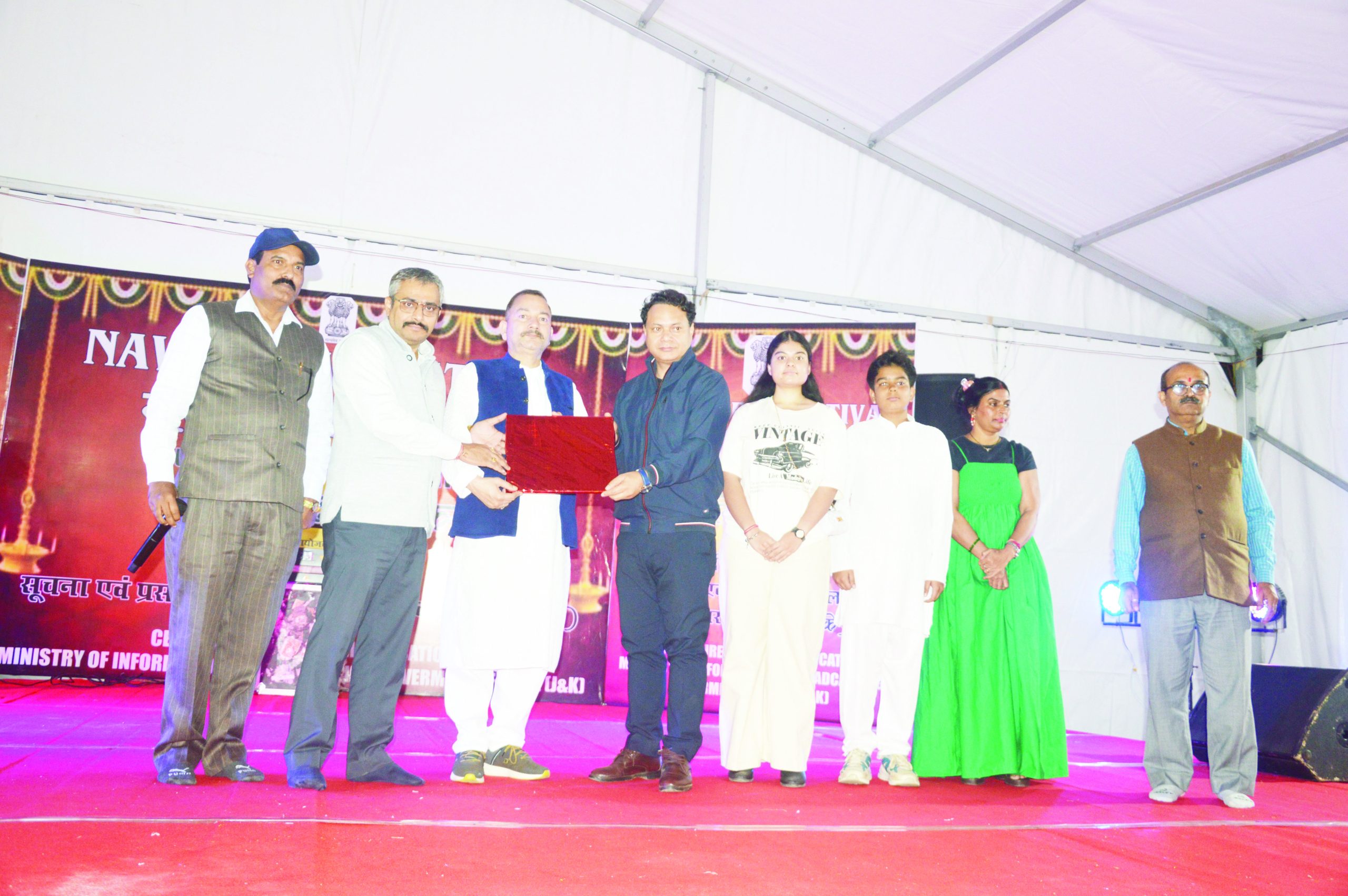
JAMMU, Oct 19: The Bhartiya Lok Sangeet Kala Sansthan (BLSKS), Jammu, organised a mega cultural programme at Government Higher Secondary School, Katra, on October 18 as part of the nine-day Navratra Festival 2026, showcasing the rich traditional Dogra culture of Jammu and Kashmir. The organisation also participated in the colourful Shobha Yatra in coordination with the Central Bureau of Communication (CBC), Ministry of Information and Broadcasting.
Devyani Rana, MLA from Nagrota constituency, was the chief guest at the Shobha Yatra and inaugurated the procession from Asia Chowk, Katra, which culminated at Fountain Chowk. Dr. Rakesh Kumar, Associate Professor and Head of School at Shri Mata Vaishno Devi University, was the chief guest at the cultural programme. Several dignitaries and CBC officials, including Vijay Matto, FPA-Nodal Officer, Neeraj Verma, Durga Parkash, Virender Kapadia, Sunita Atri and Sunil Sharma, were also present. The programme was conducted by Ram Lal, an official of CBC.
The cultural programme commenced with Mata Parvati Vandana following the lighting of the traditional lamp. Artists of BLSKS presented vibrant folk dances, including “Oh Jija Kiya Jana Udhampura” and “Gaburu Punjab Da Chalda Nishani”, highlighting the diversity and richness of regional folk traditions. The performances celebrated Dogra heritage and traditional music while providing pilgrims and visitors with an opportunity to experience the region’s cultural identity.
The programmes were organised under the direction of Neha Jalali, Director, Central Bureau of Communication and Press Information Bureau, Ministry of Information and Broadcasting. The chief guests appreciated the efforts of the organisers in promoting traditional folk music and dance and preserving Jammu and Kashmir’s cultural heritage. They observed that religious and cultural events play an important role in strengthening social harmony, bringing people together and passing traditional values on to future generations. They also appreciated the faith and devotion of pilgrims visiting Shri Mata Vaishno Devi.
The evening Shobha Yatra passed through the main market of Katra, attracting devotees and visitors. Decorated chariots carrying the idol of Mata Vaishno Devi were among the major attractions. Traditional music, devotional hymns, spiritual recitations and colourful decorations added to the grandeur of the procession.
Dr. M. L. Dogra, Chairman of BLSKS, said the grand procession during Sharadiya Navratri featured colourful tableaux and cultural performances by school students, showcasing Shri Mata Vaishno Devi, Dogra traditions and the broader cultural heritage of India. He highlighted Katra’s importance as the base camp for pilgrims visiting the shrine and noted that the cultural and devotional programmes complemented the spiritual journey of devotees during Navratri.
Visitors also had the opportunity to explore a multimedia exhibition organised by CBC, featuring information about various government-sponsored schemes through visual displays and multimedia presentations.
Dr. Dogra recalled that the musical play “Maa Vaishno Devi”, written, produced and directed by him, was staged by BLSKS artists and the Song and Drama Division of CBC for the first time in Katra during Navratra in 1997. Since then, cultural groups and artists associated with the Ministry of Information and Broadcasting have continued to contribute to the festival’s cultural programmes. These include Sudesh Kumari and Party, Vijay Kumar and Party, Nagani Cultural Troupe, Naman Cultural Group, J&K Bhoomi Welfare Society and Chinar Art Foundation, Jammu.
The programmes were recorded and uploaded online for the benefit of the general public, allowing a wider audience to experience the cultural celebrations. The festivities concluded on Maha Ashtami with a laser show depicting Mata Vaishno Devi, bringing the cultural programme to a spectacular close.
The Navratra Festival once again highlighted Katra’s religious significance and vibrant cultural traditions, bringing together devotion, folk art and community participation in a celebration of Jammu and Kashmir’s rich heritage.