
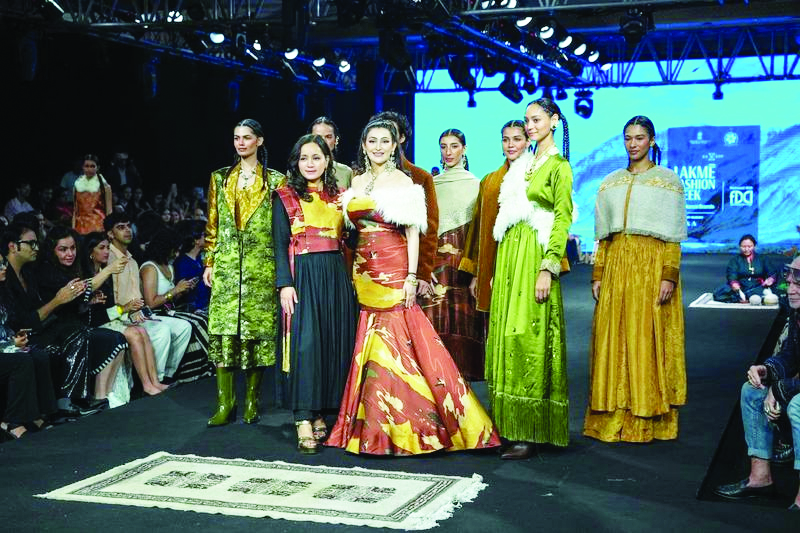
NEW DELHI, Oct 19 (Agencies): Ladakh’s rich Pashmina heritage and indigenous craftsmanship took centre stage at Lakmé Fashion Week x FDCI 2026 in New Delhi, with the showcase “The Fifth Season: A Fashion Story from Ladakh” highlighting the artistry and living traditions of Changthang’s pastoral communities and artisans.
Held at Hotel Taj Palace, New Delhi, on the concluding day of the fashion week, the showcase highlighted the journey of Pashmina from the high-altitude pastures of Changthang, nearly 14,000 feet above sea level, to contemporary fashion, celebrating the Changpa pastoralists, weavers and craftspeople who sustain the centuries-old tradition.
The showcase was enriched by a virtual address by Lieutenant Governor of Ladakh Vinai Kumar Saxena, who emphasised the importance of connecting traditional craftsmanship with contemporary design, entrepreneurship and wider markets.
Saxena highlighted the need to ensure that the benefits of growing recognition reach Pashmina herders, weavers, craftspeople, women entrepreneurs and Self-Help Groups, while preserving the authenticity of Ladakh’s indigenous traditions. He congratulated the Department of Industries and Commerce, UT Ladakh, for providing local designers and artisans with a prominent platform, expressing confidence that such initiatives would strengthen livelihoods and contribute to the region’s economic growth.
Four designers and artisanal brands-Namza by Padma Yangchan, Zilzom by Stanzin Palmo, Changra Ladakh by Deskit Angmo, and Charkha Ladakh by Rigzin Yangdol-presented their interpretations of Ladakh’s textile heritage, combining traditional techniques with contemporary aesthetics, officials said.
Namza opened the showcase with 18 ensembles featuring brocade fabrics and Pashmina, reinterpreting traditional textile elements through modern silhouettes. Zilzom presented 18 ensembles incorporating self-designed silk prints inspired by Changthang’s landscapes, alongside contemporary interpretations of ‘snambu’, a traditional Ladakhi woollen textile.
Changra Ladakh and Charkha Ladakh showcased handspun and handwoven Pashmina shawls, highlighting the quality and authenticity of the region’s indigenous craftsmanship.
The presentation featured Shalini Passi as the showstopper in a gown designed by Zilzom. The Dashugs band accompanied the showcase with a live musical performance, bringing together fashion, music and cultural storytelling.
A key feature of the presentation was the participation of Changthang artisans, placing the people behind the craft at the forefront. At the heart of Ladakh Pashmina are the Changpa pastoralists, who rear indigenous Changra goats, and the artisans and women whose specialised skills transform the fine fibre into exquisite textiles.
The initiative was conceptualised and facilitated by the Department of Industries and Commerce, UT Ladakh, under the Raising and Accelerating MSME Performance (RAMP) Scheme of the union Ministry of Micro, Small and Medium Enterprises, with support from FDCI. It aims to promote indigenous products, strengthen artisanal enterprises, and expand opportunities for entrepreneurship and market access.
The department has also been supporting the craft value chain through Common Facility Centres, skill-upgradation programmes, improved production facilities and assistance for traditional handloom enterprises, with a focus on improving product quality, encouraging innovation and creating sustainable livelihoods.
Building on the fashion showcase, the Ladakh Pashmina Conclave, scheduled for October 23-24 under the RAMP Scheme, will bring together producers, artisans, designers, entrepreneurs and buyers. More than 50 stalls and over 100 entrepreneurs and buyers are expected to participate, providing opportunities for direct business engagement and potential commercial partnerships.
While the fashion week has brought Ladakh’s craftsmanship into the national spotlight, the conclave aims to translate that visibility into market opportunities for the communities that sustain the tradition.
The initiative seeks to position Ladakh Pashmina not only as a symbol of the region’s cultural heritage but also as a driver of economic empowerment, connecting generations-old craftsmanship with contemporary design and wider markets.