
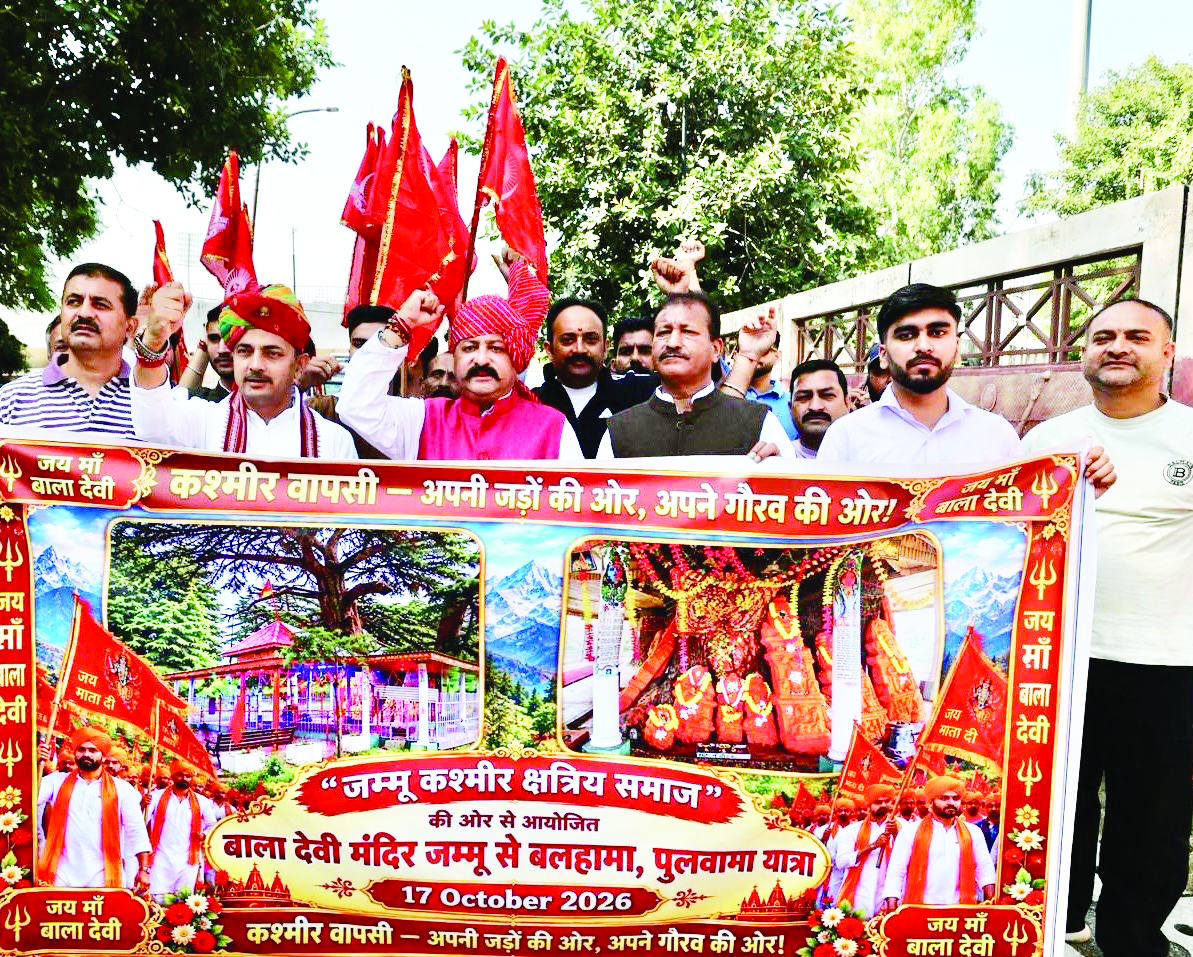
JAMMU, Oct 17: In a powerful expression of faith, cultural identity and renewed engagement with Kashmir’s ancient spiritual heritage, the First Annual Shri Bala Mata Pilgrimage from Jammu to the revered Shri Bala Devi shrine at Balhama, Srinagar, witnessed enthusiastic participation of hundreds of spirited students, members of the Kshatriya Rajput community and local residents. Organised by the Jammu and Kashmir Kshatriya Samaj under the leadership of Convenor Shri Shiv Darshan Singh Mankotia, along with Shri Samar Singh Ranyal and other community representatives, the Yatra emerged as a significant initiative to reconnect the younger generation with the region’s historical, religious and civilisational roots.
Nestled in the Balhama area of Kashmir, the Shri Bala Devi shrine occupies a special place in the religious and cultural history of Jammu and Kashmir. Revered as the Isht Devi (presiding family deity) of Kshatriya Samaj in Kashmir, the shrine is associated with a rich tradition of devotion and spiritual continuity. According to accounts of the shrine’s history, its sacred precinct is distinguished by five ancient Deodar trees, which have remained central to the veneration of devotees for generations. Historical accounts also recall the deep reverence shown by Maharaja Pratap Singh, who is said to have walked barefoot to the shrine as an expression of his devotion. Maintained by the J&K Dharmarth Trust, the shrine represents an enduring link between the Dogra legacy and Kashmir’s ancient Hindu religious traditions. Its significance extends beyond worship, embodying the continuity of faith, heritage and collective memory across generations. The shrine’s rejuvenation and preservation also resonate with the broader national endeavour to conserve and revitalise places of pilgrimage under the Government of India’s PRASHAD initiative.
The pilgrimage acquired added significance in the post-5 August 2019 landscape, with participants emphasising the importance of renewed confidence, security and the revival of religious and cultural connections with Kashmir. The gathering conveyed a strong message that the region’s historic places of worship are not merely destinations of pilgrimage, but also repositories of its civilisational memory and shared heritage.
Leading the Yatra from the front, Ranbir Singh Pathania, MLA Udhampur East, described the pilgrimage as a manifestation of faith, courage and an unwavering commitment to preserving the historical and cultural legacy of Jammu and Kashmir.
Addressing the gathering, Pathania said that the developments following 5 August 2019 had opened a new chapter in the region, with an enhanced sense of security and an opportunity for people to reconnect with their religious and cultural roots.
“The first dividend of 5 August 2019 has been the restoration of a greater sense of security and confidence. The forces of religious fanaticism and fundamentalism have been challenged, and a new atmosphere has emerged in which people are increasingly looking towards their ancient places of worship and seeking to reconnect with their spiritual heritage. This pilgrimage is a reflection of that renewed confidence and resolve,” he said.
Emphasising the historic and emotional connection of the people of Jammu with Kashmir, Pathania declared, “Today, we are going to Bala Devi; tomorrow, we will go to Sharda Peeth. The message is clear: Jis Kashmir ko khoon se sincha, woh Kashmir humara hai. Jammu and Kashmir is the product of the sacrifices, toil, labour and perseverance of our ancestors. Our connection with this land is historical, cultural and civilisational. We remain firmly committed to preserving its heritage, protecting its identity and ensuring that its history and geography are not distorted or manipulated.”
He added that the Yatra was not merely a religious journey but an assertion of the community’s determination to remain connected with its roots and pass on its heritage to future generations.
“Our resolve is sterling. We must ensure that our younger generations know their history, understand the sacrifices of their forefathers and remain connected to the sacred places that have shaped our collective identity. The journey to Bala Mata is a beginning; the larger mission is to preserve and revive our heritage with dignity, determination and pride,” he said.
Zorawar Singh Jamwal, Chairman of Team Jammu, also addressed the gathering and highlighted the deeper significance of the pilgrimage, describing it as a symbolic reaffirmation of the values and traditions associated with the Kshatriya Rajput community.
He observed that the essence of the community’s valour, sacrifice, devotion and commitment to its motherland was reflected in the spirit of the Yatra.
“The significance of this pilgrimage goes beyond the physical journey to a shrine. It embodies the values of courage, sacrifice, faith and cultural continuity that have defined the Kshatriya Rajput community through the ages. Such initiatives are vital for reconnecting our youth with their heritage and ensuring that the legacy of our ancestors continues to inspire future generations,” he said.
Moreso, traditional accounts associating Shri Shankaracharya Ji with deep spiritual contemplation at the Mandir, underscoring the place’s revered standing in the religious consciousness of the community.
The enthusiastic participation of students and young people was among the most significant features of the pilgrimage. Their presence reflected the organisers’ resolve to transform cultural remembrance into a living tradition, encouraging the younger generation to discover the sacred sites, historical personalities and civilisational landmarks associated with Jammu and Kashmir.
The organisers emphasised that the annual pilgrimage would serve as a platform for promoting religious awareness, preserving historical memory and strengthening the community’s connection with its ancestral places of worship.
The Yatra also highlighted the importance of sustained efforts to preserve ancient shrines, improve pilgrimage facilities and bring lesser-known religious and historical sites into wider public awareness.
Among those present on the occasion were Seva Singh Mankotia; Rashoal Singh; Yashpal Manhas of Rajput Ekta Manch; Sunil Singh Rajpuria; Shri Bikram Singh; Deep Singh; Himmat Singh; Sanjay Sharma; Shri Sheetal Seth; Ravinder Singh; Mohan Lal Sharma; and a large number of community members, students and local residents.
The First Annual Shri Bala Mata Yatra concluded as a strong expression of faith, collective resolve and cultural continuity, setting the stage for a renewed engagement with the ancient religious heritage of Kashmir.
With the resolve to carry the journey forward, the message from Balhama was unmistakable: faith connects generations, heritage sustains identity, and the legacy of the ancestors must be preserved and passed on.