
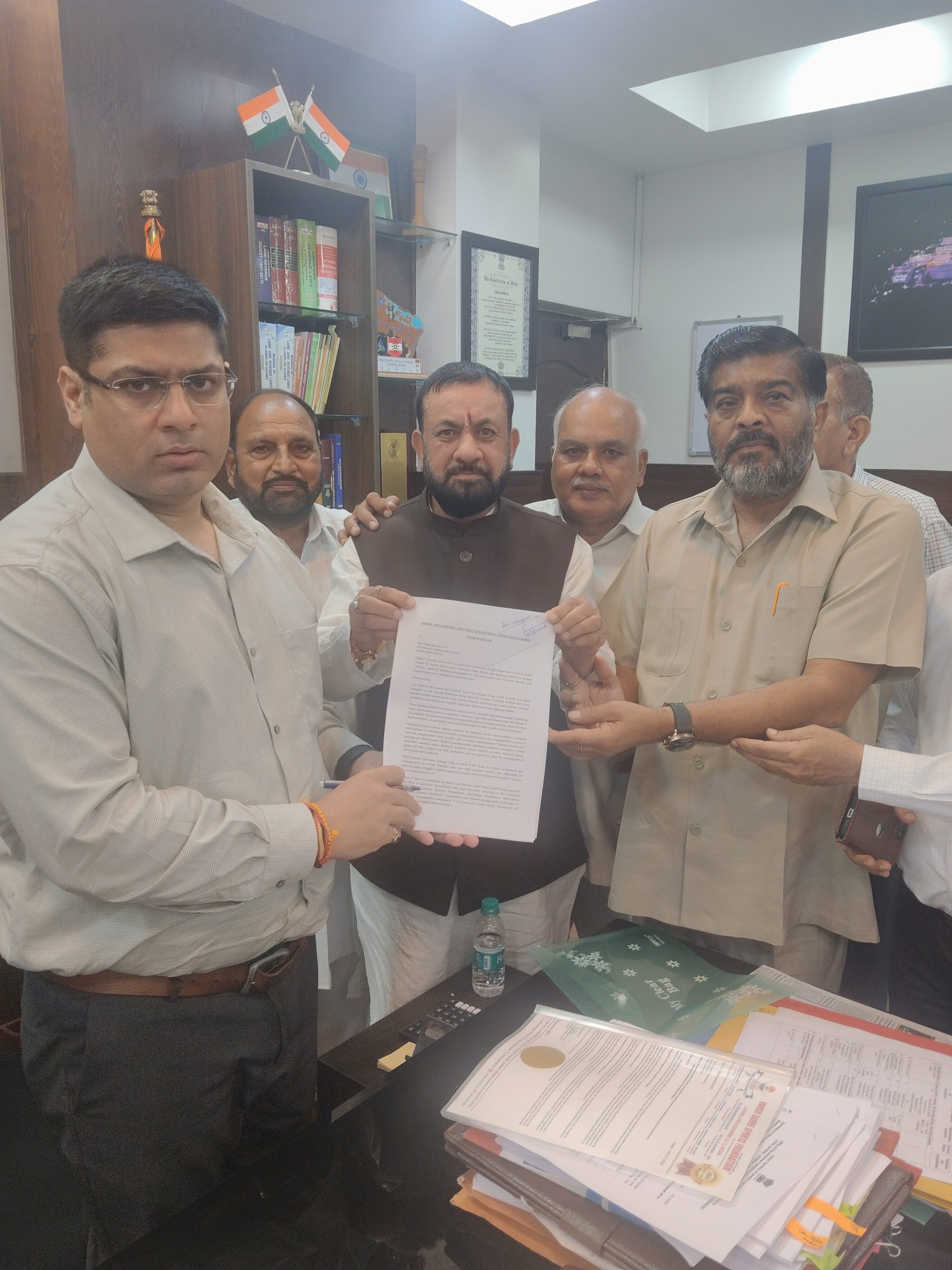
JAMMU, Oct 16: Jammu and Kashmir Apni Party Kissan Wing President Badrinath Sharma, accompanied by Apni Party SC Cell President Bodhraj, today submitted a detailed memorandum to Divisional Commissioner Jammu Dr Vikas Kundal, seeking immediate administrative intervention, a comprehensive assessment of agricultural and livestock losses caused by recent heavy rains, hailstorms, flash floods and lightning strikes, and the release of adequate compensation to affected farmers and livestock owners across Jammu Division.
The memorandum highlighted the serious hardships being faced by farming families whose standing crops, horticultural produce, vegetable cultivation, agricultural infrastructure and livestock have reportedly suffered damage due to adverse weather conditions. It urged the Divisional Commissioner to issue necessary directions to the concerned Deputy Commissioners and departments to undertake transparent, impartial and time-bound assessments of the losses and ensure that eligible affected families receive relief without unnecessary procedural delays.
Sharma emphasised that agriculture and animal husbandry constitute the backbone of Jammu and Kashmir’s rural economy, providing livelihood, employment and financial security to thousands of families. He pointed out that farmers invest their savings and often borrow money to purchase seeds, fertilisers, pesticides, machinery and other agricultural inputs. Any damage to their crops at a crucial stage of cultivation not only deprives them of their anticipated income but also jeopardises their ability to repay loans, meet household expenses and prepare for the next agricultural season.
He stressed that the administration must treat the situation with urgency and ensure that the genuine difficulties of the farming community are addressed through practical, farmer-friendly measures rather than routine administrative formalities.In the memorandum, the Apni Party Kissan Wing called for an immediate, comprehensive survey of all affected agricultural areas across Jammu Division. It urged the Divisional Commissioner to direct the concerned Deputy Commissioners to constitute joint teams comprising officials from the Revenue, Agriculture, Horticulture and other relevant departments to conduct physical inspections of affected fields and villages.
The memorandum stressed that the assessment should not be restricted to preliminary reports prepared in offices but must reflect the actual ground situation. The survey should document the extent of damage to standing crops, horticultural produce, vegetables, nurseries and other eligible agricultural activities, along with the area affected, crop varieties, stage of cultivation and estimated financial losses.
It also sought special attention to small and marginal farmers, tenant cultivators and families primarily dependent on seasonal agricultural income, subject to applicable relief provisions. Sharma urged the administration to establish a mechanism through which farmers could submit representations and supporting evidence and seek corrections if their fields were omitted or their losses were underestimated.
He maintained that a fair and reliable assessment was essential to ensure that no genuinely affected farmer was deprived of assistance because of inadequate verification or avoidable administrative lapses.Seeking adequate and befitting compensation for affected cultivators, Sharma urged the administration to ensure that financial assistance was proportionate to the verified losses and provided in accordance with applicable government relief norms and schemes.
The memorandum also called upon the administration to examine whether the existing assistance rates were sufficient to address the extent of the reported damage and, wherever necessary, take up the matter with the competent authorities for enhanced compensation or a special relief package.It underscored that small and marginal farmers were particularly vulnerable because of their limited financial resources and lack of capacity to absorb unexpected agricultural losses. Even partial damage to their crops could affect their ability to purchase inputs, repay loans, pay agricultural labourers and meet essential household requirements.
The Kissan Wing urged the authorities to prioritise severely affected and financially vulnerable farming households, facilitate the completion of necessary documentation and ensure the prompt disbursement of admissible assistance, preferably through direct bank transfers wherever applicable.The memorandum further called for specialised assessments of horticultural produce, vegetable crops, fruit-bearing plants and nurseries wherever necessary, along with assistance to eligible farmers in pursuing crop-insurance claims and other available benefits.
Drawing attention to an equally serious concern, the memorandum highlighted the financial distress faced by livestock owners whose animals have reportedly died or suffered injuries due to heavy rainfall, flash floods, lightning strikes and other weather-related incidents.Sharma pointed out that cattle, buffaloes, sheep, goats and other domestic animals represent valuable economic assets for rural households. For many small farmers, dairy producers and livestock-dependent families, the loss of even one or two animals can significantly affect their regular income and undermine their ability to sustain their livelihoods.
The Kissan Wing urged the administration to direct the Revenue Department, Animal Husbandry Department and disaster-management authorities to conduct an immediate field-level assessment of livestock losses in affected areas.The assessment, it stated, should record the number and category of animals killed or injured, the circumstances of the losses, damage to cattle sheds and animal shelters, and losses of fodder stocks and other essential livestock resources wherever reported.
The memorandum sought befitting compensation for eligible livestock owners under applicable relief norms and government schemes. It also urged the administration to pursue enhanced assistance or a special relief package wherever warranted, while ensuring emergency veterinary treatment for injured animals, fodder support and assistance to families whose livestock shelters have been damaged.It stressed that the assessment of weather-related damage must extend beyond agricultural land and standing crops, as livestock remains a crucial source of income and economic security for thousands of rural families.
The memorandum also sought appropriate relief for farmers facing difficulties in repaying agricultural loans because of verified crop losses. It urged the administration to take up the matter with the competent authorities and financial institutions to explore the possibility of loan rescheduling, restructuring or extension of repayment timelines wherever permissible under applicable guidelines.Sharma further called for the effective implementation of crop and livestock insurance schemes, urging the concerned departments to assist eligible beneficiaries with claim reporting, documentation, verification and settlement.
The Kissan Wing also demanded an assessment of damage to irrigation channels, drainage systems, field embankments, rural approach roads and other agricultural infrastructure affected by heavy rainfall and flash floods. It called for priority repairs to restore agricultural operations and prevent further damage to cultivated land.Similarly, damage to cattle sheds, livestock shelters and related infrastructure should be assessed, with eligible families provided appropriate assistance for restoration, the memorandum stated.
Emphasising the need for accountability, the memorandum urged the Divisional Commissioner to establish a time-bound mechanism for completing damage assessments, verifying claims and releasing eligible compensation.It called for district-wise monitoring of affected villages and households, agricultural and livestock losses recorded, claims received and verified, compensation sanctioned and disbursed, and pending cases requiring further action.
The Kissan Wing also sought an accessible grievance-redressal mechanism for farmers and livestock owners facing difficulties due to omitted areas, incorrect assessments, delayed payments or procedural complications. The concerned Deputy Commissioners should submit periodic progress reports to the Divisional Commissioner’s office to facilitate effective monitoring, it added.
The memorandum further recommended improved weather advisories, timely alerts, better drainage facilities, stronger irrigation systems, enhanced veterinary services and other preventive measures to minimise the impact of future weather-related disasters on rural livelihoods.Sharma also called for direct interaction between the administration and representatives of affected farming communities to identify genuine grievances and ensure that relief measures reflected the actual requirements of people on the ground.
Concluding the memorandum, Badrinath Sharma urged Dr Vikas Kundal to personally intervene and issue necessary directions to the concerned Deputy Commissioners and departmental heads to complete a comprehensive assessment of crop, horticultural, livestock and infrastructure losses within a stipulated timeframe.He stressed that farmers and livestock owners should not be left to bear the entire financial burden of natural calamities on their own. Timely compensation, transparent verification, emergency veterinary assistance and effective administrative coordination were essential to help affected families recover and resume their agricultural and allied activities.
The memorandum also called for coordination among the Agriculture, Horticulture, Animal Husbandry, Revenue and disaster-management authorities to ensure that all eligible affected families receive the assistance available under the applicable relief framework.
Prominent among those present on the occasion were Mohan Kundal, Janak Raj, Raman Sharma, Tirth Singh, Tirth Kumar and Mahesh Sharma.