
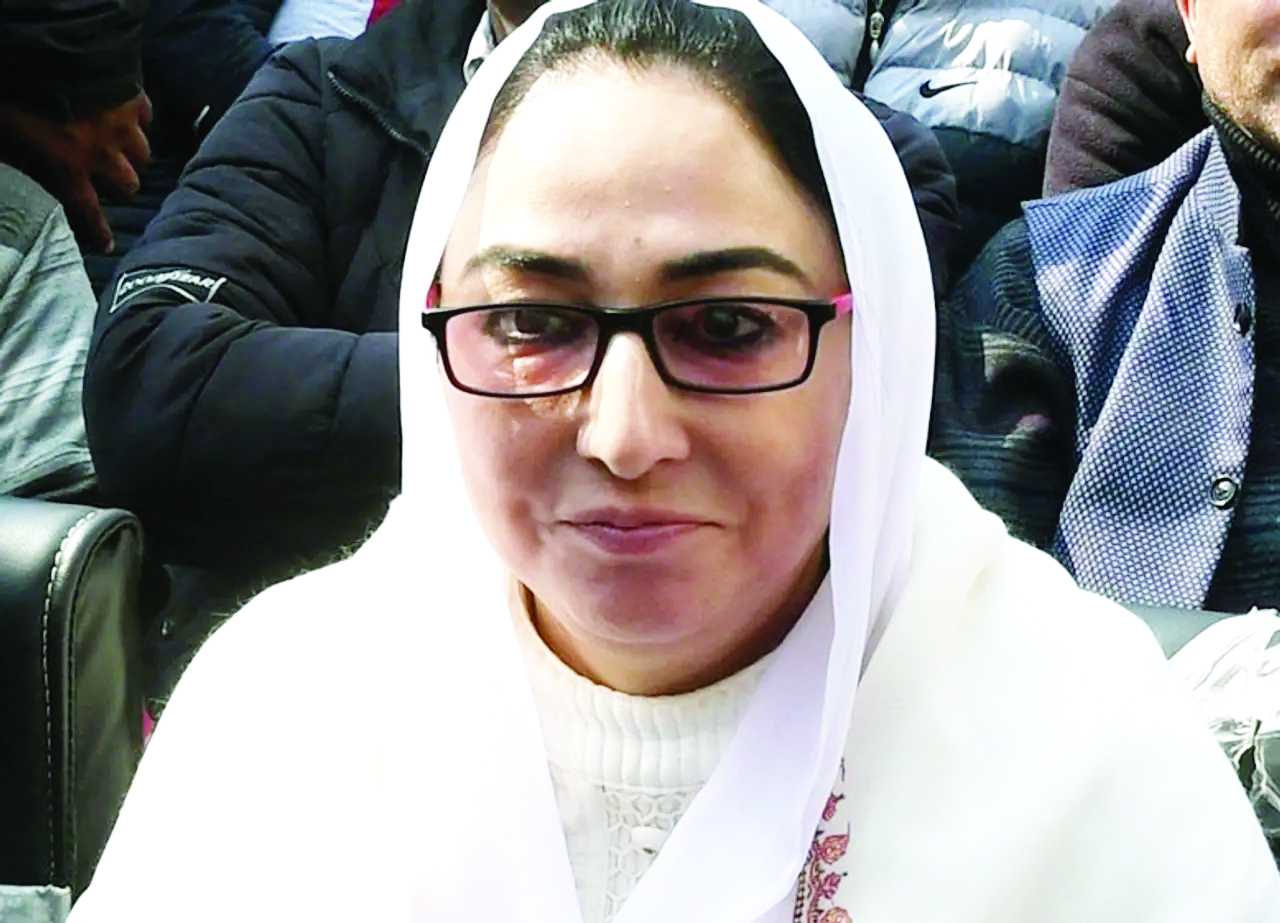
SRINAGAR, Oct 13 (Agencies): Jammu and Kashmir Waqf Board chairperson Darakhshan Andrabi on Tuesday denied that the board had issued any directive requiring imams to deliver sermons on specific topics, saying religious scholars and preachers were free to decide what they wanted to discuss. BuyMaps
Defending the proposal for mosques and shrines under the board to address common social issues during Friday sermons, Andrabi said the initiative was intended to tackle problems such as drug addiction, suicide and other social concerns affecting young people.
“Jammu-Kashmir Waqf Board is a religious board. It includes religious preachers, mosques, shrines, and scholars. If we do not talk about the problems in our society, who will?” she said.
She maintained that the decision on sermon topics rested with imams and religious scholars, not the board or political leaders.
“Here, Dr Syed Darakhshan Andrabi does not take decisions. Our scholars, preachers, imams and khateebs take decisions on religious matters,” she said.
Explaining the rationale behind the proposal, Andrabi said a common theme could help amplify the impact of sermons on local communities.
“If there is a particular problem in Srinagar, and it is discussed in 10 mosques, it will have an impact on society, on that young person and on the present generation,” she said.
Similarly, she said, imams could address specific problems in other areas, including drug addiction, by devoting a few minutes to the issue during their sermons. Politicalanalysis reports
Andrabi rejected allegations that the initiative was being driven by the BJP or the Rashtriya Swayamsevak Sangh (RSS), insisting that there was no political or government interference.
“There is no role of any government machinery in this. Nor will Darakhshan Andrabi decide anything. The imams themselves will decide what their role will be,” she said.
She also referred to the remarks of Mirwaiz Umar Farooq, who had addressed social evils during his Friday sermon at Srinagar’s Jamia Masjid.
“I was very happy to see that Dr Umar Farooq Sahib has also stressed this before us. He is saying exactly the same thing: that we need to talk about social evils and focus on one topic so that it has an impact on society,” Andrabi said.
Her remarks came amid criticism of the Waqf Board’s reported move to encourage uniform themes for Friday sermons, with political leaders questioning whether the board could direct religious preachers on what to say.
Andrabi dismissed calls to withdraw the decision, arguing that no binding order had been issued.
“What decision? Which decision? What rule has been issued? Can imams not speak for themselves now? Will our politicians not allow imams to speak for themselves if they want to stop social evils?” she said.
Asked whether the board had issued any directive, she said it had not.
“No directive has gone from here. At that time, all the scholars said that if they want to speak against drugs in Poonch, they will. It is their choice. They may also choose not to speak,” she said.
Andrabi said the proposed discussions could also cover issues such as difficulties faced by women in getting married and the cutting of beards, adding that religious scholars would determine which subjects to address.
“If our politicians want there to be no discussion on drugs, no discussion on social evils, no discussion on daughters who are not getting married, then let there be no discussion,” she said.
She urged political leaders to refrain from politicising religious matters and defended the board’s work over the past four years.
“Our aim is to make the Jammu-Kashmir Waqf Board number one, and in these four years we have done work that nobody had done before. We have not allowed politics to enter it,” she said. Politicalanalysis reports
Andrabi also accused political leaders of opposing the board’s initiatives for political reasons, adding that she remained confident in the judgment of the imams and scholars associated with it.
“I am very satisfied with our imams because whatever decision they take will be right, and it will be their own choice,” she said.
She reiterated that the board would continue working on religious and social issues for as long as she remained its chairperson.
“We are working for the Deen, and we will continue working for the Deen as long as I am in this chair,” she said.